 English
 German
 Korea
Korea Spanish
2026 Strategic Report: Navigating B2B Digital Entry Points in China
- On January 16, 2026
- china b2b marketing, china digital marketing, china marketing strategy
1. The Paradox of Presence: Why Your Website is No Longer an Entrance
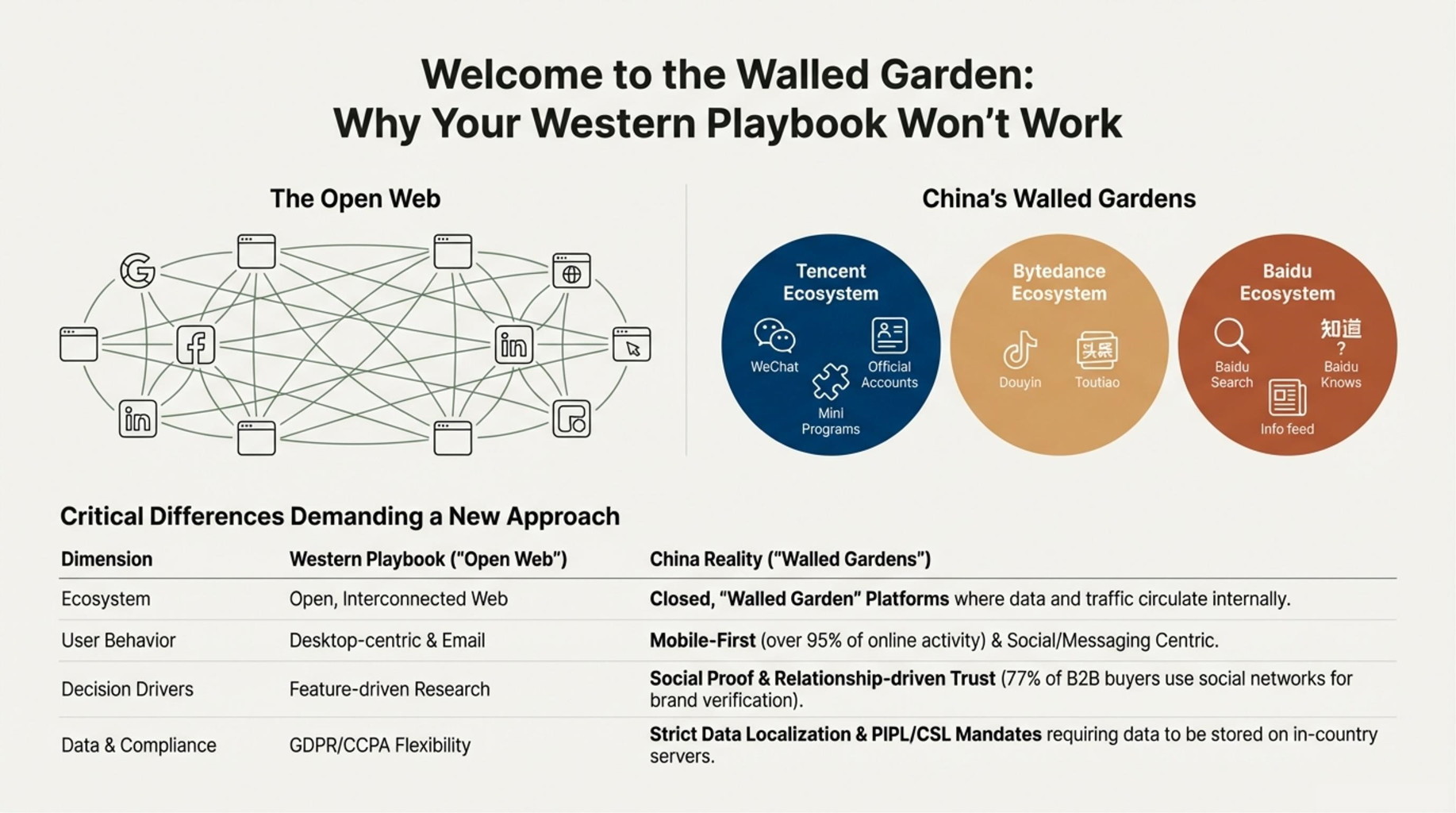
In Western digital strategy, the “Search-and-Visit” model is the undisputed architectural standard: a prospect searches on Google and clicks through to a brand-owned domain. In China, this behavior has been fundamentally decoupled. For a Western firm, being “online” via a localized website does not equate to being “accessible.” The 2026 Chinese B2B ecosystem is defined by extreme fragmentation and the absolute dominance of mobile-centric “Walled Gardens,” where 95% of all B2B activity occurs.
What if I told you that in 2026, the most successful B2B entry point in China isn’t a destination you own, but a conversation you don’t control?
The reality is that 80% of B2B research is completed online before a sales representative is ever engaged. However, this research occurs within closed ecosystems like WeChat, Douyin, and specialized AI interfaces. In this environment, your official website serves merely as a verification tool—a “trust anchor”—rather than a primary lead generator. To secure ROI, you must pivot from viewing your digital presence as a single destination to a distributed presence across high-velocity, mobile-first battlegrounds.
2. Mapping the 2026 Digital Battlegrounds: A Comparative Analysis
The strategic evolution of China’s digital landscape has transitioned from simple information retrieval to “AI-Native” marketing. Platforms are no longer mere directories; they are integrated service hubs. Western firms must differentiate their strategies across these specific entry points to capture the buyer journey effectively.
Primary B2B Entry Points: 2026 Landscape
| Platform Category | Strategic Focus | Market Dynamics & ROI Context |
| Baidu (Mobile-Dominant) | Closed-loop Ecosystem | Holds 52.79% of mobile market. Integration with Baijiahao and Smart Programs is non-negotiable to prevent traffic leakage. |
| Bing (Desktop/Security) | Enterprise Search | Dominates the desktop market (>52% share). Critical for reaching procurement and technical staff on Microsoft-integrated systems. |
| 360 Search | Government & Security | The primary entry point for B2B firms targeting high-security sectors or State-Owned Enterprises (SOEs). |
| Walled Gardens (WeChat/Douyin) | Social Validation | WeChat is the hub for relationship nurturing; Douyin uses short-form video for technical “scene-based” demonstrations. |
| Vertical Portals (1688 / Ai Caigou) | Transactional Authority | Specialized platforms like 1688 or Ai Caigou provide the industrial “proof” and supply chain transparency required for complex sales. |
| Professional Communities (CSDN / Zhihu) | Technical Mindshare | CSDN and GitHub are essential for technical gatekeepers; Zhihu functions as the “knowledge authority” for complex B2B problem-solving. |
These channels must be managed as an integrated network. A buyer may discover your solution on Zhihu, verify your credentials via a WeChat professional account, and finalize technical specifications via a Bing desktop search.
3. The New Optimization Frontier: From SEO to AEO and GEO
Traditional SEO is now merely the foundation. Strategic success in 2026 requires a transition to “Answer” Engine Optimization (AEO) and “Generative” Engine Optimization (GEO).
The SEO-AEO-GEO Pipeline
- SEO (The Foundation): Building a “Trust Anchor” via E-E-A-T (Experience, Expertise, Authoritativeness, Trustworthiness). You must leverage technical whitepapers and localized case studies to provide the raw data that AI models reference.
- AEO (The Bridge): Optimizing for “Zero-Click Exposure.” Content must be structured into 50-150 word “answer fragments.” You must deploy FAQ and HowTo Schema markup to ensure your brand provides the direct answer within AI assistants.
- GEO (The Future): Optimizing for generative recommendation. This requires a differentiated approach:
- DeepSeek: Optimize for technical/professional audiences who require deep architectural rigor.
- Doubao (ByteDance) / Wenxin Yiyan: Optimize for general business users focusing on service and practical implementation.

The “Content Middle Platform” (内容中台): You must stop treating content as “marketing collateral” and start treating it as a Digital Asset. A single authoritative whitepaper must serve as the “data source” that fuels your entire AI pipeline. However, a critical warning: 75% of buyers are wary of “dehumanized” AI content. Your strategy must balance AI-driven distribution efficiency with high-value human technical authority to maintain trust.
4. Strategic Framework for Western B2B Entrants: The “AI-Native” Mindset
Western firms must pivot from “Brand Awareness” to a model where Content is a Strategic Asset. In the 2026 Chinese market, content is the data-rich fuel that drives the entire funnel.
The Three Pillars of Modern B2B Strategy
- Data-Driven Precision: Utilize “Lookalike” modeling and sophisticated re-marketing. By tracking intent signals across “Walled Gardens,” you can target the 80% of anonymous researchers before they issue an RFP.
- Content Atomization: Deploy a “Create Once, Distribute Everywhere” model. Deconstruct a core technical asset into H5 interactive pages for WeChat, 60-second “problem-solver” videos for Douyin, and structured Q&As for GEO.
- Social Validation: B2B purchasing in China is a high-trust, relationship-driven activity. Leverage KOCs (Key Opinion Consumers)—technical experts and industry analysts—to provide third-party validation within private professional communities.
Unlike linear Western sales funnels, the Chinese journey is a multi-layered relationship network. Success requires building technical and social credit across multiple touchpoints simultaneously.
5. Performance Benchmarks: Measuring Success in a “Growth-Hard” Era
With sales cycles extending to 6-12 months, quantitative assessment is vital. You must evaluate channels based on both immediate lead costs and long-term Lifetime Value (LTV).
B2B Marketing Channel Performance Benchmarks (2026)
| Channel Type | Avg. CPL (RMB) | MQL Conversion (Avg) | Best-in-Class Conversion | Relative ROI |
| SEO / Organic Search | 150 – 300 | 8% – 15% | 20% + | High |
| Content Marketing | 300 – 600 | 10% – 20% | 25% + | High |
| Paid Search (Baidu/Bing) | 500 – 1,200 | 5% – 10% | 12% + | Medium |
| Vertical Portals | 800 – 2,000 | 3% – 8% | 10% + | Low-Mid |
| Social Media (WeChat/Douyin) | 200 – 500 | 2% – 6% | 8% + | Low-Mid |
Surgical ROI Insights:
- Paid Media: WeChat CPMs range from 30-100 RMB. CPCs on LinkedIn or Baidu are significant; these must be used for “keyword interception” rather than broad awareness.
- Industrial Best-in-Class: While the average industrial conversion rate sits at 1.8%, top-tier performers achieve 3.5% by utilizing specialized technical content and rapid inquiry response.
- Strategy: Data synergy across channels is the only way to optimize a shrinking budget. Insights from search intent should immediately inform your content atomization priorities.

6. Operational Imperatives: Compliance, Localization, and the TLO Model
Ignoring China’s unique data security requirements is a catastrophic strategic risk. Technical compliance is your “license to operate.”
Checklist for Market Entry
- Legal & Data Compliance: Non-negotiable adherence to PIPL and DSL. You must undergo cross-border data transfer security assessments for any global data flow.
- Data Residency: All customer data must reside on local Chinese servers to avoid high-penalty risks and potential business suspension.
- Technical Infrastructure: Secure an ICP License and prioritize Mobile-First design (optimized for high-speed loading within the WeChat browser).
- TLO Model (Test, Learn, Optimize): Use a “Small Budget A/B Testing” methodology. Validate your value proposition on platforms like Zhihu or LinkedIn China with minimal spend before scaling to high-cost channels.
Selecting a Local Agency Partner
| Dimension | Key Criteria for Evaluation |
| Compliance | Holds valid ICP licenses and data security certifications; proven PIPL knowledge. |
| Experience | Documented success with Western B2B firms in your specific vertical. |
| Technical Strength | Ability to manage “Content Middle Platforms” and local data architecture. |
| Service Process | Clear, cross-cultural communication and standardized delivery protocols. |
7. Future Horizon: 2026 and the Rise of Predictive B2B Entry
By 2026, B2B marketing will transition from “selling a product” to “providing a predictive service.”
- XR (Extended Reality): Remote, immersive product demonstrations will allow buyers to conduct virtual factory tours, bypassing the need for early-stage physical travel and shortening the sales cycle.
- IoT-Linked Marketing: Shifting the entry point from a search query to an automated service alert. Predictive maintenance becomes the ultimate “service-as-an-entry-point.”
Strategic Action Roadmap
| Phase | Core Objective | Key Actions |
| 0-6 Months | Foundation | Data residency compliance; ICP licensing; SEO & core “Digital Asset” creation. |
| 7-12 Months | Expansion | Marketing automation deployment; integration with vertical platforms like 1688 or CSDN. |
| 13-24 Months | Deepening | AI-driven predictive analytics; scale via the S2B2B (Supply to Business to Business) platform model. |

Final Warning: Success in China 2026 forbids a “short-term arbitrage” mindset. The era of quick wins through simple ad spend is over. Sustained market share requires technical patience, high-quality professional content that respects the 75% trust gap, and a rigorous commitment to local data compliance.
8. Actionable Recommendations for Western B2B Enterprises Entering China
| Strategic Area | Key Actionable Recommendation | Specific Local Challenge Addressed | Recommended Platforms/Tools | Priority Level | Anticipated Impact/Benefit | Implementation Timeline (Inferred) |
| Compliance & Data Security | Complete local compliance audits and ensure data is stored on domestic servers to meet PIPL/DSL requirements. | Strict data localization laws (PIPL/DSL) and cross-border transfer risks. | Local servers, ICP License, Data security certification tools | Critical | Avoidance of high penalties and business interruption; builds foundational trust with regulators. | 0-6 months (Foundation Phase) |
| Search Engine Optimization (SEO) | Implement a dual-track SEO strategy: Baidu for mobile-first/closed-loop content and Bing for desktop/structured data. | Market fragmentation between mobile (Baidu dominance) and desktop (Bing growth). | Baidu (Baijiahao, Smart Programs), Bing, 360 Search | High | Captures high-intent early-stage search traffic and builds long-term brand digital assets. | 0-6 months (Foundation Phase) |
| Content & Social Ecosystem | Develop high-quality technical content (white papers) and use WeChat/Video Accounts for scenario-based product demos. | B2B buyers’ high reliance on social validation and mobile-first information consumption. | WeChat (Official Accounts/Channels), LinkedIn, Zhihu, CSDN | High | Higher MQL conversion rates (10-20%); establishment of thought leadership. | 0-12 months (Foundation to Expansion) |
| Local Partnership & Operations | Partner with local agencies holding ICP licenses and proven experience with Western firms for “Central Strategy, Local Execution.” | Cultural barriers, unique aesthetic preferences, and complex regulatory licensing. | Local Digital Marketing Partners/Agencies | High | Faster time-to-market; localized visual design and culturally resonant storytelling. | 0-6 months (Foundation Phase) |
| Data & Marketing Automation | Deploy a Customer Data Platform (CDP) to integrate fragmented “Walled Garden” data into a 360-degree customer view. | Fragmented customer journeys across isolated platforms (WeChat, CRM, Web). | CDP, CRM, Marketing Automation workflows (H5 tracking) | High | 400% improvement in lead nurturing efficiency; 5%+ trial-to-paid conversion. | 7-12 months (Expansion Phase) |
| Emerging Tech (GEO/AEO) | Optimize knowledge bases for AI citation by creating structured, concise (50-150 word) Q&A fragments. | Shift from keyword-based search to generative AI answer engines (Zero-click exposure). | DeepSeek, Wenxin Yiyan (Ernie Bot), Tongyi Qianwen, Doubao | High | 120% increase in inquiry volume; preemptive positioning in AI-driven search results. | 13-24 months (Deep Cultivation Phase) |
| Paid Media & Precision Targeting | Mix CPM for brand awareness on WeChat with CPC/oCPM for lead generation on Baidu/LinkedIn using “Lookalike” audiences. | High cost of acquisition in “Walled Garden” ecosystems and data silos. | WeChat Moments, Douyin (TikTok China), Baidu Feed, LinkedIn | Medium | Balanced brand momentum and lead acquisition; reduced waste in ad spend. | 0-6 months (Initial Testing) |
| Emerging Experience Tech | Adopt XR (Extended Reality) for remote equipment demos and virtual factory tours to lower evaluation barriers. | High cost and long cycles for physical inspection of large-scale industrial solutions. | XR/VR/AR Platforms, IoT Sensors | Medium | Shortened sales cycles; deeper product cognition in early decision stages. | 13-24 months (Deep Cultivation Phase) |
9. top 5 English FAQs regarding the 2026 China B2B Digital Marketing Entry Strategy
1. How does the Chinese digital ecosystem differ from Western markets for B2B marketing?
The primary difference lies in China’s “Walled Garden” model, where giants like WeChat, Baidu, and ByteDance build closed ecosystems where traffic and data circulate internally, unlike the open web environment of the West. Additionally, Chinese B2B decision-makers are highly mobile-centric, with over 95% of online behavior occurring on mobile devices. Social verification is also critical; approximately 77% of B2B buyers rely on social networks to verify brand information and build trust.
2. What are GEO and AEO, and why are they essential for 2026 strategies?
As generative AI reshapes search, two new strategies have emerged: Answer Engine Optimization (AEO) and Generative Engine Optimization (GEO).
- AEO focuses on providing concise, structured answer snippets (50-150 words) to be cited by AI systems like ChatGPT or Google SGE, aiming for “zero-click exposure”.
- GEO targets the recommendation mechanisms of engines like Wenxin Yiyan or DeepSeek, emphasizing conversational content and scenario-based solutions to ensure the brand is actively recommended by AI. Together, they represent a shift from “keyword thinking” to “user intent and scenario thinking”.
3. Which digital channels provide the best ROI and lead quality for B2B firms?
According to industry benchmarks, different channels serve different strategic goals:
- SEO and Content Marketing: Offer high ROI and high-quality leads but require a long gestation period (6–12 months). They are vital for building long-term brand assets.
- Paid Search Ads: Effective for rapid lead acquisition and intercepting high-intent keywords, though they come with higher costs and varying lead quality.
- Vertical Portals and Communities: Channels like 1688 or CSDN are essential for establishing technical authority and reaching niche professional audiences.
4. What are the mandatory compliance and data security requirements for Western firms?
Compliance is the “first prerequisite” for entering the Chinese market. Firms must adhere to the Cybersecurity Law, Data Security Law, and Personal Information Protection Law (PIPL). Key requirements include:
- Data Localization: Storing data on servers within mainland China.
- Cross-border Transfer: Undergoing strict security assessments or approvals for any critical data leaving the country.
- Licensing: Ensuring the business or its partners possess an ICP License and other necessary digital certifications.
5. What is the recommended strategic roadmap for a Western B2B company entering China?
A successful entry typically follows a three-stage “Strategic Action Roadmap”:
- 0-6 Months (Foundation): Focus on compliance, data security audits, and building basic Chinese SEO assets and whitepapers.
- 7-12 Months (Expansion): Optimize content based on initial data, deploy marketing automation/CRM, and integrate with 1-2 major B2B platforms.
- 13-24 Months (Deep Cultivation): Scale up using AI-driven predictive analytics, build a local partner ecosystem, and expand from top-tier cities to high-potential emerging markets.
 Unlock 2026's China Digital Marketing Mastery!