 English
 German
 Korea
Korea Spanish
Navigating the Great De-Escalation: A Strategic Playbook for China’s Social Media Landscape in 2026
- On January 21, 2026
- china social marketing
1. The End of the Engagement-at-all-Costs Era
For Western brands operating in China, the rules of public engagement have been rewritten overnight. Two seemingly unrelated events—a celebrity chef’s public meltdown and a platform’s policy update—were not isolated incidents but the opening salvos in a state-mandated “Great De-Escalation” of online discourse. This is not a cyclical trend; it is a permanent rewiring of the digital ecosystem. This document decodes these signals to provide Western business leaders and marketers with a strategic analysis of emerging regulatory trends, actionable operational advice, and a forward-looking perspective for navigating the complexities of China’s social media landscape in 2026.
The era of prioritizing raw engagement is being replaced by a new paradigm of controlled, “healthy” discourse. This new order is being enforced by a powerful combination of top-down government regulation and proactive platform self-governance, a shift that fundamentally alters the calculus of corporate communication and reputation management in the world’s largest digital market.
2. The Xibei-Luo Dispute — A Cautionary Tale of Public Conflict
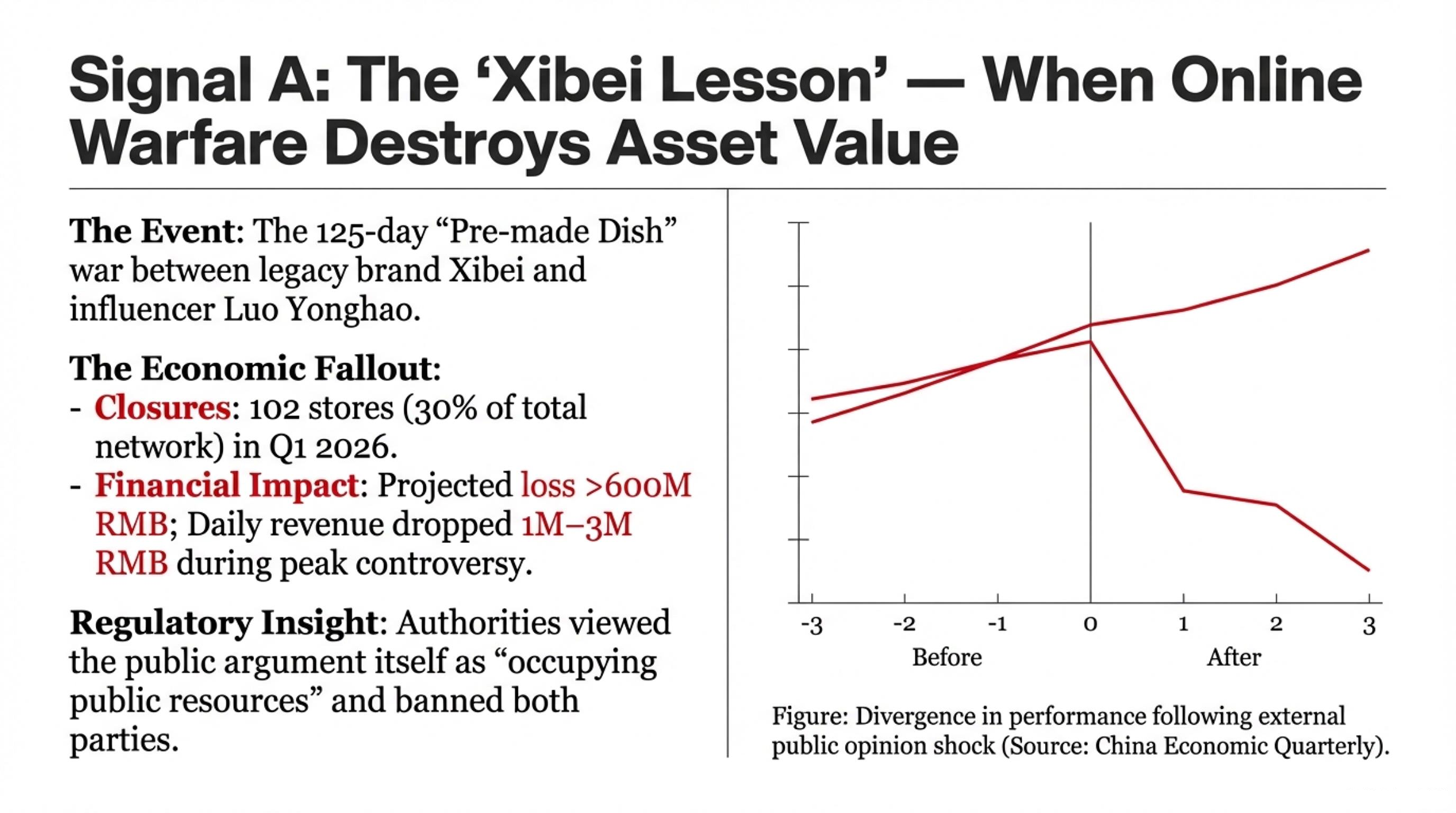
The public dispute between Xibei restaurant founder Jia Guolong and influential online personality Luo Yonghao serves as a stark illustration of the tangible, severe consequences of a mismanaged public opinion crisis in China’s new regulatory environment. What began as a consumer complaint rapidly escalated into a direct confrontation that not only inflicted severe financial damage but also triggered direct intervention from platform regulators, setting a powerful new precedent for corporate conduct.
The conflict unfolded with dramatic speed and devastating consequences:
- The Spark: The dispute ignited on September 10, 2025, when Luo Yonghao criticized the Xibei restaurant chain for its use of “pre-made dishes” and high prices, calling for national legislation to mandate transparency for consumers. This tapped directly into widespread consumer anxiety about food quality and pricing.
- The Backlash: Founder Jia Guolong mounted a traditional, confrontational defense. He focused on the technical definition of “pre-made dishes,” arguing that Xibei’s central kitchen processes were a mark of modern efficiency and food safety. This response completely missed the mark. Luo, a master of public sentiment, successfully framed the issue as one of consumer transparency and trust, a narrative that resonated far more powerfully with the public than Jia’s technical arguments.
- The Financial Fallout: The business impact on Xibei was catastrophic. The prolonged public relations battle decimated consumer trust and led to a direct financial collapse, forcing the company into a painful contraction.
| Area of Impact | Quantified Damage |
| Store Closures | 102 locations closed, representing 30% of the company’s total footprint. |
| Projected Financial Loss | Over 600 million RMB cumulative loss from September 2025 to March 2026. |
| Public Sentiment Collapse | The Net Sentiment Rate (NSR) on social media plummeted to -97%, as per a Social Research report. |
This financial collapse was not a direct result of the initial criticism, but a consequence of the founder’s decision to escalate the conflict. The market punished the confrontation, not the complaint.
- The Regulatory Hammer: In a dramatic climax, both Jia Guolong’s and Luo Yonghao’s Weibo accounts were suspended on January 16, 2026. The platform’s justification was a direct reference to the government’s official “Negative List for Online Celebrity Account Behavior,” specifically citing the rule against “organizing arranged fights and debates.” This intervention signaled that public, personal, and commercial disputes escalating into online flame wars would no longer be tolerated.
While this direct regulatory enforcement represents one side of the new reality, the other is proactive platform self-governance, where marketplaces of ideas are actively curating their own environments to stay ahead of the regulators and attract high-value users.
3. Xiaohongshu’s New Order — Building a Moat with Authenticity
Xiaohongshu’s updated community guidelines should not be viewed as a simple policy change, but as a deliberate and sophisticated business strategy. While the Xibei case shows the punitive side of the new digital order, Xiaohongshu demonstrates how platforms are now actively competing on the basis of trust and community health. By engineering a safer, more authentic environment, the platform is creating a lower-risk—and potentially more valuable—ecosystem for brands to build long-term equity.
The new guidelines are built on several core tenets, each with a clear business rationale:
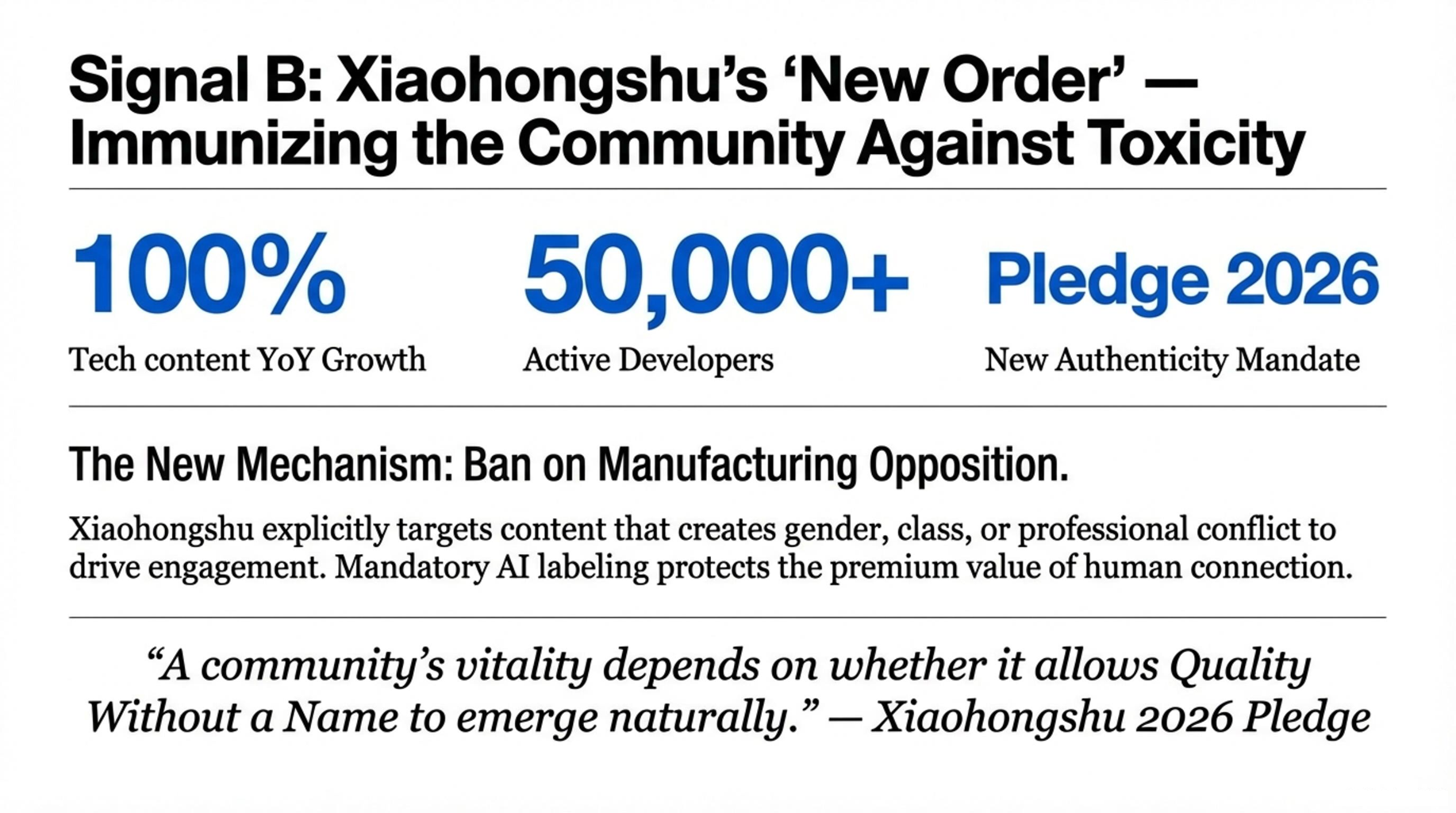
- Combating “Manufacturing Opposition”: The platform’s top priority is to flag and suppress content that intentionally stirs conflict based on gender, region, or profession. This rule proactively reduces the hostility and toxic friction that can generate short-term viral outrage but ultimately poisons the user experience. The business logic is clear: sacrifice cheap, angry clicks for long-term user retention and a healthier ecosystem attractive to brands.
- Fighting “Fake Content” & Regulating AI: Xiaohongshu has intensified its crackdown on fake personas, such as fabricated claims of wealth or experience. Critically, it has also pioneered a requirement for creators to clearly label all AI-generated content. This is a direct move to protect the platform’s most valuable asset: the trust users place in what they believe to be real human experiences and recommendations.
- Promoting “Orderly Business”: The platform has merged its community and commercial rules into a single, unified framework. This signals a commitment to sustainable, trust-based business practices over manipulative or aggressive marketing tactics. It aims to ensure that commercial activity enhances, rather than detracts from, the community experience.
The success of this strategy is vividly illustrated by the recent migration of China’s tech community to the platform. In 2025, the number of tech content creators on Xiaohongshu grew by over 200%. Companies like the AI agent startup Flowith now use the platform as a “community as a laboratory,” where the “strong sense of real people” allows them to gather authentic user feedback and iterate on their products in a constructive environment. This “community as a laboratory” model thrives specifically because the platform’s rules suppress the “toxic friction” and “hostility” that would otherwise make public product development untenable. Tech entrepreneurs are not just finding users on Xiaohongshu; they are finding a sanctuary from the very flame wars that regulators are now extinguishing elsewhere.
Xiaohongshu’s approach signifies a crucial market-driven shift towards quality over quantity. This proactive self-regulation perfectly aligns with the top-down official mandates that are now forcing this change across the entire digital ecosystem.
4. Decoding the New Rules: Official Mandates and Top-Level Priorities
The interventions seen in the Xibei dispute and the strategic shift by Xiaohongshu are not arbitrary actions. They are direct responses to a clear, top-down regulatory framework designed to sanitize online discourse. To operate effectively, businesses must now understand this new official rulebook.
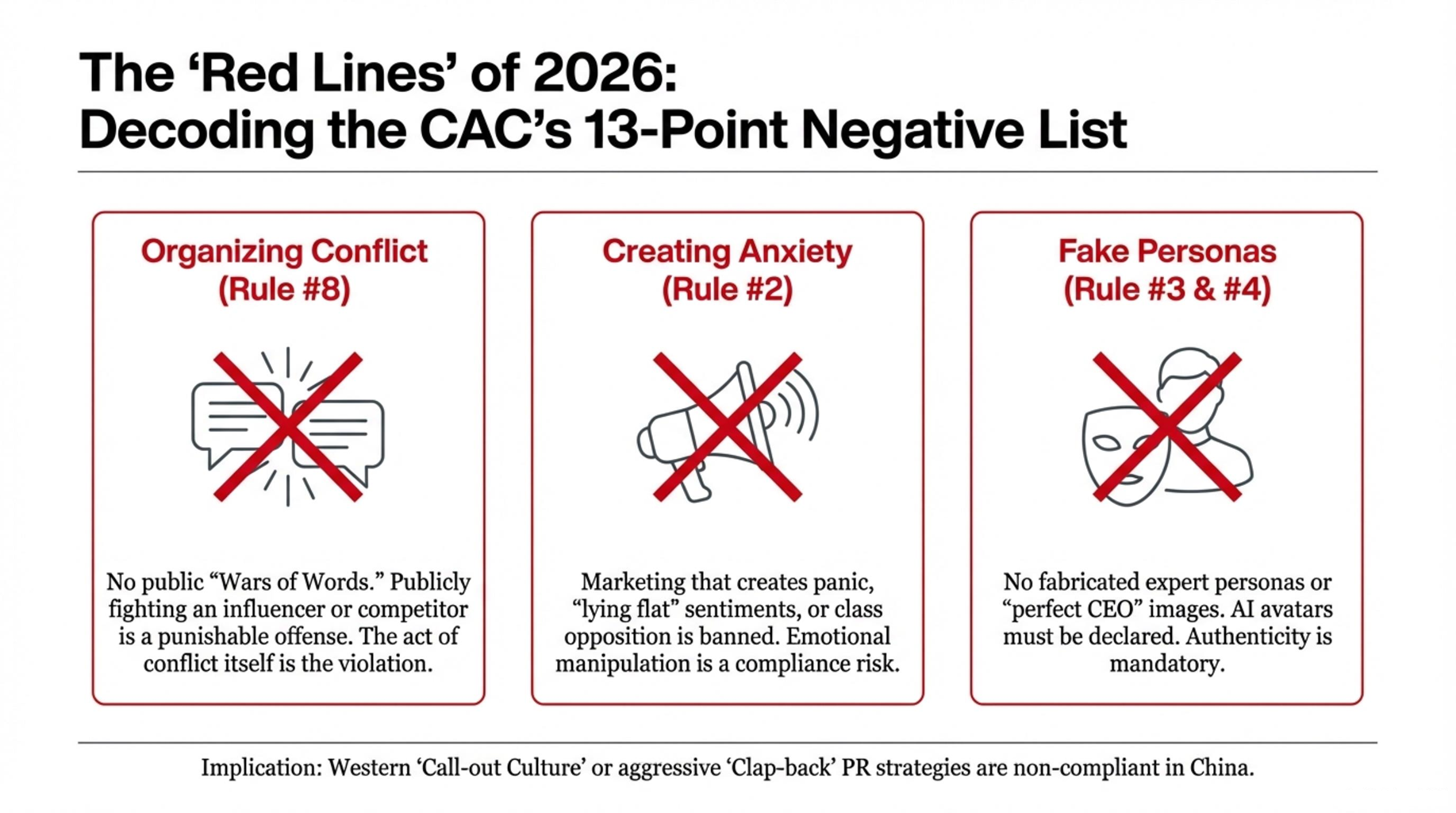
The primary regulatory instrument is the “Negative List for Online Celebrity Account Behavior,” issued by the Cyberspace Administration of China (CAC) in December 2025. This document explicitly outlaws specific types of online behavior. From a risk management perspective, these represent new, non-negotiable tripwires for brand reputation. For businesses, the three most critical prohibitions are:
- Inciting Group Confrontation: A ban on using polarizing labels related to region, gender, or profession to deliberately stir up social conflict and “provoke netizens to tear each other apart.”
- Organizing Arranged Fights and Debates: A specific prohibition on “planning or organizing online quarrels and flame wars arising from personal or commercial disputes” with the intent of stirring up hostility and occupying public resources. This was the exact rule cited in the suspension of the Xibei and Luo Yonghao accounts.
- Distorting Interpretations of Public Events: Forbidding the “out-of-context interpretation and distortion of public events” to manipulate or mislead public perception.
Crucially, these regulations must be understood within a broader national strategy. A commentary in the People’s Daily explicitly framed the “online public opinion environment” as a critical component of China’s overall “business environment.” The implication is profound. For a Western CMO, this means a poorly-worded tweet from a local brand ambassador is no longer just a PR headache; it is now viewed by the state as a potential threat to the national business environment and, by extension, economic stability.
This analysis of the “what” and “why” of the new rules leads directly to the crucial “so what” for Western brands operating in China.
5. The 2026 Playbook: Strategic Imperatives for Western Brands
To navigate this new landscape, Western brands must execute a fundamental shift in communication strategy. The old model of aggressive broadcasting and confrontational public relations is now dangerously obsolete. The new imperative is to move towards a model of nuanced, de-risked engagement that prioritizes authenticity and long-term trust over short-term metrics.
Brands must adopt four key strategic shifts to align with this new reality:
- Pivot from Confrontation to De-escalation Aggressive public relations tactics, such as publicly denouncing critics, are now extremely high-risk activities that can trigger regulatory intervention. As seen in the Xibei case, a confrontational stance can escalate a manageable issue into a brand-destroying crisis. The 600 million RMB loss incurred by Xibei should be viewed as the new cost of a single, poorly-managed public argument. Companies must develop clear de-escalation protocols for handling public criticism, focusing on transparency, good-faith dialogue, and finding common ground rather than winning arguments.
- Treat Executive Communication as a Primary Risk Factor A report from the Communication University of China highlights the “entrepreneur’s poor ability to handle public opinion” as a key reputational threat. Xibei founder Jia Guolong’s emotional, combative responses serve as a textbook case of what to avoid. Senior executives are no longer just business leaders; they are high-impact media channels. Companies must implement strict social media guidelines and provide media training for all public-facing executives to ensure their communications are controlled, empathetic, and strategically aligned with de-escalation principles.
- Re-evaluate Platforms Based on Governance, Not Just Reach Marketing teams must add “Community Governance Quality” as a key metric in their platform selection process. A platform’s raw user numbers are no longer sufficient. Xiaohongshu’s strategy proves that well-governed platforms are actively creating “safe harbors” for brands, turning community health into a competitive business advantage. Investing in platforms that protect brands from manufactured outrage is now a critical component of risk management.
- Leverage Authenticity as a Strategic Asset In an ecosystem that is actively suppressing fake, inflammatory, and AI-generated content, authentic brand narratives and genuine user engagement become significantly more powerful and valuable. The new regulations create a market premium for truth. Brands should follow the model of the tech developers on Xiaohongshu who transparently share their development process and engage in direct, honest conversations with users. This approach builds a defensible moat of trust that is difficult for competitors to replicate and is fully aligned with the new rules of the road.
These strategic shifts are essential for survival today, but businesses must also look ahead to understand how this landscape will continue to evolve.
6. Future Outlook: Key Trends Shaping the Road to 2027
The current regulatory landscape is not a final state but the beginning of a continued evolution toward a more controlled and systematically managed digital space. Based on expert forecasts from the Communication University of China, businesses should monitor the following key trends. While all these trends warrant monitoring, our analysis indicates that the interplay between AI-driven disinformation and defense (“AI as Both Threat and Shield”) will pose the most immediate and technically demanding challenge for corporate reputation teams in 2026-2027.
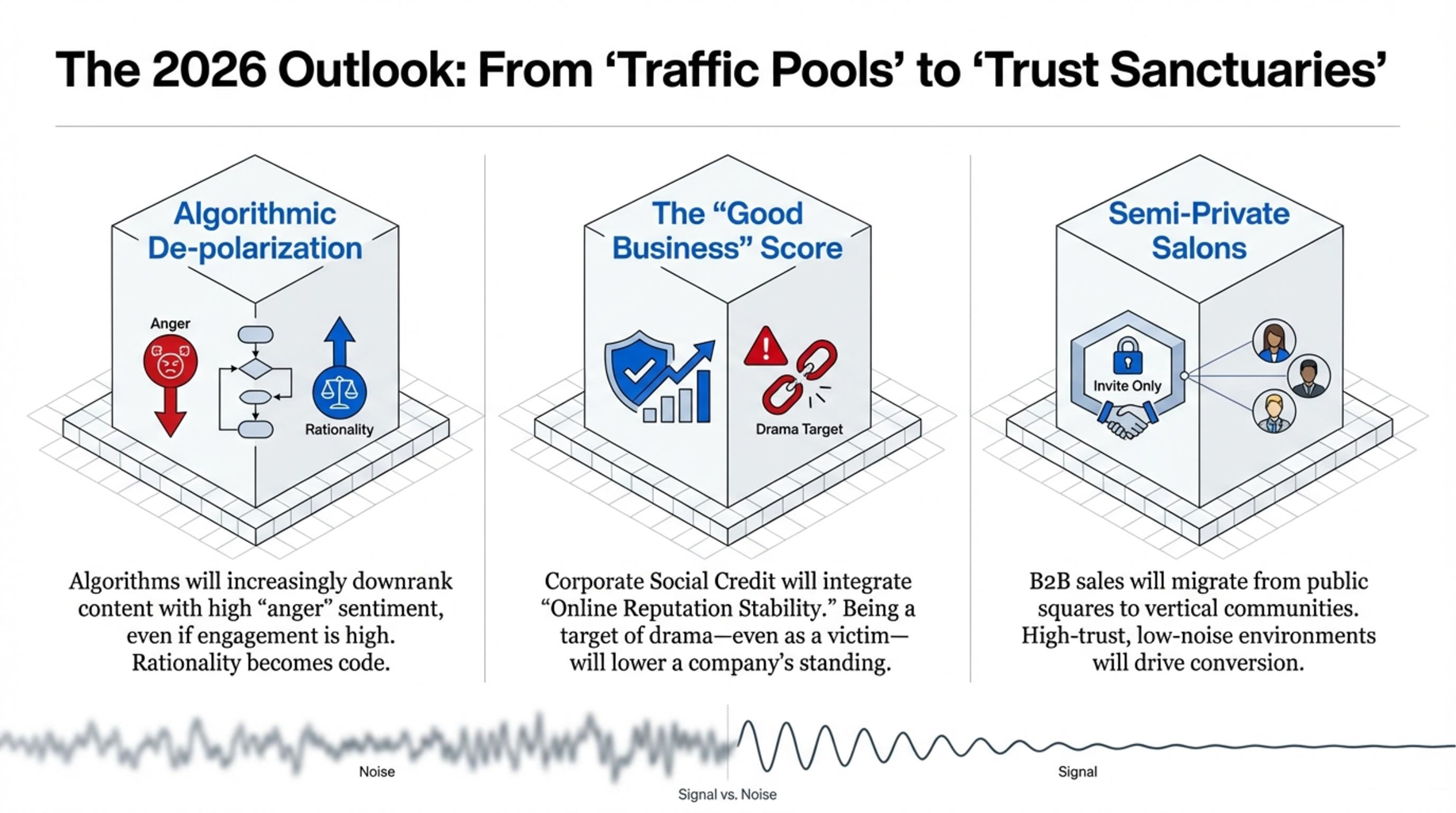
- Deepening Systemic Governance: The collaboration between government regulators and social media platforms will intensify. Expect more sophisticated, automated, and seamlessly integrated enforcement of content and behavior rules, moving from reactive takedowns to proactive, system-level management of the information ecosystem.
- The Rise of the “Rumor Refutation + Complaint” Model: The ad-hoc, public nature of addressing misinformation will give way to more formalized, platform-mediated channels. Corporations will increasingly use official “rumor refutation” platforms and structured complaint mechanisms to address false information, reducing the need for high-risk public confrontations.
- AI as Both Threat and Shield: Artificial intelligence will present a dual challenge. On one hand, AI-powered disinformation, such as deepfakes and “AI poisoning,” will become a more significant threat to corporate reputation. On the other, businesses will need to leverage their own sophisticated AI-powered tools for advanced sentiment analysis, crisis simulation, and reputation defense, creating a dynamic of “using AI to fight AI.”
- Persistent Non-Rational Sentiment: Despite heavy regulation, the power of emotional and non-rational public sentiment will not disappear; it will remain a potent force. The primary challenge for businesses will shift from winning a public debate to skillfully navigating powerful undercurrents of public emotion within an increasingly strict set of rules for engagement.
The only constant will be change, reinforcing the need for constant adaptation and strategic foresight.
7. Conclusion: Thriving in the New Era of Managed Discourse
The fundamental rules of engagement for businesses on Chinese social media have changed irrevocably. The “Great De-Escalation” has replaced the chaotic, engagement-driven free-for-all with a new era of managed discourse, where stability and control are prized above all else. The path to success in 2026 and beyond lies not in winning public arguments, but in building resilient, crisis-proof brands through authenticity, transparent communication, and a sophisticated understanding of the new regulatory red lines. For any brand, the objective is no longer to win the argument, but to become the most trusted voice in a managed conversation.
 Unlock 2026's China Digital Marketing Mastery!