 English
 German
 Korea
Korea Spanish
AI Agents Are Not a Tool Revolution – They Are a Shift in Decision Power
- On March 23, 2026
- ai agent, ai agent marketing
Why businesses must move from “building AI” to becoming “AI-selectable”
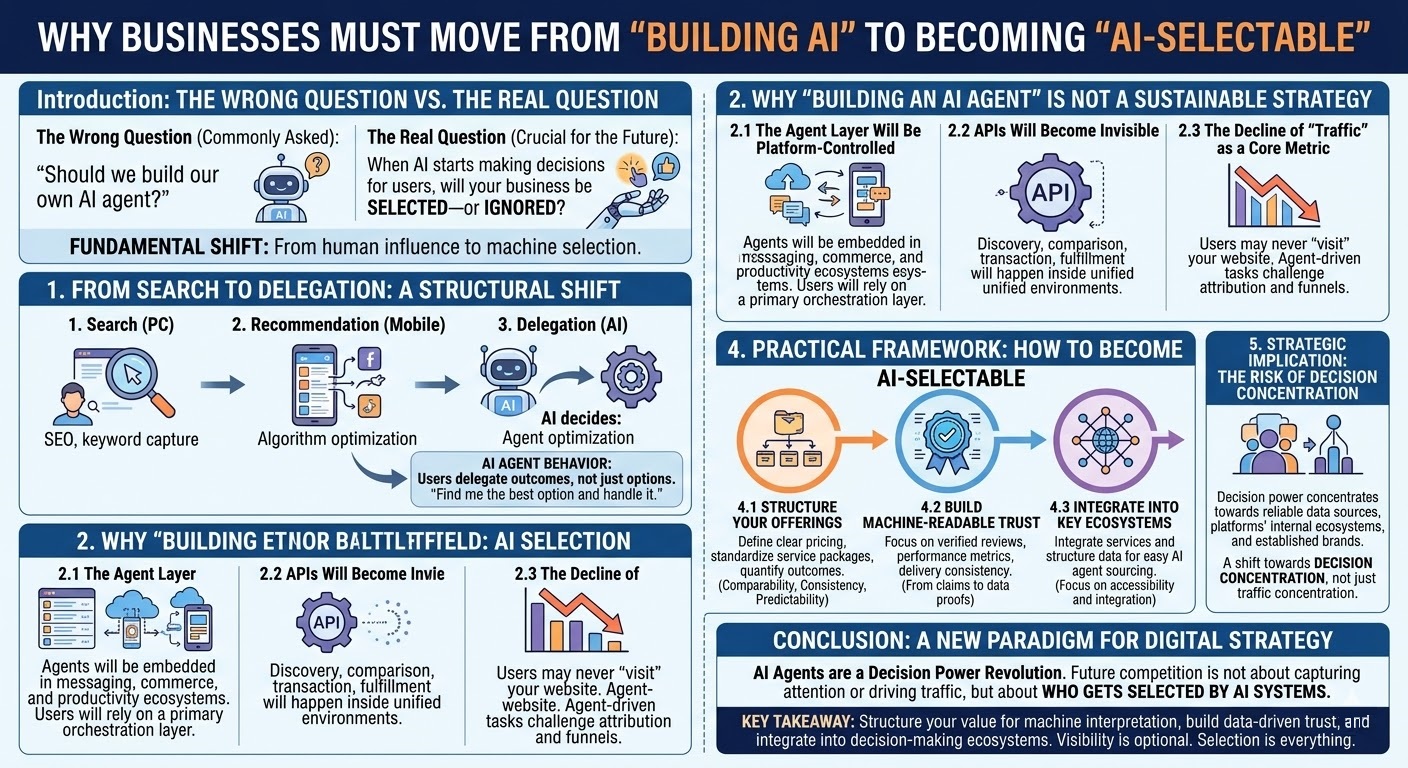
Introduction: The Wrong Question Most Companies Are Asking
Since early 2026, the rise of AI agents (often referred to in China as “Xiaolongxia,” inspired by projects like OpenClaw) has sparked global attention.
Across boardrooms and marketing teams, one question dominates:
“Should we build our own AI agent?”
It’s a logical question—but it’s the wrong one.
It is a fundamental shift in how decisions are made in the digital economy.
The real question is:
When AI starts making decisions for users, will your business be selected—or ignored?
1. From Search to Recommendation to Delegation: A Structural Shift
To understand the magnitude of this change, we need to zoom out.
Digital interaction has evolved in three stages:
| Era | User Behavior | Business Strategy |
|---|---|---|
| Search (PC) | Users search | SEO, keyword capture |
| Recommendation (Mobile) | Platforms suggest | Algorithm optimization |
| Delegation (AI) | AI decides | Agent optimization |
AI agents introduce a new behavior:
👉 Users no longer explore options
👉 They delegate outcomes
Instead of comparing:
“Which product is best?”
Users now say:
“Find me the best option and handle it.”
This is not a UX improvement. It is a transfer of decision-making authority.
2. Why “Building an AI Agent” Is Not a Sustainable Strategy
Many companies are rushing to:
- Launch AI copilots
- Build branded agents
- Integrate LLM APIs
However, based on current platform dynamics and infrastructure evolution, three realities are becoming clear.
2.1 The Agent Layer Will Be Platform-Controlled
Just as mobile ecosystems consolidated around a few dominant platforms, AI agents will likely follow the same trajectory.
Agents will not exist as independent tools. They will be embedded into:
- Messaging platforms
- Commerce ecosystems
- Productivity environments
Users will not manage multiple agents. They will rely on a primary orchestration layer.
2.2 APIs Will Become Invisible
Current discussions around:
- API standardization
- Multi-model orchestration
- Integration complexity
miss a key trend:
APIs are being abstracted away by platforms
In the near future, businesses won’t “call APIs” in the traditional sense.
Instead:
- Discovery
- Comparison
- Transaction
- Fulfillment
will all happen inside unified environments.
2.3 The Decline of “Traffic” as a Core Metric
Digital marketing has long been built on:
- Traffic acquisition
- Click-through rates
- Conversion funnels
But in an agent-driven world:
👉 Users may never “visit” your website
👉 Agents may complete tasks without exposure
This fundamentally challenges:
- Attribution models
- Funnel design
- Performance marketing assumptions
3. The New Competitive Battlefield: AI Selection
The most important shift for marketers and business leaders is this:
Competition is moving from influencing humans to being selected by AI systems
3.1 From SEO to AEO (Agent Engine Optimization)
Traditional SEO focuses on:
- Keywords
- Content ranking
- Visibility
In contrast, AEO focuses on:
- Structured data
- Machine-readable services
- Verified performance
The objective is no longer:
👉 “Be visible”
But:
👉 “Be selected”
3.2 From Customer Acquisition to Agent Compatibility
In the past, businesses invested in:
- Brand awareness
- User acquisition
- Customer engagement
Now, a new requirement emerges:
Agent compatibility
This includes:
- Clear service definitions
- Standardized pricing
- Reliable delivery outcomes
- Accessible data signals
If AI cannot interpret your value, it cannot recommend you.
3.3 From Advertising to Decision Integration
Traditional advertising aims to:
- Capture attention
- Influence perception
But AI agents bypass this layer.
Instead of showing ads, they:
- Evaluate options
- Rank providers
- Execute transactions
This means:
The “moment of influence” is shifting inside the AI decision process
4. Practical Framework: How to Become AI-Selectable
Based on current industry signals and platform trajectories, companies should prioritize three strategic shifts.
4.1 Structure Your Offerings
AI systems operate on logic, not narrative.
To be competitive:
- Define clear pricing models
- Standardize service packages
- Quantify outcomes
Think in terms of:
👉 Comparability
👉 Consistency
👉 Predictability
4.2 Build Machine-Readable Trust
Trust, in an AI-driven environment, is data-driven.
Focus on:
- Verified customer reviews
- Performance metrics
- Delivery consistency
Shift from:
“We claim we are the best”
To:
“Our data proves it”
4.3 Integrate into Key Ecosystems
Distribution strategy is evolving from reach to integration.
Instead of asking:
“How do we get traffic?”
Ask:
“Where do AI agents source decisions from?”
And ensure:
- Your services are accessible
- Your data is structured
- Your presence is embedded
5. Strategic Implication: The Risk of Decision Concentration
One critical but often overlooked implication:
AI may increase, not decrease, market concentration.
Why?
- AI favors reliable, large-scale data sources
- Platforms prioritize internal ecosystems
- Established brands are easier to model
We are potentially moving toward:
👉 Decision concentration, not just traffic concentration
Conclusion: A New Paradigm for Digital Strategy
AI agents represent more than a technological upgrade.
They signal a paradigm shift in how economic decisions are made.
The future of competition will not be defined by:
- Who captures attention
- Who drives traffic
But by:
Who gets selected by AI systems
Key Takeaway
AI agents are not a tool revolution. They are a decision power revolution.
Businesses that succeed will not be those that simply adopt AI tools, but those that:
- Structure their value for machine interpretation
- Build data-driven trust
- Integrate into decision-making ecosystems
In the AI era, visibility is optional. Selection is everything.
 Unlock 2026's China Digital Marketing Mastery!