 English
 German
 Korea
Korea Spanish
Beyond Retrieval: The Structural Evolution of China’s AI Search Landscape in 2026
- On February 6, 2026
- china ai search
As we cross the threshold of early 2026, the term “search engine” is increasingly viewed by Chinese tech analysts as a linguistic relic—a 20th-century label for a 21st-century cognitive architecture. The digital landscape of China, once defined by the gatekeeping of hyperlinks, has undergone a fundamental structural migration.
In 2026, China’s AI search market has moved beyond the “Answer Engine” phase. It has entered the era of Autonomous Intent Fulfillment. This is not merely an incremental improvement in accuracy; it is a systemic shift from Information Retrieval to Cognitive Agency.
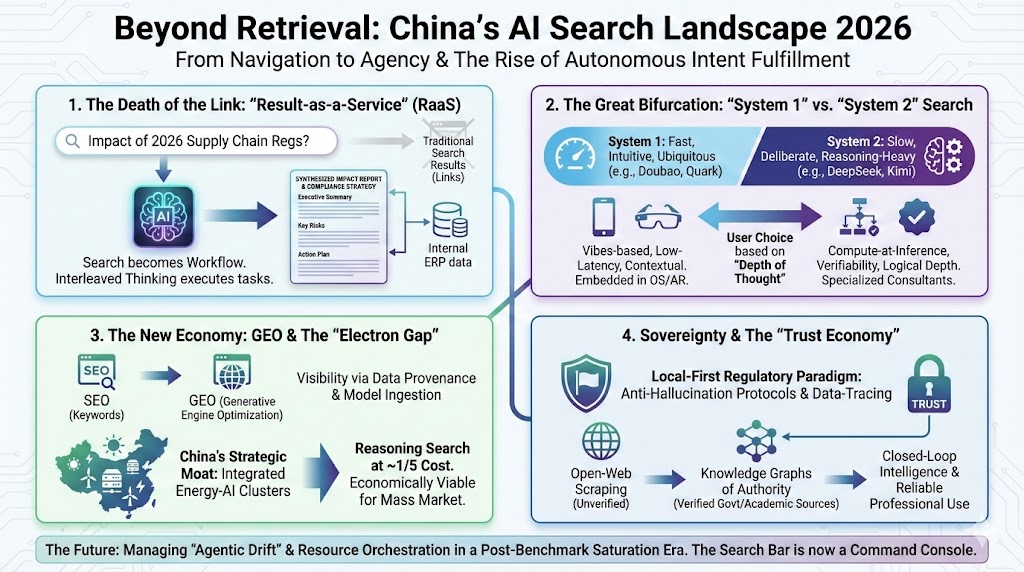
1. The Death of the Link: From Navigation to “Result-as-a-Service” (RaaS)
For two decades, the primary logic of search was “diversion”: a user asks a question, and the engine provides a list of destinations. In 2026, this logic has inverted. The “destinations” now come to the user.
Leading incumbents like Baidu (still holding approximately 58% of search volume) and aggressive “AI Tigers” like Moonshot AI (Kimi) and DeepSeek have pivoted to a Result-as-a-Service (RaaS) model. Instead of providing a bibliography of sources, the system performs “interleaved thinking”—a technique popularized by the recently released Zhipu GLM-4.7—where the AI searches, reasons, cross-references, and then executes tasks within the search interface.
If a professional in Shanghai searches for “the competitive risk of a new supply chain regulation,” the engine does not provide news links. It generates a synthesized impact report, cross-checks it against the company’s internal ERP data (via secure enterprise connectors), and drafts a compliance strategy. The “search” has become a “workflow.”
2. The Great Bifurcation: “System 1” vs. “System 2” Search
The most significant structural change in 2026 is the functional split of search architectures. The market has bifurcated into two distinct cognitive layers:
- “System 1” Search (Fast, Intuitive, Ubiquitous): Dominated by the ByteDance (Doubao) and Quark ecosystems. This layer thrives on low-latency, multi-modal interaction. It leverages China’s massive short-video and social data to provide “vibes-based” and “contextual” answers. It is the search of the everyday, embedded in AR glasses and mobile OS layers.
- “System 2” Search (Slow, Deliberate, Reasoning-Heavy): This is where the real innovation lies. Models like DeepSeek-R1 and Kimi K2 Thinking have introduced “Compute-at-Inference” logic into search. These engines explicitly “think” before they speak, allocating more processing power to complex queries. The value proposition here is not speed, but verifiability and logical depth.
This bifurcation has effectively killed the “one-size-fits-all” search bar. Users now consciously choose their search tool based on the required “depth of thought,” treating AI models as specialized consultants rather than encyclopedias.
3. The New Economy: The Rise of GEO and the “Electron Gap”
The shift to AI search has obliterated the traditional SEO (Search Engine Optimization) industry. In its place, GEO (Generative Engine Optimization) has become the standard.
In 2026, visibility is no longer about keywords; it is about Data Provenance and Model Ingestion. Brands now compete to have their high-quality, verified data included in the training sets or RAG (Retrieval-Augmented Generation) pipelines of major models.
Furthermore, the “Electron Gap” has emerged as China’s strategic moat. While the U.S. continues to hold an advantage in peak GPU performance, China has capitalized on its energy infrastructure. By early 2026, the deployment of specialized AI-energy clusters—where data centers are physically integrated with renewable energy grids in the west—has allowed Chinese firms to offer “Reasoning Search” at roughly 1/5 the cost of their Western counterparts. This efficiency has made high-token “System 2” search economically viable for the mass market, not just elite subscribers.
4. Sovereignty and the “Local-First” Logic
The 2026 landscape is governed by a “Local-First” regulatory paradigm. China’s AI search engines are now mandated to implement granular and data-tracing labels.
This has created a “Trust Economy.” Because the cost of misinformation is now high (both legally and computationally), engines are moving away from open-web scraping toward Knowledge Graphs of Authority. The search engine of 2026 is a curated digital nervous system, where information from government white papers, academic repositories, and verified industry leaders is weighted significantly higher than unverified web content. This “closed-loop” intelligence ensures that while the Chinese AI ecosystem remains distinct from the global web, it is arguably more structured and reliable for professional use within its own jurisdiction.
Conclusion: The Long-Term Challenge
The current triumph of China’s AI search landscape is its transition from “finding” to “doing.” However, a critical tension remains as we look toward 2027.
The industry is reaching a “Benchmark Saturation” point. As models converge on near-perfect performance for standard queries, the competition is shifting from algorithmic superiority to Resource Orchestration. The ultimate constraint is no longer the model’s intelligence, but the system’s ability to manage “Agentic Drift”—the tendency for autonomous search agents to hallucinate or deviate during long-horizon tasks.
For the professional reader, the takeaway is clear: 2026 marks the end of search as a passive activity. The “search bar” is now a “command console,” and the competitive advantage has shifted from those who can find information to those who can direct the reasoning power that processes it.
 Unlock 2026's China Digital Marketing Mastery!