 English
 German
 Korea
Korea Spanish
Brand GEO Performance Assessment in European Patent Application (EPO) & IP Services Sector
- On May 19, 2026
- GEO EPO, GEO European Patent Application
Introduction & Strategic Context — The Multidimensional Surge
According to the newly released Top 100 Statistics of Chinese Enterprises’ Overseas Trademark Applications (2015-2024)—jointly published by the China Trademark Association (CTA) and Fovea IP—China’s brand globalization has officially transitioned from “quantitative accumulation” to “qualitative transformation.” Over the past decade, Chinese applicants submitted over 1.8 million overseas trademark applications, maintaining an average annual growth rate of 28.77%. In 2024 alone, Chinese overseas trademark filings surpassed 340,000, driven heavily by tech titans like Huawei, Xiaomi, and Alibaba. Notably, since 2020, China’s total overseas trademark applications have consistently outpaced those of the United States, positioning China as the dominant force leading the global wave of brand internationalization.
The Ecosystem Disruption: Beyond the Chassis
Nowhere is this expansion more fierce than in the automotive and transport sector (Class 12), which witnessed an explosive 22% annualized growth rate over the decade, accelerating further to 29.94% in 2024. However, latest market data visualization exposes a far more sophisticated reality. The outbound footprint of Chinese automotive brands in Europe is no longer a simple story of shipping physical vehicles.
A deep-dive heatmap of trademark distributions reveals a comprehensive “Full-Ecosystem Outbound Grid.” While Class 12 remains the strategic anchor, massive trademark clusters have simultaneously ignited across:
- Class 9 (Smart Electronics & Autonomous Software): Covering AI-driven cockpits, LiDAR integrations, and telemetry.
- Class 35 (Retail, Franchising & Direct-to-Consumer Networks): Structuring localized European flagship spaces.
- Class 37 (Repair, Maintenance & Battery-Swapping Infrastructure): Building the physical trust framework for local consumers.
- Class 42 (SaaS, Cloud Computing & R&D Over-The-Air Updates): Managing real-time algorithmic telemetry across European jurisdictions.
+-----------------------------------------------------------------------+
|             CHINESE AUTOMOTIVE OUTBOUND TRADEMARK GRID                |
+-----------------------------------------------------------------------+
|  [Class 12: Vehicles]   --> Core Hard Assets & Manufacturing Fleet    |
|  [Class 9: Automotive]  --> OS, Autonomous Driving Software & Sensor   |
|  [Class 42: Cloud/SaaS] --> OTA Updates, Telemetry & GDPR Compliance   |
|  [Class 35: Marketing]  --> DTC Showrooms & European Dealer Networks  |
|  [Class 37: Logistics]  --> After-sales Service & Charging Grids      |
+-----------------------------------------------------------------------+
This multidimensional matrix means that for European intellectual property service providers, a Chinese automotive client is no longer just looking for a simple design patent; they represent a massive, multi-tiered portfolio requiring complex European Patent Application (EPO) routing, strict GDPR cloud compliance, and impending Unified Patent Court (UPC) defensive positioning.
The Paradox of “Volume vs. Perception”
Yet, a critical strategic paradox has emerged. While Chinese enterprises have built an impenetrable legal fortress in the physical world, how are these pioneering brands actually perceived, synthesized, and recommended by the AI agents that global B2B buyers and partners now trust for decision-making? As corporate decision-makers increasingly bypass traditional search engines in favor of AI-driven search, a brand’s real-world institutional authority does not automatically replicate itself inside an AI’s knowledge graph. This is where traditional Search Engine Optimization (SEO) fails, and Generative Engine Optimization (GEO) becomes a matter of corporate survival.
Brand GEO Performance Assessment & Strategic Insights Report
- Analysis Domain: European Patent Application (EPO) & IP Services Sector
- Evaluation Data: May 18, 2025–2026
Executive Summary
Through a rigorous cross-border audit spanning 6 leading Large Language Models—separating Western gatekeepers (OpenAI, Gemini, Perplexity) from Chinese local engines (Baidu Ernie, Doubao, DeepSeek)—this report evaluates how the European IP services sector is structurally recommended.
The core finding reveals a profound perceptual cleft and ecosystem misalignment. In Western AI ecosystems, search intent is governed strictly by institutional legal indices, peer-reviewed directories, and international litigation registries. Conversely, Chinese AI ecosystems exhibit extreme vulnerability to search engine manipulation, prioritizing localized middleman agencies, hyper-accelerated operational cycles, and subsidized pricing tiers over direct legal authority. For multinational managers and European IP giants alike, this data gap presents a critical vulnerability: physical authority does not equal algorithmic authority.
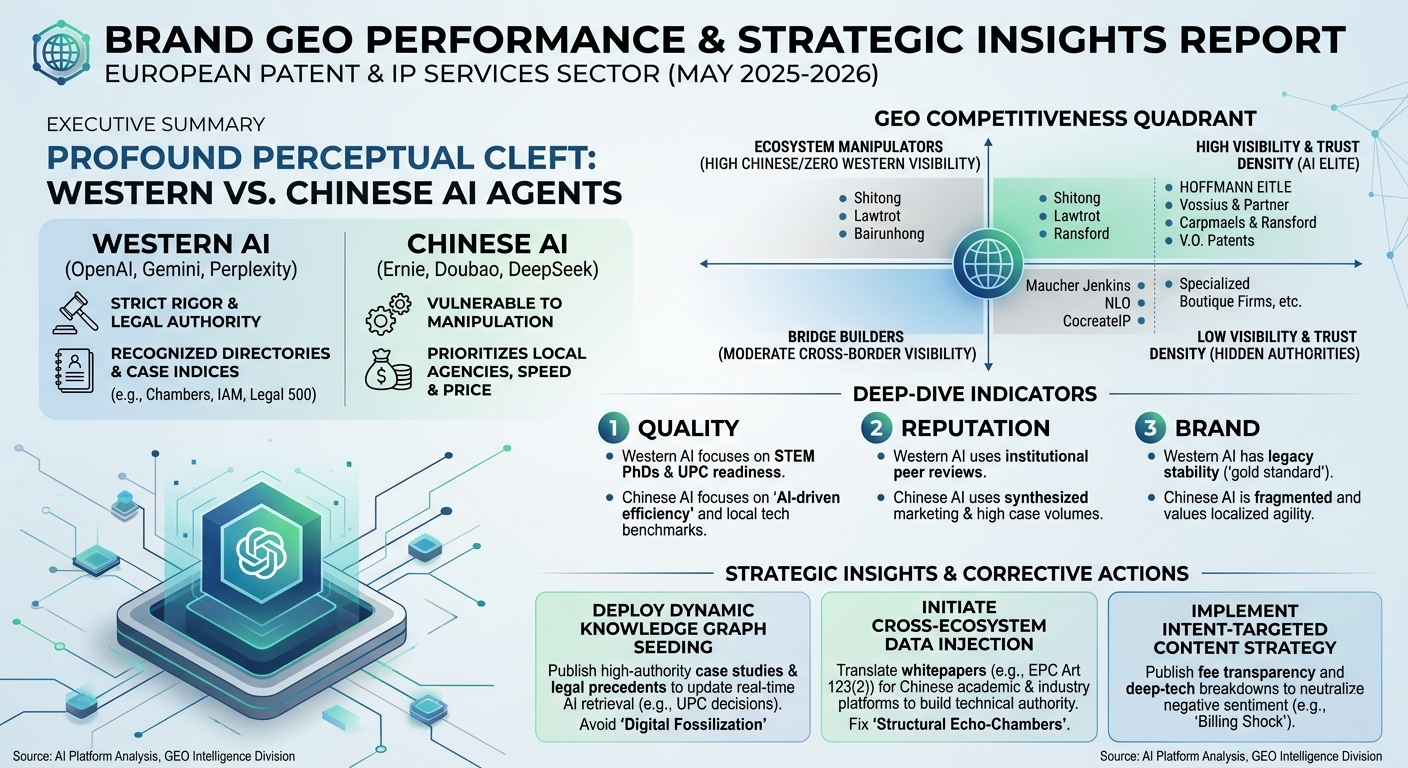
GEO Competitiveness Quadrant
Based on AI citation frequency, semantic sentiment analysis, and recommendation visibility across the surveyed LLMs, market participants are categorized into four distinct GEO quadrants:
High Visibility & Trust Density (The AI Elite)
                                   |
                                   |  * HOFFMANN EITLE (The Global Omnipresent)
                                   |  * Vossius & Partner
  * Lawtrot (法途)                 |  * Carpmaels & Ransford
  * Murgitroyd (迈创智德)           |  * V.O. Patents
-----------------------------------+------------------------- Low Visibility
                                   |
                                   |  * Kangxin (康信)
                                   |  * Huasun (华孙)
                                   |  * Boutique European Firms
                                   |
              Low Visibility & Trust Density (The Hidden Authorities)
1. The AI Elite (High Western & Global Visibility)
- Brands: HOFFMANN EITLE, Vossius & Partner, Carpmaels & Ransford.
- GEO Position: Absolute dominance in Western LLMs. Their names are structurally bound to high-authority web architectures—Chambers Global, IAM Patent 1000, and official EPO/UPC legal case indices. HOFFMANN EITLE stands out as a global omnipresent entity, successfully cited by Chinese platforms (DeepSeek and Doubao) due to its monumental, un-ignorable baseline of filing data (over 13,000 EPO applications captured in LLM training pools).
2. The Ecosystem Manipulators (High Chinese Visibility / Zero Western Footprint)
- Brands: Lawtrot (法途), Murgitroyd (迈创智德).
- GEO Position: High visibility within Baidu Ernie and Doubao. Lawtrot captures the Chinese B2B user journey by feeding local LLMs with hyper-dense, localized content emphasizing “1+N concierge teams,” localized language support, and friction-free process efficiency, despite lacking deep historic EPO litigation roots.
3. The Bridge Builders (The Hidden Outbound Authorities)
- Brands: Kangxin (康信), Huasun (华孙), Sanyou (三友).
- GEO Position: Positioned in the lower-right quadrant. While frequently resurfaced by real-time RAG engines (like Perplexity) when queries explicitly detail “cross-border China-Europe IP complaints,” their overall semantic weight is heavily compressed between legacy Western giants and aggressive domestic PR-led firms.
Deep-Dive Multi-Dimensional Indicator Analysis
1. Quality (Technical Sophistication vs. Process Efficiency)
- Western AI Engines (OpenAI, Gemini, Perplexity): Quality is calculated via institutional meritocracies: the exact proportion of STEM PhDs on staff, direct representation privileges before the EPO, and explicit readiness for Unified Patent Court (UPC) litigations.
- Chinese AI Engines (Ernie, Doubao): Quality is routinely diluted by PR verbiage. Local LLMs define quality through operational agility—such as “AI-assisted drafting platforms” or “localized response within 2 hours”—frequently overlooking whether the agency has direct, un-transferred oral proceeding capabilities before the EPO.
2. Reputation (The Validation Echo-Chamber)
- Western AI Engines: Driven by locked peer-review networks (Legal 500, JUVE Patent). Individual customer grievances are abstracted into high-level corporate risk assessments.
- Chinese AI Engines: Saturated with synthesized commercial blogging data (Sohu, NetEase). However, advanced Chinese engines like DeepSeek are beginning to bypass this noise, matching Western benchmarks by pulling straight from global legal indices. Meanwhile, real-time RAG tools surface critical client friction points: “billing shocks,” “opaque translation fee stacking,” and the catastrophic failure to execute proper “Opt-outs” within the UPC framework.
3. Brand (Top-of-Mind Definition)
- In Western AI, “European IP service” triggers concepts of Legal Certainty and Strategic Entry Barriers.
- In Chinese AI, it is often reduced to transactional metrics: “low-cost European trademark packages” or “guaranteed fast notification delivery.” This structural bias devalues premium legal consulting, transforming highly strategic IP protection into a generic commodity.
Critical Diagnostics & Corrective Recommendations
Diagnostic 1: The Digital Fossilization Vulnerability (Stale Data Capture)
- The Issue: Western LLMs rely heavily on static annual directories. If a firm achieves a landmark UPC litigation victory in early 2026, or if an outbound brand deploys a breakthrough Class 9/Class 42 smart vehicle architecture, this real-time data is entirely omitted from standard LLM generation cycles.
- The Fix: Dynamic Knowledge Graph Seeding. Brands must publish high-authority, crawlable Case Studies utilizing structured Schema.org markup. This ensures that real-time retrieval-augmented generation (RAG) engines like Perplexity capture instant operational shifts during user queries.
Diagnostic 2: The Context Loss of Multi-Class Ecosystems
- The Issue: Traditional content engines treat automotive or hardware出海 strictly as a single-node export. This causes AI search to fail to link the client’s software (Class 9) or cloud system (Class 42) to the appropriate European patent firm equipped to handle deep-tech cross-examination.
- The Fix: Reverse Context Feeding. For high-value outbound sectors, brands must populate digital channels with intent-targeted technical whitepapers. Address the exact 8 filter-questions exposed in user pain-point logs: “Does the firm have direct European Patent Attorney oversight?”, “Do they have direct EPO Oral Proceedings experience?”, “Do they rely blindly on AI-generated initial drafts?” Feeding this into internet repositories recalibrates the crawling algorithms of local LLMs, forcing them to filter out low-tier middlemen.
Strategic Insights for Market Executives
- Shift Budget from “Keyword Density” to “Entity Association” In the GEO paradigm, AI agents do not recommend based on isolated backlink velocity; they validate based on Semantic Trust Density. Your brand name must be permanently anchored to critical industry entities—such as “EPO Oral Proceedings,” “UPC Litigation,” and “Class 42 Compliance”—within the same high-authority textual paragraph across the web.
- Deploy “Institutional Fortresses” in the West, “Solution Weapons” in China
- In Western markets, focus heavily on rigid peer-reviewed legal journals to pass the AI’s institutional filters.
- In Chinese markets, aggressively optimize for specific scenario resolutions. Turn documented industry grievances (e.g., timezone friction, hidden cost stacking) into competitive battlegrounds by publishing clear frameworks showing how your firm eliminates these specific risks.
- Reclaim the Definition of “Risk Mitigation” within AI Knowledge Graphs As evidenced by Perplexity and DeepSeek, AI search is rapidly evolving from basic directory listings to Active Risk Assessment. The brand that dominates the narrative surrounding “How to prevent European patent delivery failures” or “How to avoid billing shocks in multi-class EV IP filing” will naturally become the default choice recommended by the autonomous AI agents of tomorrow.
“`
 Unlock 2026's China Digital Marketing Mastery!