 English
 German
 Korea
Korea Spanish
Case Study: How a European Industrial Park Operator Validated China Market Entry Through Search Behavior Analysis
- On March 19, 2026
- search behavior, search behaviors
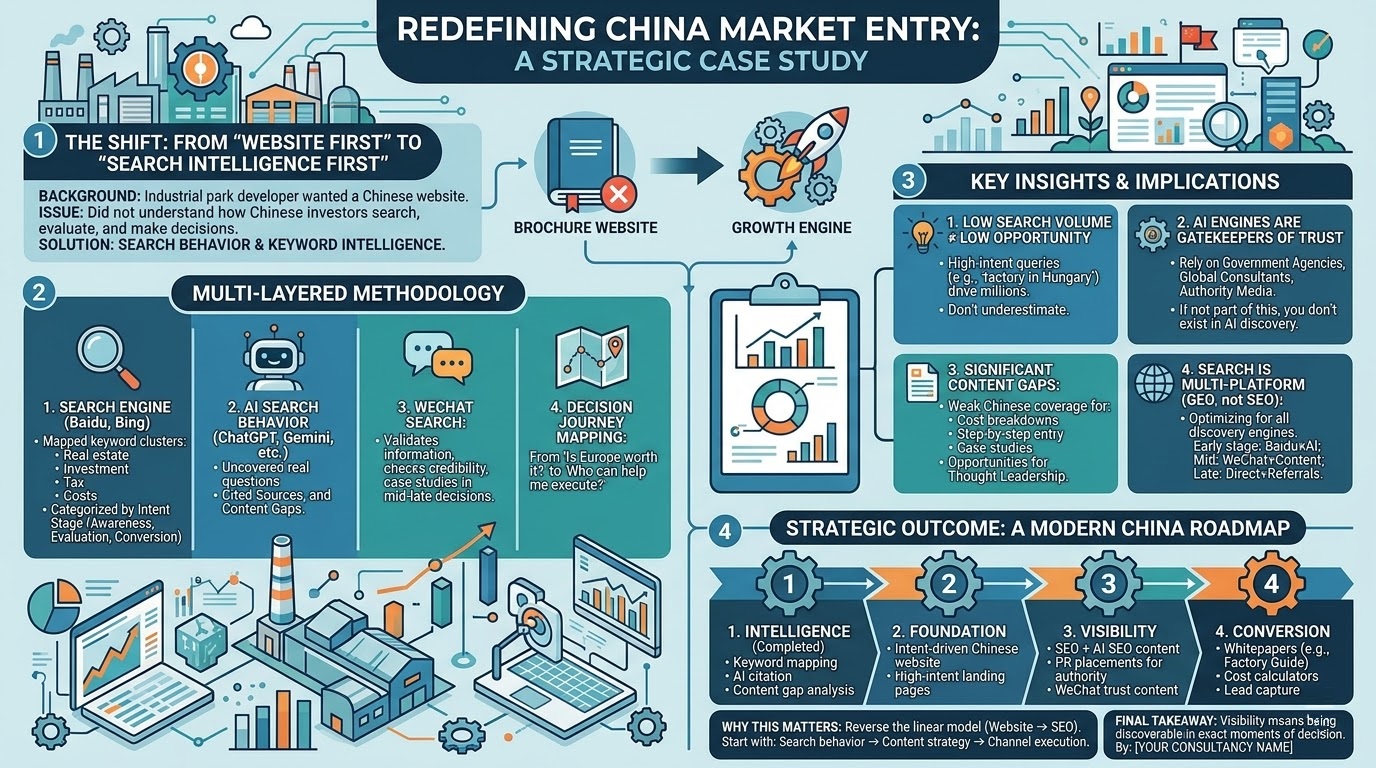
Background
A Central European industrial park developer (hereafter referred to as the Client) approached us with a seemingly straightforward request: they wanted to build a Chinese-language website.
The trigger was practical. They had already received inquiries from Chinese investors—mostly through intermediaries—and realized they lacked a direct communication channel with this audience.
At first glance, the solution appeared simple: translate the website and make it accessible to Chinese users.
However, based on our experience working with Western companies entering China, we identified a critical gap:
The Client did not yet understand how Chinese investors actually search, evaluate, and make decisions.
Without this layer of insight, a Chinese website would function more like a brochure than a growth engine.
The Shift: From “Website First” to “Search Intelligence First”
Instead of immediately executing website localization, we recommended starting with a Search Behavior & Keyword Intelligence Project.
The goal was to answer four fundamental questions:
- What do Chinese investors actually search when considering Europe or this specific country?
- Where do they search (Baidu, WeChat, AI platforms)?
- How do their queries evolve along the decision-making journey?
- What sources do they trust—and which ones are cited by AI engines?
To their credit, the Client quickly aligned with this approach.
They chose to begin with a focused research phase before committing to full-scale marketing execution.
This decision significantly reduced risk and improved strategic clarity.
Methodology
We conducted a multi-layered analysis across both traditional and emerging search ecosystems:
1. Search Engine Analysis (Baidu & Bing)
We mapped keyword clusters across:
- Industrial parks / real estate
- Investment and market entry
- Taxation and policy
- Cost and site selection
More importantly, we categorized keywords by intent stage, not just volume:
- Awareness (e.g., “Which European country is best for manufacturing?”)
- Evaluation (e.g., “Hungary tax rate for foreign companies”)
- Conversion (e.g., “industrial land for sale Hungary”)
2. AI Search Behavior Analysis
We tested structured prompts across major AI platforms, including:
- ChatGPT
- Gemini
- Claude
- DeepSeek
- Baidu AI
- Alibaba AI
This allowed us to uncover:
- The actual questions Chinese decision-makers ask AI
- The sources AI engines cite (government portals, consulting firms, media)
- Content gaps where no strong Chinese-language answers exist
3. WeChat Search (WeChat Search)
We analyzed keyword suggestions and content patterns inside the WeChat ecosystem.
Key insight:
WeChat search reflects mid-to-late stage decision behavior, where users validate information, look for case studies, and assess credibility.
4. Decision Journey Mapping
We reconstructed a typical Chinese investor’s search journey:
“Is Europe worth investing in?”
→ “Which country is best?”
→ “Is this country competitive?”
→ “What are the tax and labor costs?”
→ “How difficult is it to set up operations?”
→ “Who can help me execute?”
This journey became the backbone of all future content and channel strategy.
Key Insights
1. Low Search Volume ≠ Low Opportunity
Many highly relevant keywords (e.g., “build a factory in Hungary”) have relatively low monthly search volume.
However:
- These are high-intent, high-value queries
- They often indicate investment decisions worth millions
Traditional SEO metrics alone would underestimate their importance.
2. AI Engines Are the New Gatekeepers of Trust
Across platforms, we observed that AI-generated answers consistently rely on:
- Government investment agencies
- Global consulting firms
- Established media outlets
- Occasionally, authoritative corporate websites
Implication:
If your company is not part of this information ecosystem, you effectively do not exist in AI-driven discovery.
This is where EEAT (Experience, Expertise, Authoritativeness, Trustworthiness) becomes critical—not just for Google, but for AI visibility.
3. Content Gaps Are Significant
We identified multiple high-value topics with weak or fragmented Chinese-language coverage, such as:
- Real cost breakdowns of building a factory in Central Europe
- Step-by-step market entry processes
- Industry-specific investment case studies
These gaps represent immediate opportunities for thought leadership.
4. Search Is Multi-Platform, Not Just “SEO”
Chinese investors do not rely on a single channel:
- Early stage → Baidu + AI tools
- Mid stage → WeChat + content platforms
- Late stage → Direct website visits + referrals
This reinforces the importance of GEO (Global Engine Optimization)—optimizing for all discovery engines, not just search engines.
Strategic Outcome
Based on the research, we redefined the Client’s China market entry roadmap:
Phase 1: Intelligence (Completed)
- Keyword and search behavior mapping
- AI citation and content gap analysis
Phase 2: Foundation (Next Step)
- Chinese-language website built around search intent, not translation
- Core landing pages targeting high-intent queries
Phase 3: Visibility
- SEO + AI SEO content system
- PR placements to build authority signals
- WeChat content for trust-building
Phase 4: Conversion
- Whitepapers (e.g., “Factory Setup Guide”)
- Cost calculators
- Lead capture mechanisms
Why This Approach Matters
Many Western companies entering China still follow a linear model:
Website → SEO → Social
But in today’s environment, this sequence is reversed.
Search behavior → Content strategy → Channel execution
Without understanding how your audience searches, you risk building assets that never get discovered.
Final Takeaway
This project demonstrates a simple but powerful principle:
In B2B international expansion, visibility is no longer just about being online—it’s about being discoverable in the exact moments of decision.
By starting with search intelligence, the Client avoided premature execution and built a strategy grounded in real user behavior.
About Us
We are a China-focused digital marketing consultancy specializing in helping international companies:
- Understand Chinese buyer behavior
- Build search-driven market entry strategies
- Achieve visibility across search engines, AI platforms, and content ecosystems
If you are considering entering the China market—or attracting Chinese investors globally—this is where the process should begin.
Start with how your audience searches.
 Unlock 2026's China Digital Marketing Mastery!