 English
 German
 Korea
Korea Spanish
China’s AI Content Crackdown: What Global Marketers Must Understand About the Future of Content Trust
- On April 13, 2026
- AI content, wechat content
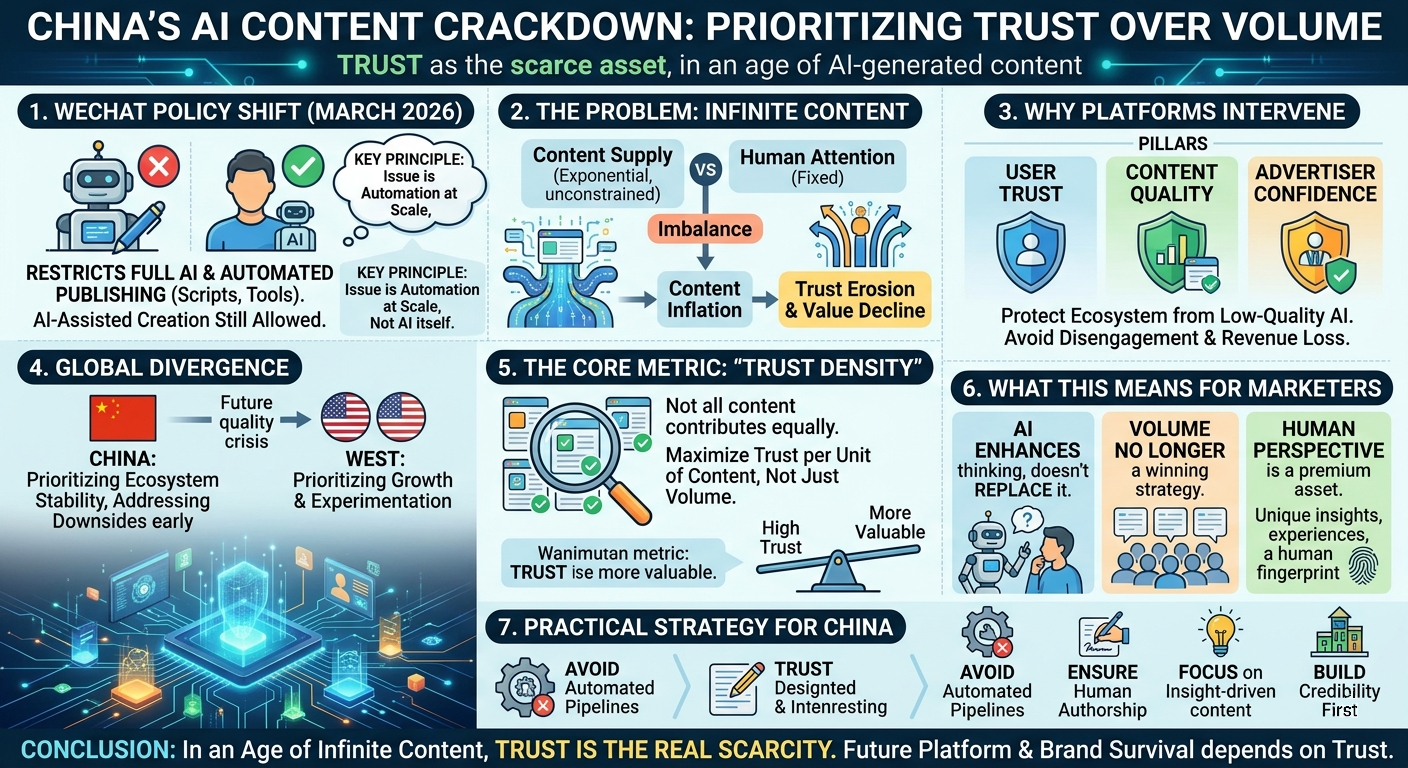
In March 2026, WeChat introduced new rules restricting fully AI-generated and automated content publishing.
Many interpreted this as another example of China tightening control over technology.
That interpretation misses the point.
This is not about censorship.
This is about the survival of the content economy.
1. What the New WeChat Policy Actually Says
The updated policy targets three core behaviors:
- Fully AI-generated content without meaningful human input
- Automated, large-scale publishing via scripts or tools
- Promotion of “AI content production systems” or tutorials
Importantly, AI-assisted creation is still allowed.
This distinction reveals a critical principle:
The issue is not AI — it is automation at scale.
2. The Real Problem: Infinite Content
AI has fundamentally changed content economics.
For the first time in history:
👉 Content supply is no longer constrained by human effort
This creates a dangerous imbalance:
- Supply grows exponentially
- Demand (human attention) remains fixed
The result?
Content inflation.
And like any inflation:
- Quality perception drops
- Trust erodes
- Value declines
3. Why Platforms Are Forced to Intervene
Platforms like WeChat rely on three pillars:
- User trust
- Content quality
- Advertiser confidence
Low-quality AI content threatens all three.
If left unchecked:
- Users disengage
- Advertisers reduce spending
- Platform revenue declines
So regulation becomes inevitable.
4. China Is Moving Earlier Than the West
While Western platforms are still benefiting from AI-driven growth, China is already addressing the downside.
This creates an important divergence:
- China: Prioritizing ecosystem stability
- West: Prioritizing growth and experimentation
However, history suggests:
👉 Growth-first models eventually face quality crises
China is simply encountering it earlier.
5. The Rise of “Trust Density” as a Metric
One of the most overlooked concepts is what we can call:
👉 Trust Density
Not all content contributes equally to platform value.
High-trust content:
- Builds long-term engagement
- Attracts premium advertisers
Low-trust content:
- Creates noise
- Reduces overall platform credibility
WeChat’s policy is effectively an attempt to:
Maximize trust per unit of content.
6. What This Means for Global Marketers
This shift has immediate implications:
(1) AI should enhance thinking, not replace it
Using AI for efficiency is acceptable.
Using it to mass-produce content is increasingly risky.
(2) Volume is no longer a winning strategy
Publishing more content does not guarantee more impact.
(3) Human perspective is becoming a premium asset
Original insights, opinions, and experiences are harder to replicate.
7. Practical Strategy for Entering China
If you are a Western brand entering China:
- Avoid automated content pipelines
- Ensure visible human authorship
- Focus on insight-driven content
- Build credibility before scaling
China’s platforms are evolving toward:
👉 Quality-controlled ecosystems
Conclusion
WeChat’s AI policy is not an isolated regulatory action.
It is an early signal of a broader global shift.
In an age where content can be generated infinitely:
The real scarcity is no longer content.
It is trust.
And in the long run:
👉 Trust will define which platforms — and which brands — survive.
 Unlock 2026's China Digital Marketing Mastery!