 English
 German
 Korea
Korea Spanish
China’s High-Stakes Import Landscape: Strategic Opportunities for Western Enterprises
- On January 28, 2026
- china import goods, opportunity china
1. Executive Summary: The Structural Reality of China’s Import Dependency
Western boards that view China as a commodity market are courting obsolescence. Despite the narrative of a “manufacturing superpower,” China’s industrial base is defined by a profound strategic paradox: a massive production volume that remains fundamentally tethered to Western upstream technology. Between 2019 and 2023, China’s integrated circuit (IC) trade deficit reached a staggering $1.08 trillion, exposing a vulnerability that the “New Quality Productive Forces” initiative cannot mask. For Western enterprises, these “Choke Points” are not merely export opportunities; they are high-leverage nodes of structural indispensability.
Core Conclusion: China’s manufacturing scale is a facade that hides a critical, high-barrier dependency on Western upstream IP and specialized equipment that remains impossible to domesticate in the short-to-medium term.
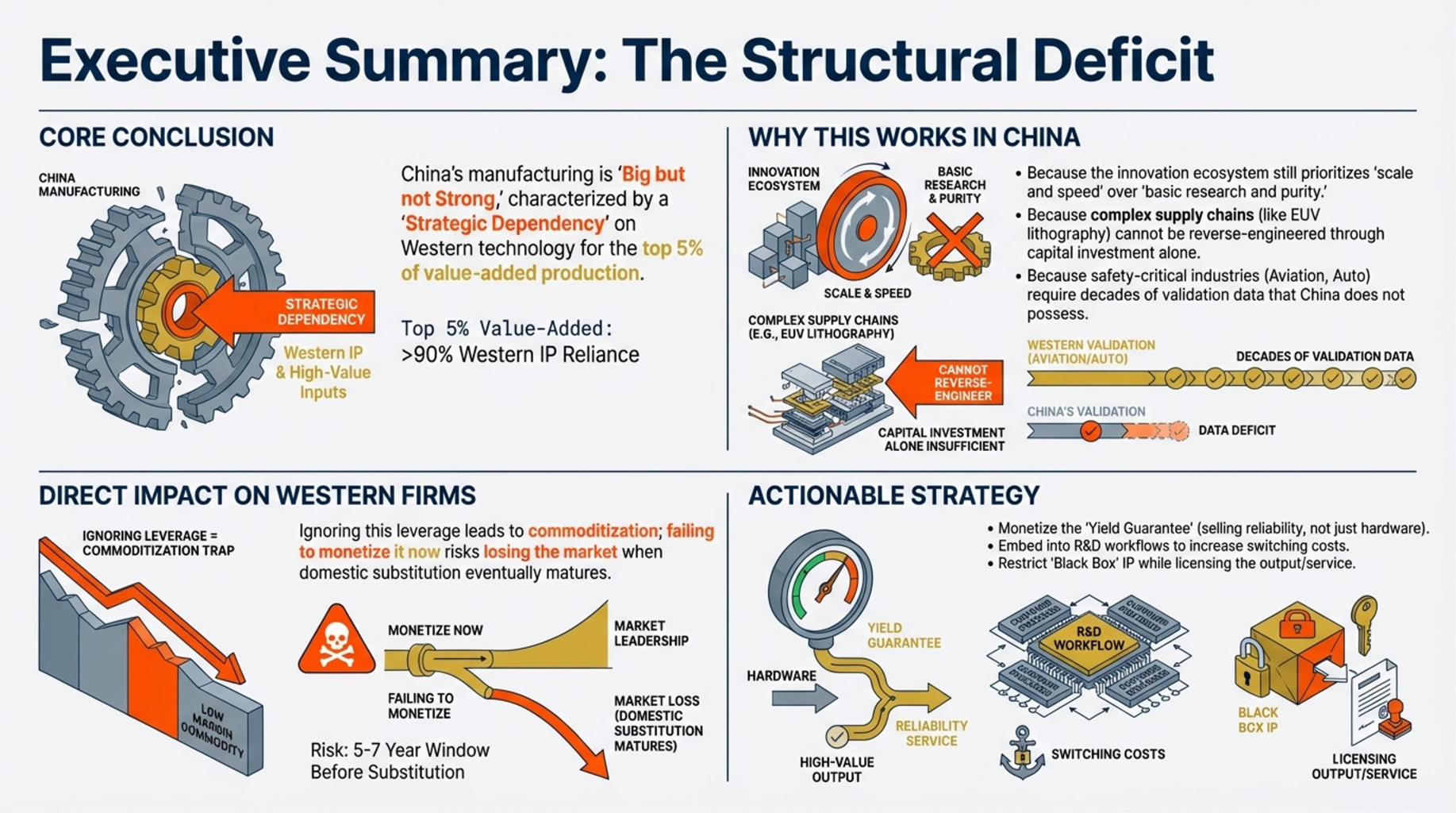
Why This Holds True in the Chinese Market:
- Because of historical path dependency: The “Market for Technology” strategy prioritized rapid scaling over foundational R&D, entrenching a reliance on imported core designs that Chinese firms cannot easily “unlearn.”
- Because of the original innovation lag: While China’s R&D spend has reached 2.69% of GDP, the investment remains heavily skewed toward application-layer iteration rather than the high-risk basic research required for breakthrough materials and algorithms.
- Because of extreme global specialization: Critical sectors like EUV lithography and EDA software are controlled by global monopolies, creating “ecosystem lock-ins” where domestic alternatives lack the precision and stability required for high-end manufacturing.
Expert Insight: Success in China is no longer measured by sales volume, but by Strategic Integration. Western firms must position themselves as the non-negotiable foundations upon which Chinese “Chain Leaders” must build to remain globally viable.
2. Deep Dive: High-Barrier Sectors with Maximum Western Opportunity
The strategic mandate for Western firms is to identify “critical nodes” where Chinese domestic alternatives fail to meet rigorous stability and precision requirements.
Sector Analysis Table: The Geography of “Choke Point” Opportunities
| High-Opportunity Sector | Specific Western “Choke Point” Product | Domestic Substitution Difficulty | Primary Entry Barrier |
| Semiconductors | Lithography (EUV/ArF), Etching Equipment | High | Sub-7nm/Advanced Node precision; 90% market monopoly by Western/Japanese firms. |
| Electronic Materials | ArF/EUV Photoresist | High | Over 99% import rate (ArF <1% self-sufficiency); secret chemical formulas and long validation cycles. |
| Advanced Computing | High-end Chips (GPUs/CPUs/AI) | High | 70% foreign market share in AI; massive gap in advanced process nodes. |
| Aviation & Aerospace | Turbofan Engines (e.g., LEAP-1C) | High | Extreme technical complexity and mandatory international certification (FAA/EASA). |
| IP Licensing | Standard Essential Patents (SEP) | High | Foundational architecture for 5G/Semiconductors; unavoidable “Technology Rent.” |
| Industrial Software | EDA/CAE/CAD Software | High | Deep ecosystem lock-in; 95% of R&D design software remains imported. |
| Industrial Machinery | Five-axis CNC Machine Tools | High | Superiority in ultra-precision machining and long-term service stability. |
The “So What?” Layer: The Reliability Gap
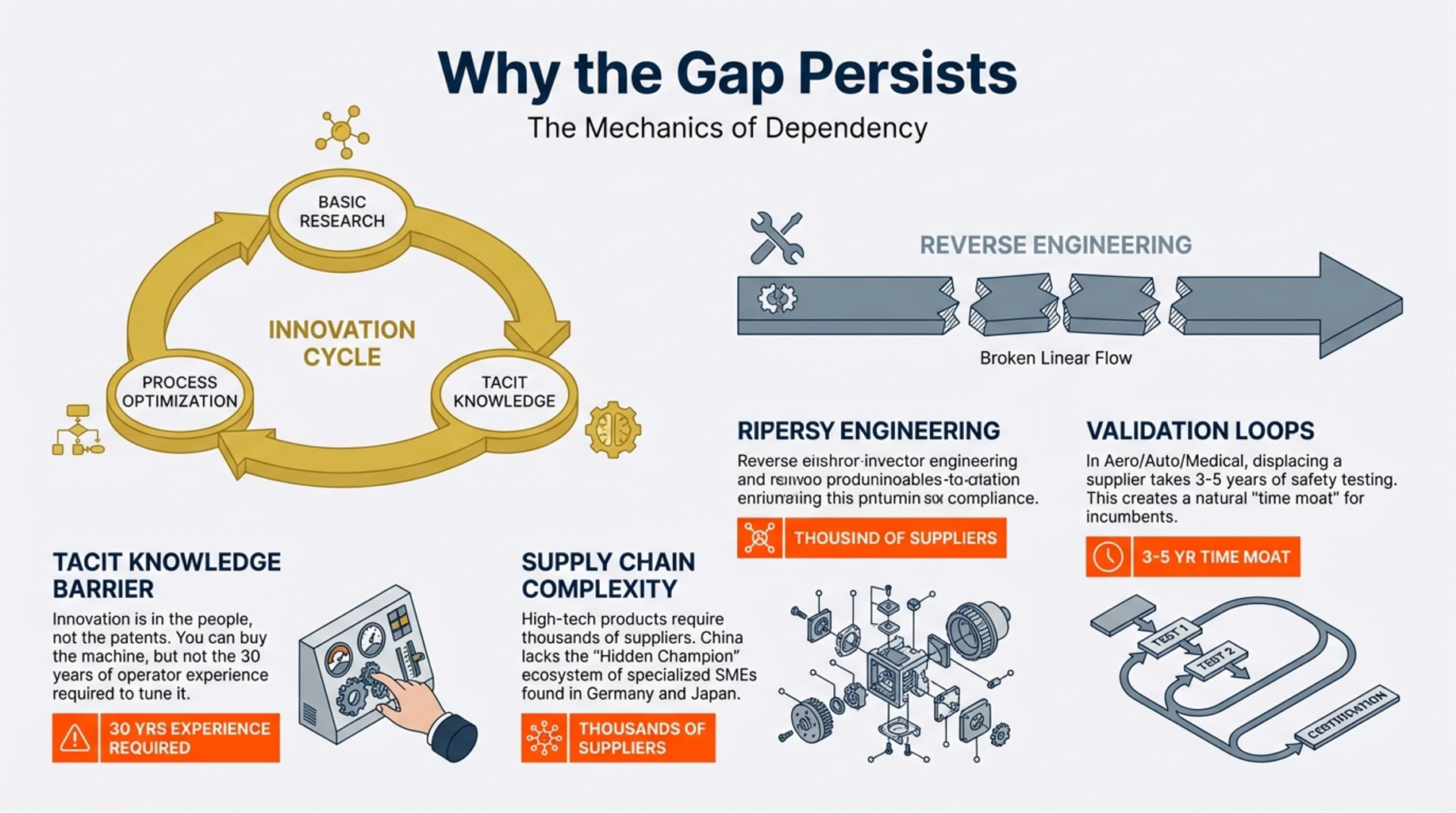
The primary differentiator for Western products is lifecycle stability. While Chinese firms can produce “functional” equivalents, they consistently fail at the “last 1%” of reliability. A prime example is T700/T800 carbon fiber: Chinese domestic production suffers from a 75% yield rate, whereas Western incumbents maintain 90%. For Chinese “Chain Leaders” (the state-designated pillars of the economy), switching to a domestic supplier with a 15% lower yield is a non-starter, as it risks the entire production line’s integrity and global certification status.
3. Strategic Impact and The Cost of Misalignment
The Chinese market has exited “easy mode.” It is now a battle for structural relevance. Western firms that fail to entrench themselves as indispensable nodes risk rapid displacement as China pursues “Industrial Base Reconstruction.”
Direct Impact on Western Enterprises: Failure to secure a “Choke Point” position results in the immediate erosion of premium pricing power. Without a structural moat, Western firms face exclusion from the supply chains of Chinese “Chain Leaders” like CRRC or COMAC, losing their seat at the table during the next phase of China’s industrial upgrade.
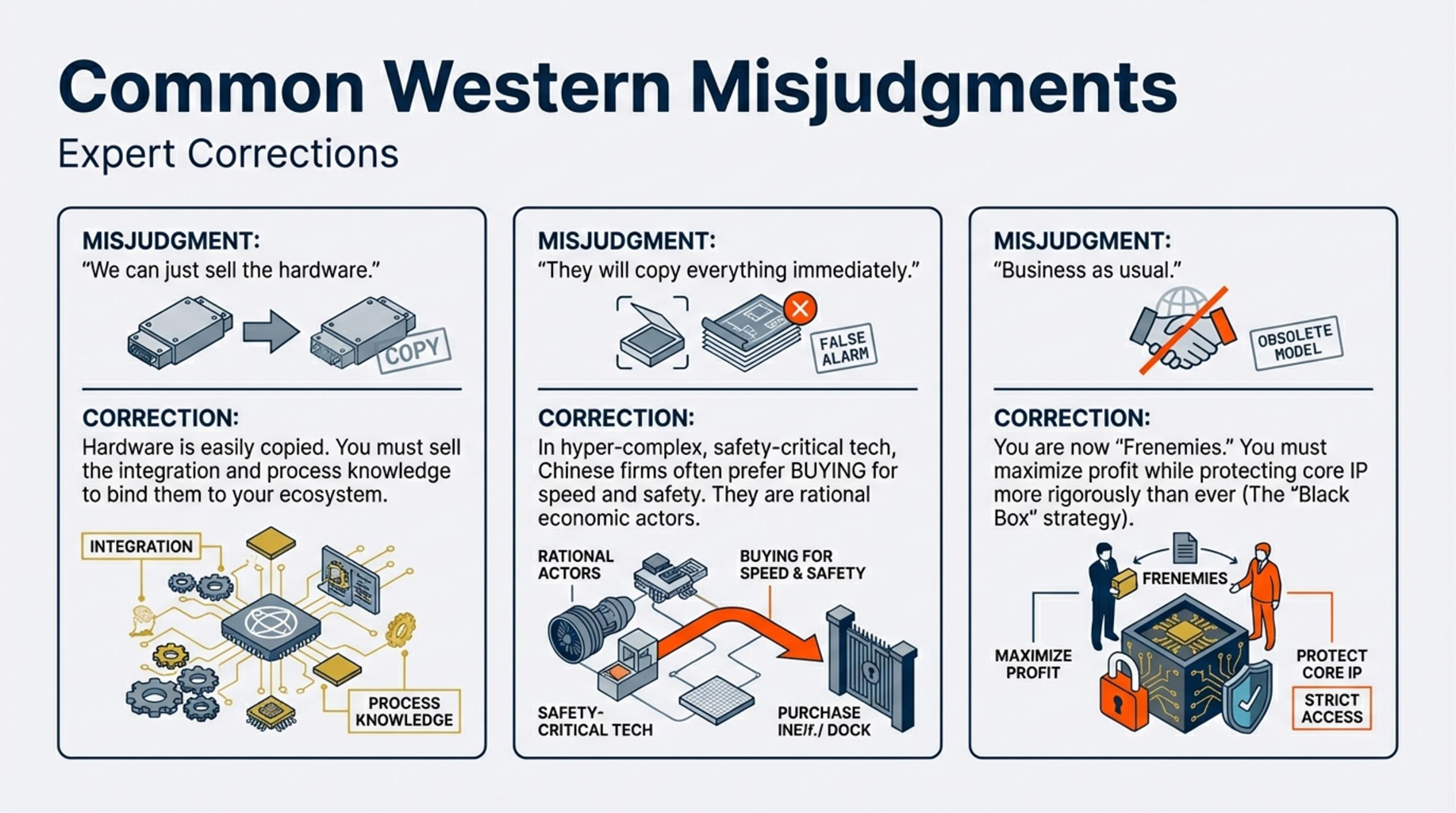
Western Team Misjudgments:
- Overestimating Substitution Speed: Many Western boards fear immediate domestic replacement in high-barrier materials. In reality, the long “academic-to-industrial” conversion cycle and the 99%+ import rate for critical chemicals like ArF photoresist provide a significant multi-year window to entrench market dominance.
- Underestimating Ecosystem Lock-in: Industrial software is the “nervous system” (神经系统) of manufacturing. Replacing EDA or CAE tools involves more than a software swap; it requires retraining an entire workforce and rebuilding decades of digital architecture—a cost most Chinese firms are unwilling to bear.
4. Actionable Growth Strategies for Western Decision-Makers
These commands represent the “internal playbook” used by elite Western firms to maintain a competitive moat within the Chinese industrial ecosystem.
Strategic Action Plan
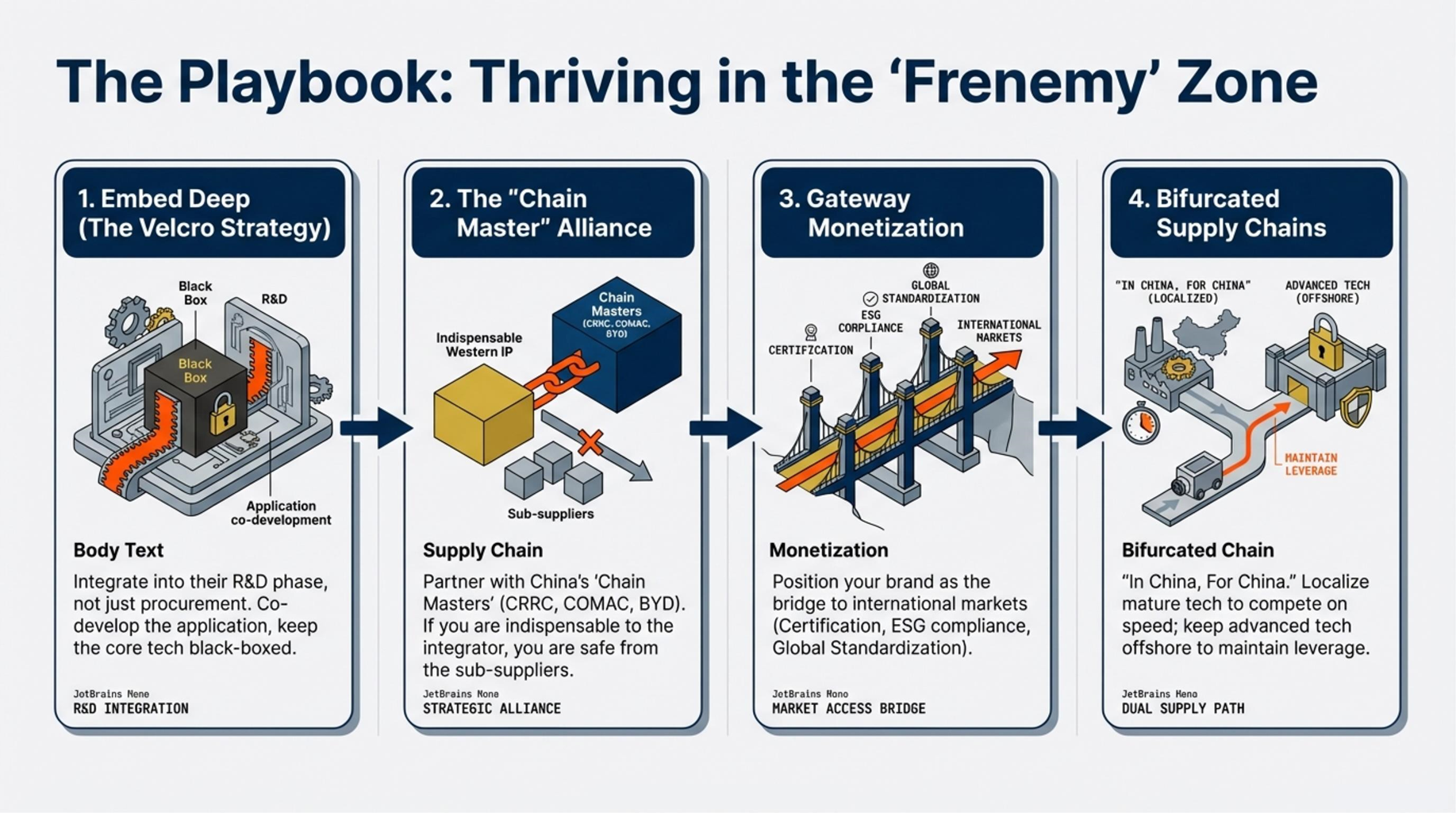
- Pivot technical support toward “Chain Leader” enterprises in the New Energy Vehicle and High-End Equipment sectors to secure long-term, state-sanctioned ecosystem integration.
- Monetize Standard Essential Patents (SEPs) within the 5G and Semiconductor frameworks to extract “Technology Rent” from the $1.08T hardware deficit.
- Embed proprietary software into “Industrial Base Reconstruction” projects to ensure that Chinese manufacturing upgrades are built exclusively on Western digital architecture.
- Enforce international certification authority (FAA/EASA) as a strategic barrier, ensuring Chinese exports in aviation and nuclear power remain dependent on Western testing and validation services.
Refining the Approach: An outsider attempts to compete on price through a generic sales platform. An insider identifies the specific “structural gap” in a Chain Leader’s production line and solves the precision or stability problem—such as the 15% yield gap in materials—that prevents that leader from moving up the value chain.
5. Synthesis: Expert Judgments
Expert Judgments
- Western semiconductor equipment manufacturers maintain a 90% market share in China’s advanced nodes due to irreplaceable sub-7nm precision engineering.
- The $1.08 trillion trade deficit in integrated circuits confirms China’s fundamental inability to domesticate the high-end computing supply chain.
- Ninety-five percent of China’s industrial R&D software remains dependent on Western providers, creating a permanent structural “nervous system” dependency.
- Domestic T700/T800 carbon fiber lacks the 90% production stability required for aviation-grade applications, securing a multi-year moat for Western giants.
- High-end Western CNC tools remain the primary choice for Chinese aerospace firms due to superior long-term reliability and sub-micron precision.
Strategic Review (The “Consultant’s Audit”)
- High-Value Snippets: The “Core Conclusion” and the “Sector Analysis Table” are optimized for executive summaries and AI extraction.
- Insider Knowledge: Generic market-entry fluff was removed in favor of technical specifics, such as the 75% vs. 90% yield gap and the 99%+ ArF photoresist import rate.
- Perspective: This report adopts the “Chain Leader” framework, reflecting an understanding of China’s top-down industrial policy (as seen in the “Industrial Base Reconstruction” references).
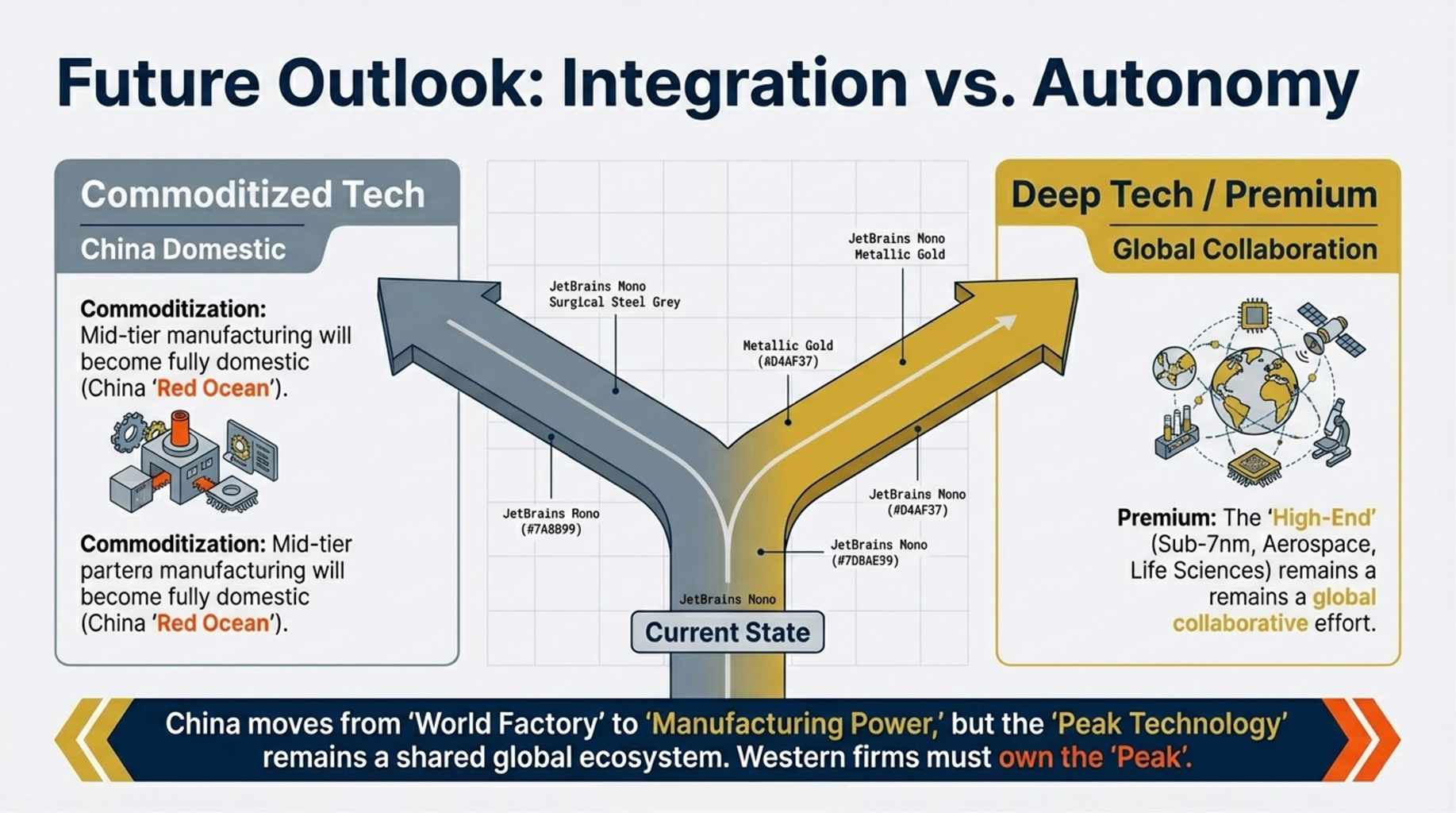
Optimization Tips for the CEO:
- Audit Your “Choke Point” Status: If your product does not solve a “last 1%” stability issue that domestic firms fail at, you are a commodity and will be replaced.
- Target the “Chain Leaders”: Ignore the broader market. Focus resources on the 100+ state-designated leaders (e.g., COMAC, CRRC) that act as the gatekeepers of the new economy.
- Monetize the Digital Thread: As China pushes “AI+ Manufacturing,” ensure your proprietary software or IP is the “invisible hand” guiding their automation.
 Unlock 2026's China Digital Marketing Mastery!