 English
 German
 Korea
Korea Spanish
Competitive Intelligence: The 2025-2026 AI Landscape and New Paradigm for Digital Growth
- On December 8, 2025
- AI marketing, geo seo, marketing 2026
Shifting Brand Strategy from “Content Generation” to “Intelligent Decisioning” Across US, EU, and China Markets
Preface: 2025 – From “Tech Shock” to “Commercial Deep Dive”
If 2023–2024 marked the “Cambrian Explosion” of Generative AI, 2025 is the business world’s “Natural Selection” moment. For global enterprise operators, managing mere “AI anxiety” has become unproductive; it is replaced by a serious, quantifiable interrogation of ROI (Return on Investment).
For marketing executives, the challenge is acute: when search pivots to conversation, and traffic channels shift to compute power, the traditional digital growth flywheel is failing. This report provides a comparative analysis across the US, European, and Chinese markets to reveal the new commercial map and the growth mandates required for the AI era.
Part I. Mapping the Terrain: Global AI Landscape and Marketing Ecosystem Reshaping
The global AI competition has evolved beyond a pure technology race into three distinct and competing ecosystem models. Enterprises must align their technology stack and marketing strategies with the regulatory and market dynamics of their target regions.
1.1 Macro Landscape Restructuring: The Tripartite Game of Compute, Models, and Regulation
🇺🇸 The United States: Defining Power and the “Copilot” Economy
- Landscape Feature: The US, anchored by key players like OpenAI, Google, and Anthropic, holds the standard-setting power over Foundation Models. The market is characterized by a high degree of SaaS integration.
- Marketing Imperative: In the US market, AI is primarily embedded into enterprise productivity suites (e.g., Microsoft 365 Copilot, Salesforce). B2B marketing must prioritize “API Ecosystem Compatibility” . Can your brand’s data and value proposition seamlessly integrate into a client’s core AI workflow? This is the new B2B sales funnel.
🇨🇳 China: Application Power and the “Mobile-First” Breakthrough
- Landscape Feature: While the development of foundational models started slightly later, the market shows extreme velocity in the Application Layer. Local giants like ByteDance (Doubao), Baidu, and Tencent deeply embed AI into closed-loop social, livestreaming, and e-commerce ecosystems. China has become the world’s only at-scale laboratory for Predictive Retail and Online-Merge-Offline (OMO).
- Marketing Imperative: AI in the Chinese market is “mobile-first” and “highly interactive.” From digital human livestreaming to the surge of AI companions (e.g., MiniMax’s Talkie and ByteDance’s Doubao) , marketing increasingly focuses on delivering Emotional Value and driving instantaneous conversion. Surveys show over 60% of young Chinese consumers trust product suggestions from virtual assistants, provided their AI identity is transparent.
🇪🇺 Europe: Access Power and the “Privacy Premium”
- Landscape Feature: The EU AI Act formalized the globe’s strictest regulatory framework, focusing on safety and fundamental rights. This framework has extraterritorial jurisdiction, applying to non-EU entities if their AI system outputs are intended for use within the EU.
- Marketing Imperative: In Europe, “Compliance” is a core competency and a competitive differentiator. Brand marketing must emphasize data transparency, particularly regarding First-Party Data handling under GDPR. High-risk AI systems (e.g., used in credit scoring or hiring) face strict obligations, making systems that ensure traceability and human oversight essential.
1.2 The MarTech “Fusion”: Obsolescence and Rebirth
Data Insight: According to predictions from Gartner and Forrester, traditional digital marketing vendors face a significant obsolescence risk. Forrester’s analysis predicts a market correction where high payback expectations are unmet: only 15% of AI decision-makers report an EBITDA lift from AI in the past 12 months. This disconnect leads enterprises to delay 25% of planned AI spend into 2027.
This failure to deliver concrete P&L value means that traditional vendors unable to integrate generative AI into measurable outcomes will be challenged.
- The Tool Layer Transformation:
- Past: MarTech tools were “Systems of Record,” such as traditional CRM, focused solely on logging customer data.
- Present/Future: MarTech tools are becoming “Systems of Intelligence and Agency.” Examples like Salesforce’s Agentforce not only analyze the customer but are designed to autonomously execute tasks like personalized email outreach and meeting scheduling.
- The Media Layer Shift:
- Platforms are no longer just content distributors but content producers. Algorithms on platforms like TikTok and Instagram are evolving from “recommending content you like” to “generating bespoke content snippets for you.” This presents a fundamental challenge to brand consistency and content licensing.
Part II. Decoding the Landscape: 2025 – The Collapse and Rebuilding of Traffic Rules
2.1 The Traffic Exodus: From SEO to GEO (Generative Engine Optimization)
This represents the most significant paradigm shift in digital marketing in the last decade.
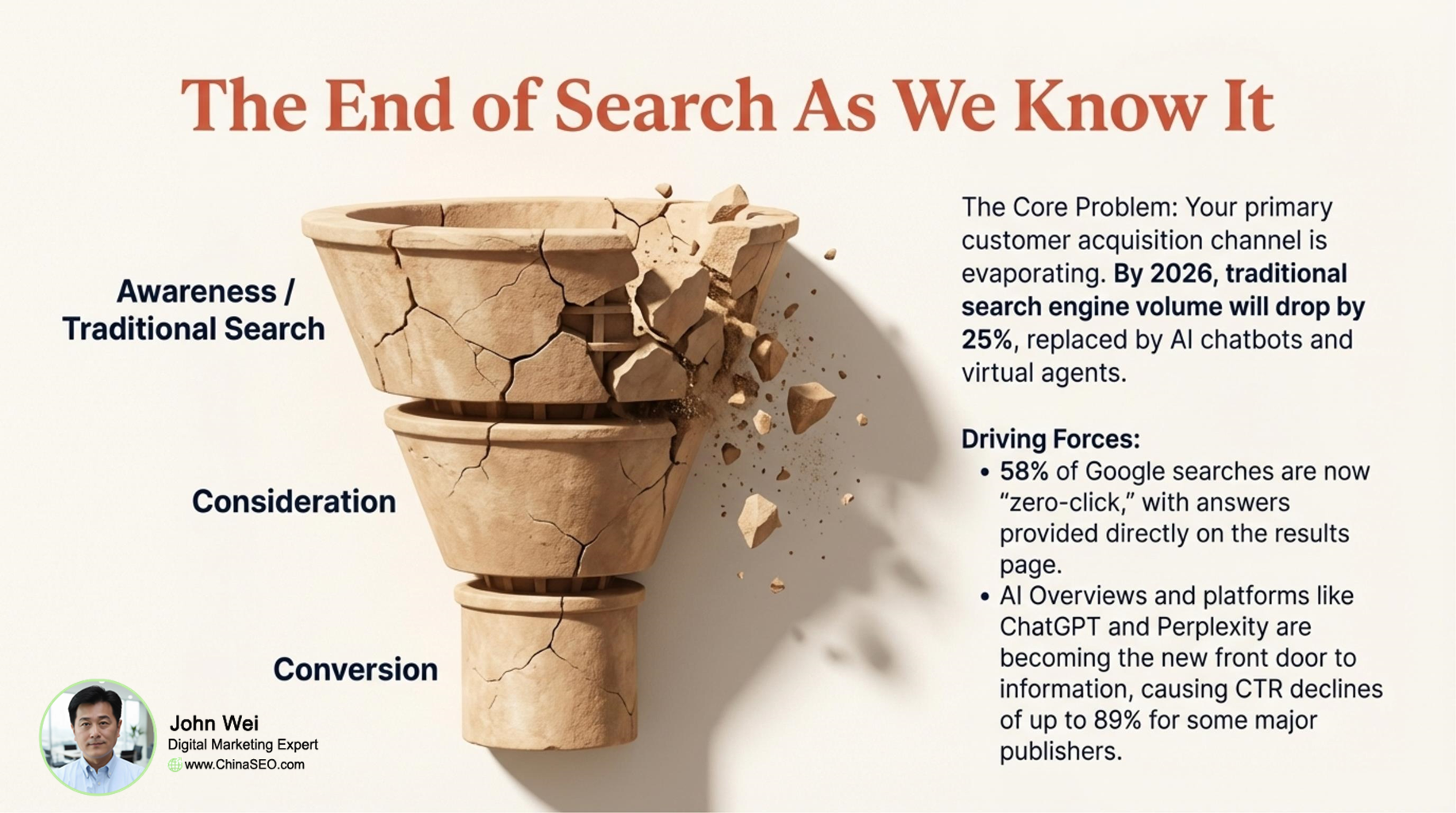
Crisis Warning: Gartner predicts that by 2026, traditional search engine volume will drop by 25% as market share shifts to AI chatbots and virtual agents. The primary reason is that users are no longer typing keywords and scrolling through “ten blue links” but asking direct questions to LLMs (ChatGPT, Perplexity, Google AI Overviews) for a single, synthesized answer.
The New Battleground – GEO (Generative Engine Optimization):
- Definition: GEO is the practice of adapting your digital content and online presence to increase its visibility, retrieval, and citation potential within generative AI outputs.
- Core KPI: The key performance indicator is no longer “Click-Through Rate (CTR)” but “Share of Model/Share of Voice” , meaning how often your brand or content is cited, summarized, or recommended in the final AI-generated answer.
- Strategy Implementation:
- Structured Data Feeding: Content must be highly structured. LLMs extract information more reliably from structured content. Ensure your website and knowledge base utilize logical heading hierarchies (H1/H2) and are formatted with lists, tables, and clear step-by-step guides. Research indicates that 60% of AI responses come from content structured as FAQs.
- Establish Authoritative Sources: AI models prioritize content based on Authority Signals and factual density . PR strategy must pivot from measuring mere coverage volume to securing Earned Citations from sources models trust (high-authority media, analyst reports like Gartner/Forrester, academic journals) . Positioning executives as Subject Matter Experts (SMEs) and publishing original data-driven content strengthens the domain’s E-E-A-T (Expertise, Experience, Authoritativeness, and Trustworthiness).
2.2 The Content Supply Chain Revolution: The Signal-to-Noise Challenge
Current Reality: AI has driven the marginal cost of content production toward zero.
The Double-Edged Sword:
- Pro: Mass personalization and content scale become feasible.
- Con: The internet faces a crisis of “Content Slop” (low-quality, high-volume AI output). This overwhelming influx is dramatically reducing the Signal-to-Noise Ratio. If content creation is driven by “laziness,” brands risk losing engagement and consumer trust.
The Solution: The Authenticity Premium: When content quantity is infinite, “Authenticity” becomes the most expensive luxury and a scarce resource. CMOs must shift focus from content volume to quality and credibility.
- Recommendation: Capture the Authenticity Premium by emphasizing Founder Visibility (88% of consumers trust the founder’s personal brand more than the company’s ) and integrating “Human Verified” labels. Prioritize non-scripted, experience-based content that AI cannot easily replicate, reinforcing the brand’s human core.
2.3 Hyper-Personalization and the “Uncanny Valley” Effect
Technical Capability: AI can now generate real-time, completely different landing pages, product copy, and visuals for every single visitor.
Consumer Psychology (West vs. China):
- Western Users: They are highly sensitive to privacy (driven by GDPR compliance ). If personalization feels too accurate (e.g., “I saw you were chatting about coffee; buy this now”), it crosses the “Creepy Line” and triggers “Uncanny Valley Scenarios,” resulting in strong customer backlash and damaged reputation.
- Chinese Users: They are generally more accepting of the “data-for-convenience” trade-off. However, tolerance for perceived “big data discrimination” remains extremely low.
The Marketing Red Line: Brands must draw a clear boundary between “Knowing Me” and “Monitoring Me.” Future personalization must be based on intent-based prediction rather than privacy intrusion.
Part III. The 2026 Outlook: The Endpoint of Marketing is M2A (Marketing to Agents)
This section analyzes the disruptive trends projected for the next two years.
3.1 The M2A Era: When Your Customer is No Longer Human
Trend Prediction: By 2026, high-value consumers will commonly utilize Personal AI Agents. These Agents will autonomously handle tasks such as comparison shopping, product screening, and even direct purchasing.
The Change in Marketing Target:
- Traditional Marketing: Uses color, emotional copy, and storytelling to appeal to the human, emotional brain.
- Future Marketing (M2A): Must appeal to the rational algorithm of the AI Agent using parameters, API calls, and demonstrable price/specification advantages.
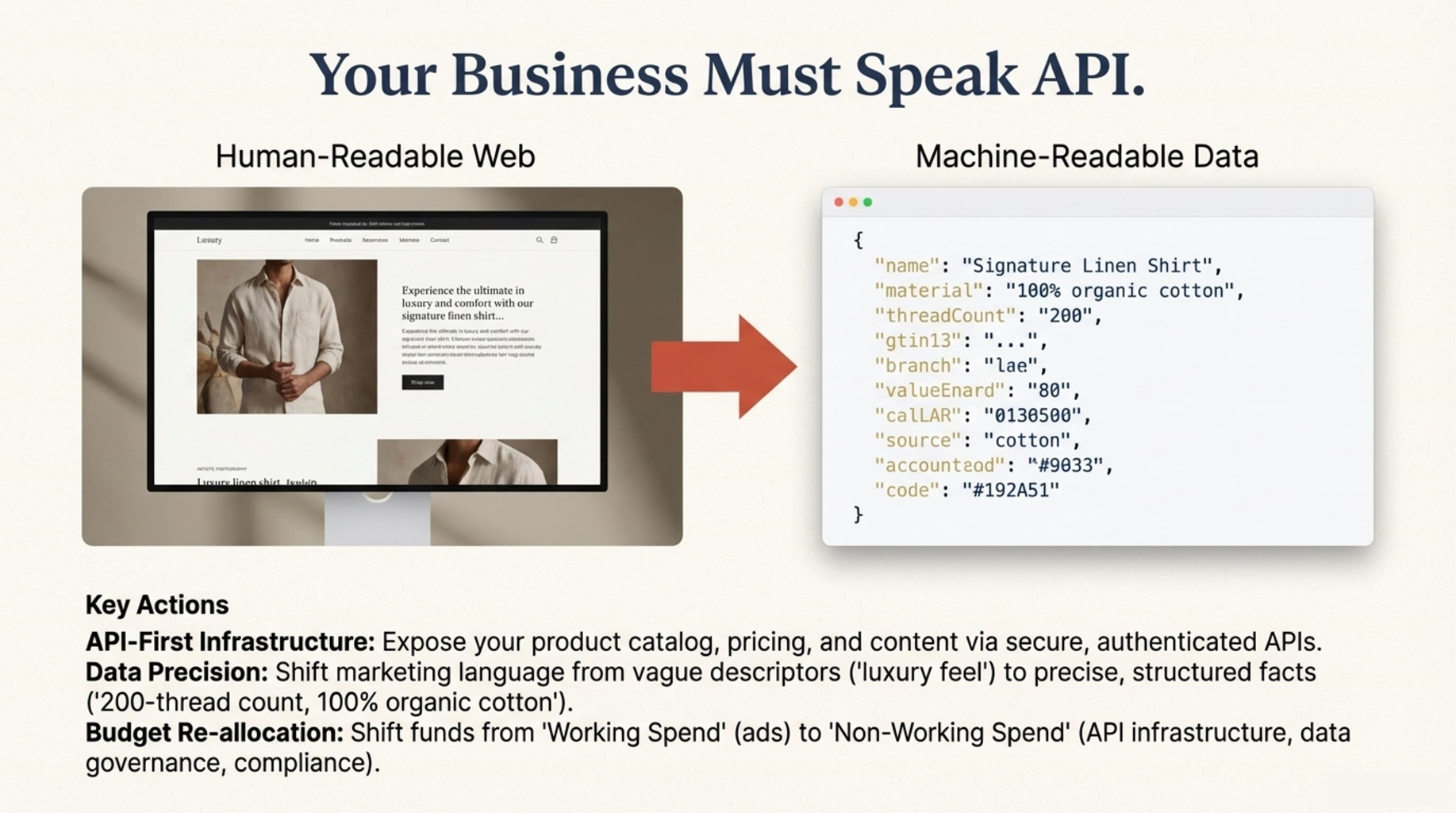
Strategic Action: Enterprises must build “Machine-Readable Brand Assets.” If your product advantage is only articulated in glossy imagery or flowery prose without the underlying Structured Data (Schema Markup, Alt Text, precise parameters), your brand will be invisible in the M2A era.
- API Priority: Building secure, authenticated APIs to provide real-time product, pricing, and availability data is more reliable than relying on web scraping. Real-time accuracy and consistency across all channels are mandatory; agents will avoid sources promoting out-of-stock or incorrectly priced items.
3.2 Spatial Computing and Contextual Marketing Integration
With the increasing adoption of spatial devices (Apple Vision Pro, Meta Ray-Ban), AI moves digital advertising from the “screen” into the “physical world.”
Case Example: A user wearing smart glasses walks past a coffee shop. The AI doesn’t just push a generic coupon; it performs ultra-contextualized recommendations by combining real-time location data with the user’s health metrics (“You haven’t had caffeine today”) and social data (“Your friend Alice rated this latte highly”).
Part IV. Enterprise Response: Building an “AI-Driven” Digital Growth Engine
This section provides actionable guidance for executives.
4.1 The CEO/Decision-Maker’s AI Balance Sheet
- Data Sovereignty: In the post-Cookie era, First-Party Data is the most critical asset. Do not feed all proprietary data to public LLMs. Enterprises must invest in building their own Small Language Models (SLMs) or Retrieval-Augmented Generation (RAG) knowledge bases to ground AI outputs in proprietary, verifiable, and compliance-friendly data.
- Organizational Agility: Break down silos between Marketing and IT. Establish a CAIO (Chief AI Officer) or an AI Growth Team to unify the technology vision, execution, and ROI tracking . The CAIO must have the mandate (authority), including budget control, to drive AI strategy across the enterprise, not just in the lab.
4.2 The Marketing Manager’s Four-Step Action Checklist
For marketing managers requiring rapid deployment:
Step 1: Audit Your Digital Footprint (The GEO Audit)
- Action: Conduct an AI Visibility Audit by querying mainstream LLMs (ChatGPT, Claude, Gemini) using your brand and industry keywords.
- Question: How does AI describe your brand? Does it contain factual errors or recommend competitors? Analyze how your content is being cited (or ignored).
Step 2: Construct the Human-Machine Content Flywheel
- Action: Re-engineer the content production workflow to “AI Generation -> Human Curation -> AI Refinement -> Human Final Approval.”
- KPI Change: Shift away from measuring sheer output volume towards measuring the conversion efficiency per content unit and brand consistency.
Step 3: Upgrade to Full-Channel Intelligent Customer Service
- Action: Upgrade customer-facing Chatbots from simple “keyword matching” to “Emotion-Aware AI” (especially critical for the Chinese market).
- Goal: The AI must not only answer questions but also identify sales leads (Lead Generation) within the conversation and autonomously complete transactions (booking, selling) . This should reduce daily human agent workloads by an average of 1 hour through automation of narrow tasks .
Step 4: Deploy M2A (Marketing to Agents)
- Action: Optimize your website’s Schema Markup (JSON-LD) , ensuring product pricing, inventory, and technical specifications are machine-readable and real-time accurate. Your product advantages must be describable using factual parameters (“100% organic cotton, 200 thread count”) rather than vague marketing language (“luxuriously soft bedding”).
4.3 Risk Mitigation: The Brand Safety Baseline
- Anti-Hallucination Guardrails: Strictly prohibit the direct use of unaudited AI-generated content for customer communication. This is to avoid the risk of the AI making false or legally binding promises (e.g., the widely reported case of the “AI Chatbot offering to sell a car for $1”). Robust deployment requires embedding strict guardrails and clear liability limitations.
- Copyright Isolation: Exercise extreme caution regarding the use of publicly generated images (e.g., Midjourney), where the training data copyright is uncertain . For commercial advertising and brand assets, favor enterprise-grade tools like Adobe Firefly, which offers clearer commercial safety and copyright assurance . Businesses should protect AI-created logos and identifiers via Trademarks since copyright protection for AI output remains legally ambiguous .
The 2025-2026 AI Landscape: Top 10 Executive FAQs
Q1: What is the expected global AI expenditure in 2025, and why is ROI the key concern now?
Global AI spending is projected to reach $1.5 Trillion in 2025. However, the key challenge is value realization: only 15% of AI decision-makers report an EBITDA lift in the past 12 months. This failure to deliver immediate, measurable profits has led enterprises to delay 25% of their planned AI spend into 2027, prioritizing functional over exploratory projects.
Q2: How is digital traffic acquisition fundamentally changing by 2026?
The structure of traffic is collapsing. Gartner predicts that traditional search engine volume will drop 25% by 2026 as market share shifts to AI chatbots and virtual agents. This is accelerated by the rise of “zero-click” searches, which already account for 58% of Google searches in the U.S..
Q3: What is GEO (Generative Engine Optimization), and what is the new key marketing metric?
GEO is the practice of adapting content to improve its visibility, retrieval, and citation potential within generative AI outputs (like Google AI Overviews or ChatGPT). The new core KPI is no longer Click-Through Rate (CTR) but “Share of Model” or “Share of Voice”—the frequency your brand is cited in the final AI-generated answer. Content must be highly structured, as 60% of AI responses come from content structured as FAQs.
Q4: What is the M2A (Marketing to Agents) era, and what is the critical technical requirement?
M2A is the future where Personal AI Agents handle comparison shopping and purchasing on behalf of human customers. The critical technical requirement is ensuring your brand assets are “Machine-Readable.” This means deploying secure APIs for real-time product data and utilizing Schema Markup (e.g., JSON-LD, Product Schema) so agents can find and understand your offerings without human context.
Q5: How should brands prepare their MarTech stack for obsolescence?
Gartner predicts GenAI and AI agents will create a $58 billion market shakeup by 2027, challenging mainstream productivity tools. MarTech tools that function only as “Systems of Record” (storage) are at high risk. Investment must shift toward platforms that are “Systems of Intelligence and Agency”—capable of autonomous prediction, execution, and API integration.
Q6: What is the primary concern for brands operating under the EU AI Act?
Governance and Compliance are paramount. The EU AI Act imposes strict obligations on high-risk AI systems (e.g., used in hiring or credit scoring) , which will be enforced starting in August 2026 and August 2027. Companies must immediately build a repository of all AI models and ensure logging of activity and clear human oversight to maintain traceability and safety.
Q7: How does the China market’s AI paradigm differ from the West?
While the US focuses on B2B productivity, China is driven by the Application Layer and the Emotional Economy. China is an at-scale laboratory for Predictive Retail, OMO, and AI Companions (like ByteDance’s Doubao). This high-trust environment means over 60% of young consumers trust product suggestions from virtual assistants.
Q8: How can brands avoid the “Uncanny Valley” effect of hyper-personalization in the West?
Brands must draw a clear line between “Knowing Me” and “Monitoring Me” to avoid triggering backlash. Excessive personalization, especially if perceived as based on sensitive information or eavesdropping, creates “Uncanny Valley Scenarios” that severely damage brand reputation. Compliance with GDPR, which mandates explicit consent for personal data reuse, is key to maintaining customer trust.
Q9: What is the “Authenticity Premium,” and how is it captured?
As AI drives the cost of content to zero, resulting in “Content Slop,” Authenticity becomes the most expensive luxury and a new competitive advantage. Brands should capture this premium by elevating Founder Visibility (88% of consumers trust the founder’s personal brand more than the company’s ) and by focusing on original research and human-verified expertise.
Q10: What are the key brand safety risks related to AI hallucination and content copyright?
AI Hallucinations pose a legal risk, where an AI can make unauthorized, false promises (e.g., the “AI Chatbot offering to sell a car for $1”). For content creation, there is Copyright Uncertainty—the US Copyright Office cannot prejudge if the use of copyrighted works for training GenAI constitutes “Fair Use”. For commercial work, companies should prioritize enterprise tools like Adobe Firefly for its clearer commercial safety and copyright assurance.
 Unlock 2026's China Digital Marketing Mastery!