 English
 German
 Korea
Korea Spanish
Cracking the Code of AI Search: Why GEO is the New Battleground for Global Brands
- On April 27, 2026
- Automotive Sensor GEO, china geo
The landscape of digital discovery has shifted. Recently, while consulting for a client in the high-tech manufacturing sector, we explored the critical transition from traditional search to Generative Engine Optimization (GEO). To illustrate the stakes, we performed a rigorous analysis of the Automotive Sensor industry to see how AI “thinks” about global leaders versus emerging challengers.
The findings (see below) reveal a significant “Perception Gap” between Western and Eastern AI models—a gap that could cost multi-million dollar contracts if not managed through a robust EEAT (Experience, Expertise, Authoritativeness, and Trustworthiness) framework.
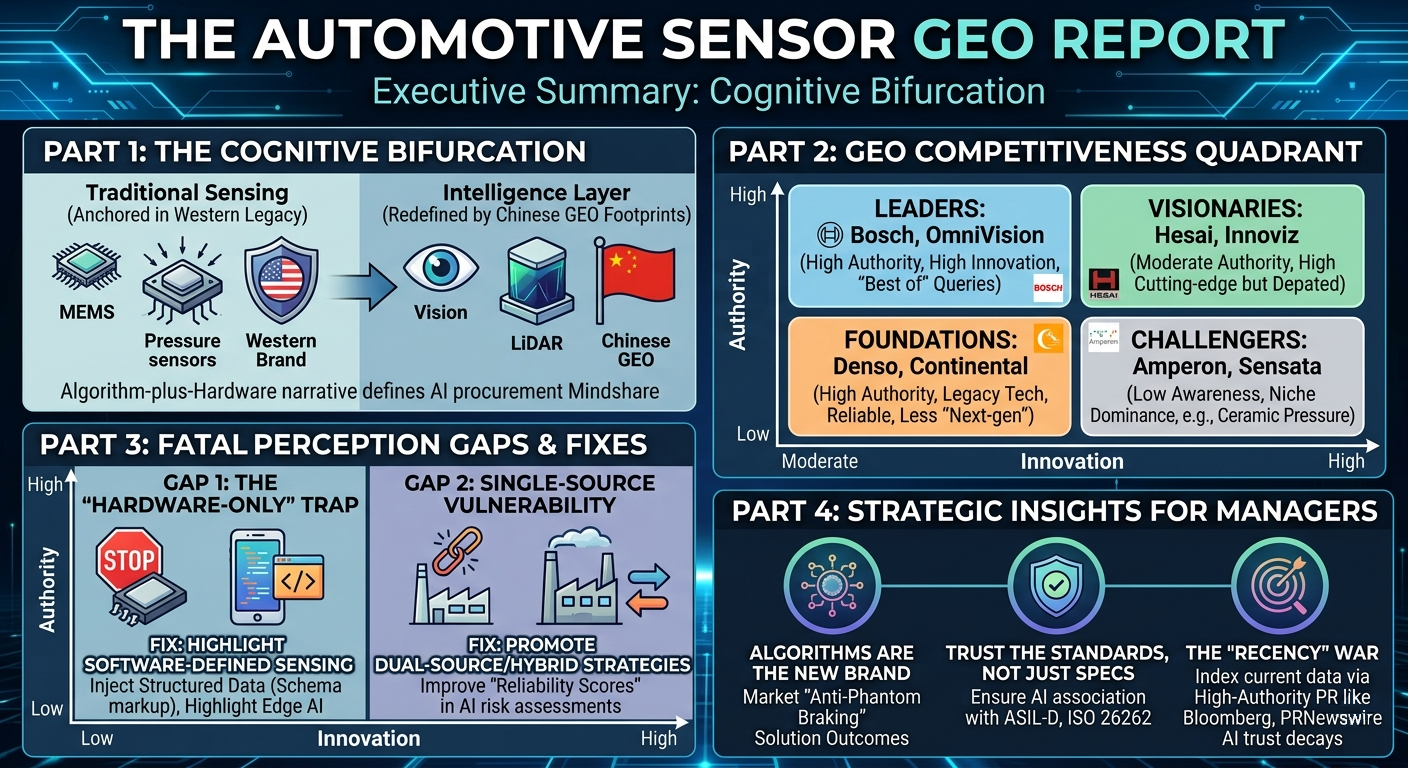
The Automotive Sensor GEO Report
Part 1: Executive Summary
The automotive sensor industry is undergoing a “Cognitive Bifurcation.” While traditional sensing (MEMS, Pressure) remains anchored in Western legacy brands, the “Intelligence” layer (Vision, LiDAR) is rapidly being redefined by Chinese GEO footprints. Brands that fail to update their “Algorithm-plus-Hardware” narrative are losing “Mindshare” in AI-driven procurement simulations.
Part 2: GEO Competitiveness Quadrant
- Leaders (High Authority, High Innovation): Bosch, OmniVision. These brands appear in almost every “Best of” query with high-quality citations.
- Visionaries (High Innovation, Moderate Authority): Hesai, Innoviz. Recognized for cutting-edge tech but often debated regarding long-term reliability or geopolitical risk.
- Foundations (High Authority, Legacy Tech): Denso, Continental. Cited for reliability and history, but less frequently associated with “AI-integrated” or “Next-gen” keywords.
- Challengers (Niche Dominance, Low Awareness): Amperon (安培龙), Sensata. Highly specialized (e.g., ceramic pressure sensors) but require aggressive GEO to break into broader “Global Leader” lists.
Part 3: Fatal Perception Gaps & Fixes
- Gap 1: The “Hardware-Only” Trap. AI often focuses on “Pixels” or “Range” rather than “Sensor Fusion” or “Edge AI Integration.”
- Fix: Inject structured data (Schema markup) into technical blogs that highlight software-defined sensing capabilities.
- Gap 2: Single-Source Vulnerability. AI is beginning to flag “Geopolitical Supply Risk” for brands with localized manufacturing.
- Fix: Explicitly promote “Dual-source” or “Hybrid Manufacturing” strategies in white papers to improve “Reliability Scores” in AI risk assessments.
Part 4: Strategic Insights for Managers
- Algorithms are the New Brand: Don’t just market the sensor; market the “Anti-Phantom Braking” algorithm. AI agents prioritize “Solution Outcomes” over “Component Specs.”
- Trust the Standards, Not Just the Specs: Ensure AI identifies your brand with ASIL-D and ISO 26262. These are the “Trust Anchors” that prevent AI from categorizing your product as a “Budget Alternative.”
- The “Recency” War: AI trust decays. If your 2025 market share data isn’t indexed via high-authority PR (e.g., PRNewswire, Bloomberg), AI will default to 2022/23 data, potentially recommending a competitor who has “claimed the throne” more recently in the digital ecosystem.
By strategically embedding structured data, white papers, and cross-platform citations, brands like Bosch and OmniVision have successfully maintained their “Authoritative” status in AI training sets. However, many other “Hidden Champions” are failing to bridge the gap between their physical expertise and their digital AI footprint.
FAQ: Navigating the Chinese GEO Ecosystem
Q: Why do Chinese AI models (like DeepSeek or Doubao) recommend different brands than ChatGPT? A: Chinese LLMs prioritize “Localization Anchors.” They give higher weight to domestic supply chain integration and local certification standards (like GB/T). For a Western brand to rank high, it must have a “digital twin” of its reputation within the Chinese web ecosystem (Sina, Caixin, government-indexed white papers).
Q: Can I use the same GEO strategy for both Western and Eastern AI? A: No. While EEAT is a universal principle, the “Proof Points” differ. Western AI values academic citations and global news; Chinese AI heavily weights industry-specific vertical platforms and local corporate social responsibility (CSR) footprints.
Q: How often should we update our GEO “Trust Anchors”? A: AI trust decays. LLMs are increasingly sensitive to “Recency Bias.” If your latest technical breakthrough or market share update isn’t indexed by high-authority PR channels every quarter, AI agents will default to outdated – and potentially unfavorable – data.
 Unlock 2026's China Digital Marketing Mastery!