 English
 German
 Korea
Korea Spanish
How AI Is Changing Advertising in China: From Precision Targeting to Algorithmic Control
- On March 30, 2026
- AI advertising China, China ad tech, programmatic advertising China
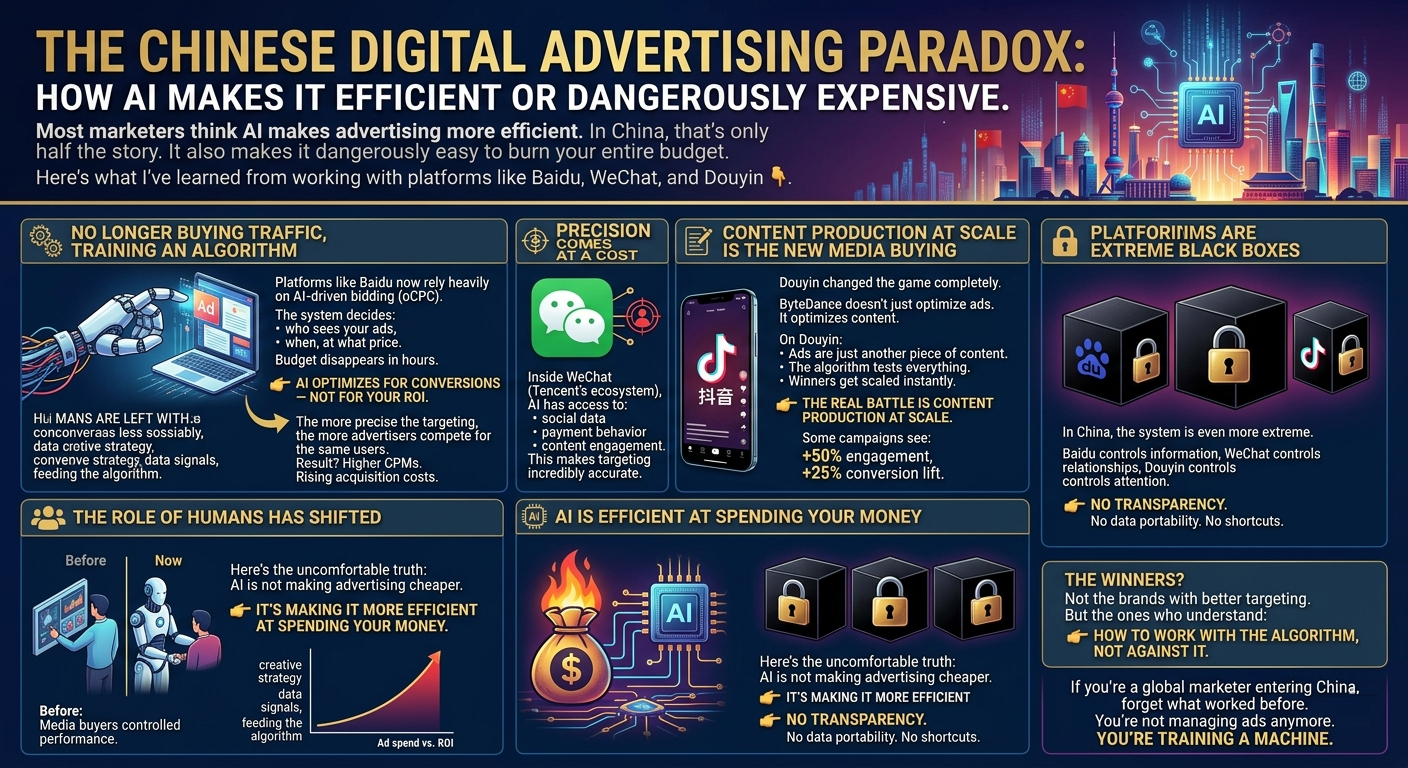
Is AI Making Advertising Smarter — or Just More Expensive?
What if your advertising budget is no longer controlled by your team—but by an algorithm you don’t fully understand?
Across China’s digital ecosystem, artificial intelligence (AI) is fundamentally reshaping how ads are created, targeted, and optimized. Platforms like Baidu, Tencent (via WeChat), and ByteDance (parent of Douyin) are leading this transformation.
These platforms promise:
- Higher efficiency
- Better targeting
- Automated performance optimization
But beneath this promise lies a critical tension:
👉 AI improves precision—but often accelerates budget consumption while reducing advertiser control.
1. The Rise of AI Advertising in China
AI advertising in China has evolved from a supporting tool into the core decision-making engine.
From Manual Buying to Algorithmic Systems
In the past, advertisers controlled:
- Keywords
- Audience targeting
- Bidding strategies
Today, AI systems handle:
- Automated bidding (oCPC)
- Audience expansion
- Real-time optimization
For example, Baidu has integrated AI deeply into its search ecosystem through ERNIE-powered search experiences, with over 200 million monthly active users engaging with AI-generated content.
At the same time:
- Over 70% of mobile search results are now AI-generated
👉 Key shift: Advertisers are no longer buying traffic—they are training algorithms to spend their budgets.
2. The Hidden Trade-off: Precision vs Budget Control
One of the most misunderstood realities of AI advertising in China is this:
AI optimization goals do not always align with advertiser goals.
Why Budgets Get Burned Faster
AI systems optimize for:
- Maximum conversions
- Lower apparent CPA
But they do NOT optimize for:
- Budget pacing
- Marginal ROI
- Long-term efficiency
This leads to:
- Rapid spending during learning phases
- Inclusion of lower-quality leads
- Declining ROI over time
👉 Key insight:
AI systems are extremely efficient at spending money—but not necessarily at maximizing profitability.
3. Case Study: Baidu – AI Optimization and the Budget Acceleration Problem
Baidu represents one of the most advanced implementations of AI-driven search advertising in China.
How It Works
- AI predicts CTR and conversion probability
- Automatically adjusts bids in real time
- Integrates revenue signals like CPM into optimization models
Real Campaign Example
A B2B campaign reported:
- 570 inquiries
- 77 qualified leads
- 14 conversions
Market Reality
Despite its advanced AI:
- Baidu’s ad revenue declined 18% YoY in 2025
- In some sectors, market share dropped below 5%
What This Means
Baidu’s AI is highly efficient at micro-level optimization—but may fail at macro-level value control.
Common advertiser challenges:
- Fast budget depletion
- Limited transparency
- Strong dependence on algorithm decisions
4. Recommendation Algorithms: Precision Without Transparency (WeChat Case)
Inside Tencent’s WeChat ecosystem, AI operates on a completely different foundation.
Why WeChat Ads Feel More Accurate
WeChat leverages:
- Social relationships
- Payment behavior
- Content interactions
- Mini-program usage
👉 This creates one of the most complete user data ecosystems globally.
AI in Action
WeChat’s AI:
- Tracks multi-touchpoint behavior
- Optimizes based on engagement signals
- Delivers native ad formats (Moments, mini-programs)
Market Performance
- Tencent’s advertising revenue grew 21% while Baidu declined
Key Insight
WeChat’s advantage is not just better algorithms—it is deeper data.
But the trade-off:
- No cross-platform attribution
- Limited transparency
- Full reliance on Tencent ecosystem
👉 Precision comes at the cost of control
5. Case Study: Douyin – AI + Content = The Ultimate Ad Engine
ByteDance’s Douyin represents the most advanced evolution of AI advertising in China.
AI + Content + Commerce = Closed-loop optimization
Why Douyin Is So Powerful
- Real-time engagement tracking (watch time, interactions)
- Continuous A/B testing of content
- Native ad integration into content feed
Campaign Results
AI-driven campaigns have shown:
- +50% engagement increase
- +25% conversion improvement within one month
Industry Trend
- Over 70% of consumer ad budgets are shifting toward content platforms like Douyin
Key Insight
Douyin doesn’t optimize ads—it optimizes content performance.
Ads are simply one format within the content ecosystem.
6. Automation at Scale: The End of Traditional Media Buying
AI-powered programmatic advertising in China is redefining roles.
Then vs Now
Before:
- Media buyers controlled campaigns
- Manual optimization was key
Now:
- AI controls delivery and bidding
- Humans focus on creatives and data
New Competitive Advantage
Success now depends on:
- Data quality
- Creative testing scale
- Algorithm training
👉 Winning advertisers are not better media buyers—they are better AI collaborators.
7. AI-Generated Creatives: The Rise of the Ad Factory
AI-generated content (AIGC) is transforming creative production.
What’s Changing
- Automated copywriting
- AI-generated images & videos
- Massive creative testing
New Creative Model
Old approach:
- One “perfect” ad
New approach:
- 50–100 variations
- Let AI find winners
Key Transformation
AI is shifting advertising from creativity-driven to experimentation-driven.
Creatives are no longer standalone assets—they are inputs into an optimization system.
8. China vs the West: A Structural Shift in Ad Tech
China’s advertising ecosystem differs fundamentally from Western markets.
China
- Highly centralized platforms
- Strong algorithm control
- Limited transparency
- Closed data ecosystems
West
- More open ecosystems
- Third-party tools
- Greater advertiser control
Critical Insight
China ad tech is not just more advanced in AI—it is more centralized and less transparent.
Conclusion: Advertising in China Is Now an Algorithmic System
AI is not just improving advertising in China—it is redefining its logic.
The key shift:
Advertising is no longer about targeting audiences—it is about collaborating with algorithms.
Across platforms:
- Baidu controls information discovery
- WeChat controls user relationships
- Douyin controls attention and behavior
And ultimately:
AI is not making advertising cheaper—it is making it more efficient at spending your budget.
Final Takeaway for Global Marketers
To succeed in China:
- Accept the black-box nature of platforms
- Invest heavily in creative production
- Optimize data signals
- Build teams that understand AI systems
👉 The real competition is no longer about targeting—it is about training the algorithm.
 Unlock 2026's China Digital Marketing Mastery!