 English
 German
 Korea
Korea Spanish
How AI Will Transform Marketing Inside China’s Super-App Ecosystems
- On March 13, 2026
- China’s ecosystems, China’s Super-App Ecosystems
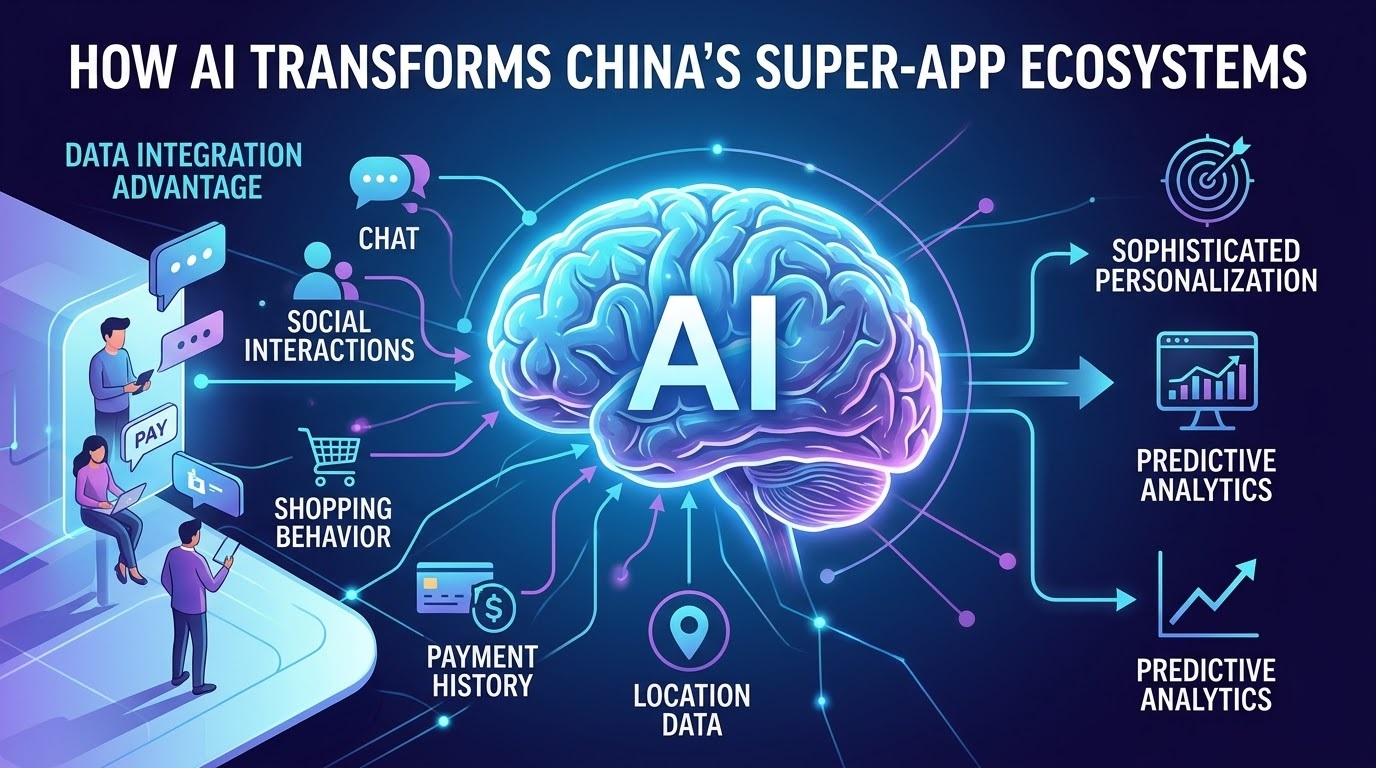
Artificial intelligence is reshaping marketing everywhere, but nowhere may the transformation be as dramatic as inside China’s super-app ecosystems.
Unlike many Western markets, where digital marketing is spread across numerous platforms and tools, China’s digital landscape is dominated by integrated ecosystems that combine communication, commerce, payments, and content distribution.
These ecosystems create a unique environment where AI can operate across the entire customer journey.
For marketers, this could redefine how brands interact with consumers.
What makes super-app ecosystems unique
Super-app ecosystems combine multiple digital services within a single platform.
Users can communicate with friends, discover products, consume content, and make purchases without leaving the app.
This creates an environment where nearly every user action generates valuable data.
From an AI perspective, this integrated environment provides an extraordinary advantage.
AI systems can analyze:
- social interactions
- shopping behavior
- content engagement
- payment history
- location data
This level of data integration enables far more sophisticated personalization.
AI-powered discovery
One of the most important areas where AI is transforming marketing is content discovery.
In super-app ecosystems, AI algorithms already play a major role in deciding which content users see.
These systems analyze enormous volumes of behavioral data to determine what content is most likely to generate engagement.
For brands, this means marketing success increasingly depends on understanding how AI recommendation systems work.
Instead of simply purchasing advertising space, marketers must learn how to create content that performs well within algorithm-driven distribution systems.
Conversational commerce
AI is also enabling new forms of conversational commerce.
Consumers increasingly interact with brands through messaging interfaces.
AI-powered assistants can respond to customer questions, recommend products, and guide users through purchasing decisions.
This creates a marketing environment where customer service, sales, and brand engagement merge into a single continuous interaction.
Predictive personalization
Because super-app ecosystems control extensive user data, AI can build detailed behavioral profiles.
This allows marketing systems to anticipate user needs before they are explicitly expressed.
For example, AI systems may recommend products based on:
- past purchases
- recent browsing behavior
- social activity
- seasonal trends
This predictive capability significantly increases conversion rates.
Closed-loop marketing
One of the most powerful aspects of AI within super-app ecosystems is the possibility of closed-loop marketing.
In this model, the entire marketing cycle occurs within a single environment.
AI can:
- generate marketing content
- distribute campaigns
- track engagement
- analyze conversions
- automatically optimize future campaigns
Because all the data exists within the same ecosystem, optimization can happen extremely quickly.
Challenges for brands
Despite these advantages, AI-driven marketing in super-app ecosystems also presents challenges.
Brands must rely heavily on platform algorithms and data systems.
This creates dependencies that can limit strategic flexibility.
Companies must balance the efficiency of ecosystem integration with the need to maintain independent brand assets.
Conclusion
China’s super-app ecosystems provide one of the most powerful environments for AI-driven marketing in the world.
By integrating data, communication, and commerce, these platforms allow AI to operate across the entire customer journey.
For marketers, mastering this ecosystem may become one of the most important competitive advantages in the coming decade.
 Unlock 2026's China Digital Marketing Mastery!