 English
 German
 Korea
Korea Spanish
How China’s E-commerce Platforms Transform AI into Infrastructure: Strategic Lessons for Western Brands
- On February 23, 2026
- China e-commerce platforms, China e-commerce platforms AI
1. Executive Mandate: The Paradigm Shift to “AI as Infrastructure”
In the China market, artificial intelligence has transcended its status as a “business-plus” additive; it is now a “business-base” utility. Similar to electricity or water, AI functions as the essential grid through which all commerce, logistics, and consumer interactions flow. For Western boards, acknowledging that platform-level AI is an operational baseline—not a luxury—is critical for survival. Western leaders must shift their perspective from viewing AI as a productivity tool to treating it as total-stack infrastructure.
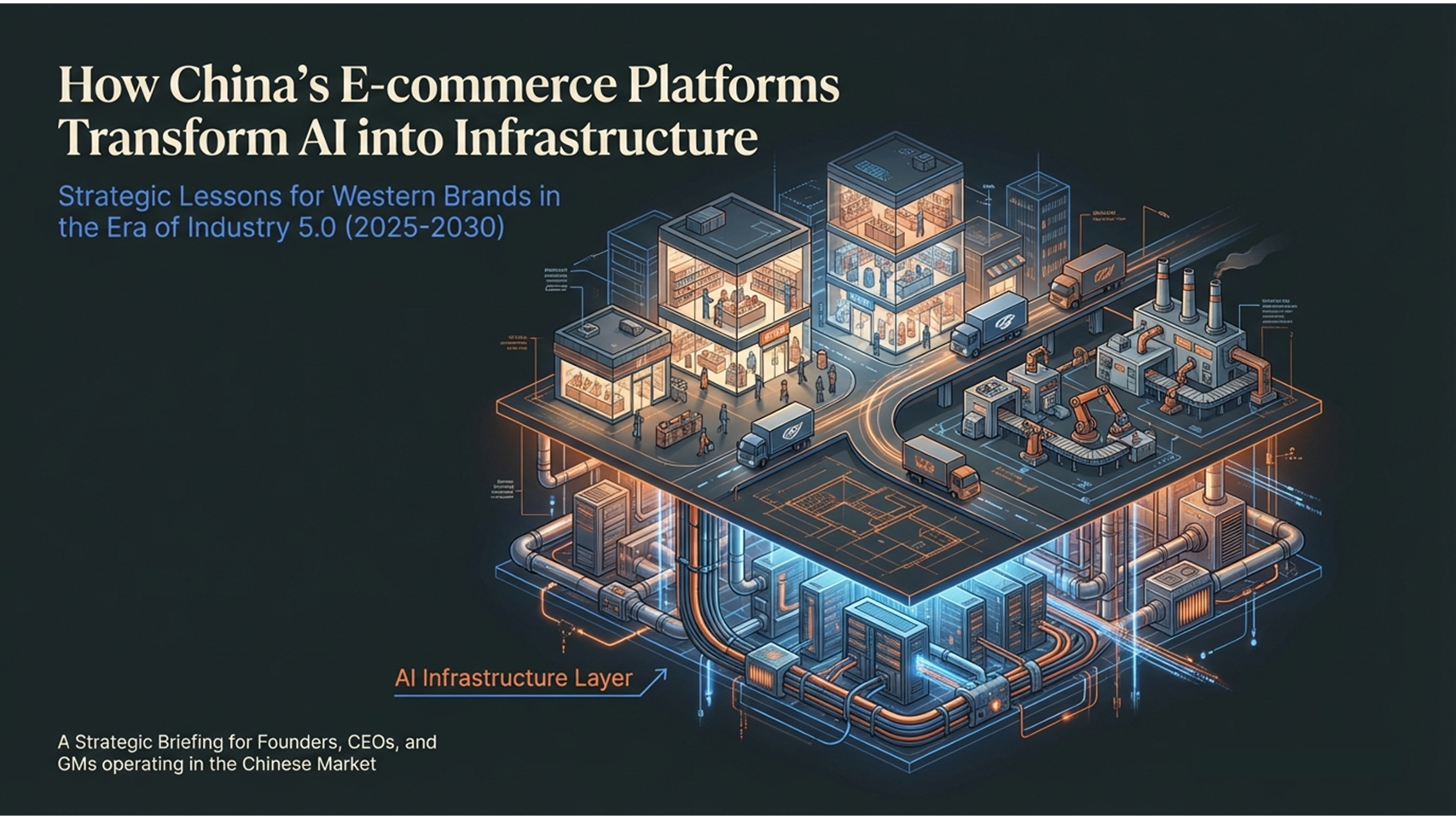
Core Conclusion | Expert Judgment In the current Chinese landscape, AI is no longer a competitive advantage; it is the fundamental operating system. For Western firms, full integration into this AI-driven infrastructure is the mandatory minimum for market entry and sustained relevance.
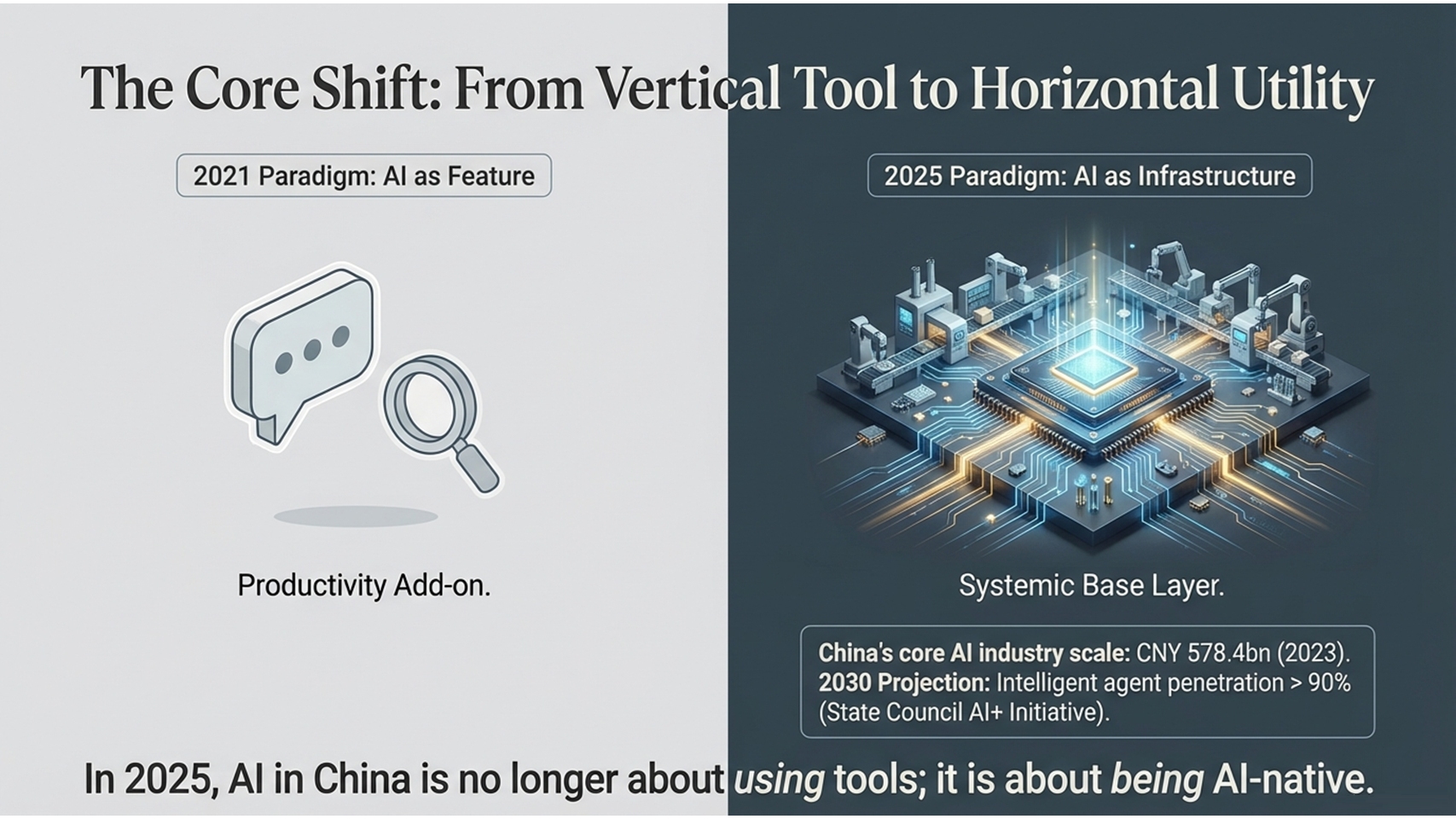
Why This Holds True in the China Market
- Because of the National “AI Plus” Mandate: The 2025 “AI Plus” initiative dictates a roadmap where the penetration of intelligent terminals and AI agents must exceed 70% by 2027 and 90% by 2030, transforming AI from a feature into a national utility.
- Because of Platform Centralization: Alibaba’s “data middle platform” has successfully broken down information silos, allowing AI to synchronize over 2,000 suppliers and 300 logistics partners in real-time, effectively automating the entire supply chain.
- Because of Utility-Scale Compute: The barrier to entry for specialized AI has vanished; Alibaba Cloud’s RMB 380 billion investment plan has commoditized full-stack AI services, resulting in over 180,000 derivative Qwen models that function as specialized “micro-utilities.”
These insights are derived from ground-truth execution in cross-border B2B SaaS localization and advising Tier-1 luxury brands on digital re-entry strategies within the mainland ecosystem.
Direct Business Impact for Western Companies Western companies that misjudge this transition face terminal strategic risks. Failure to adopt platform-level AI infrastructure leads to immediate Customer Acquisition Cost (CAC) escalation and severe conversion friction. Consumers now demand “predictive commerce”—where the infrastructure anticipates their needs before they are articulated—and anything less is viewed as a functional failure. This infrastructure is physically manifested through the divergent models of China’s “Big Three” platforms.
2. The Tri-Model Anatomy of Chinese AI Infrastructure
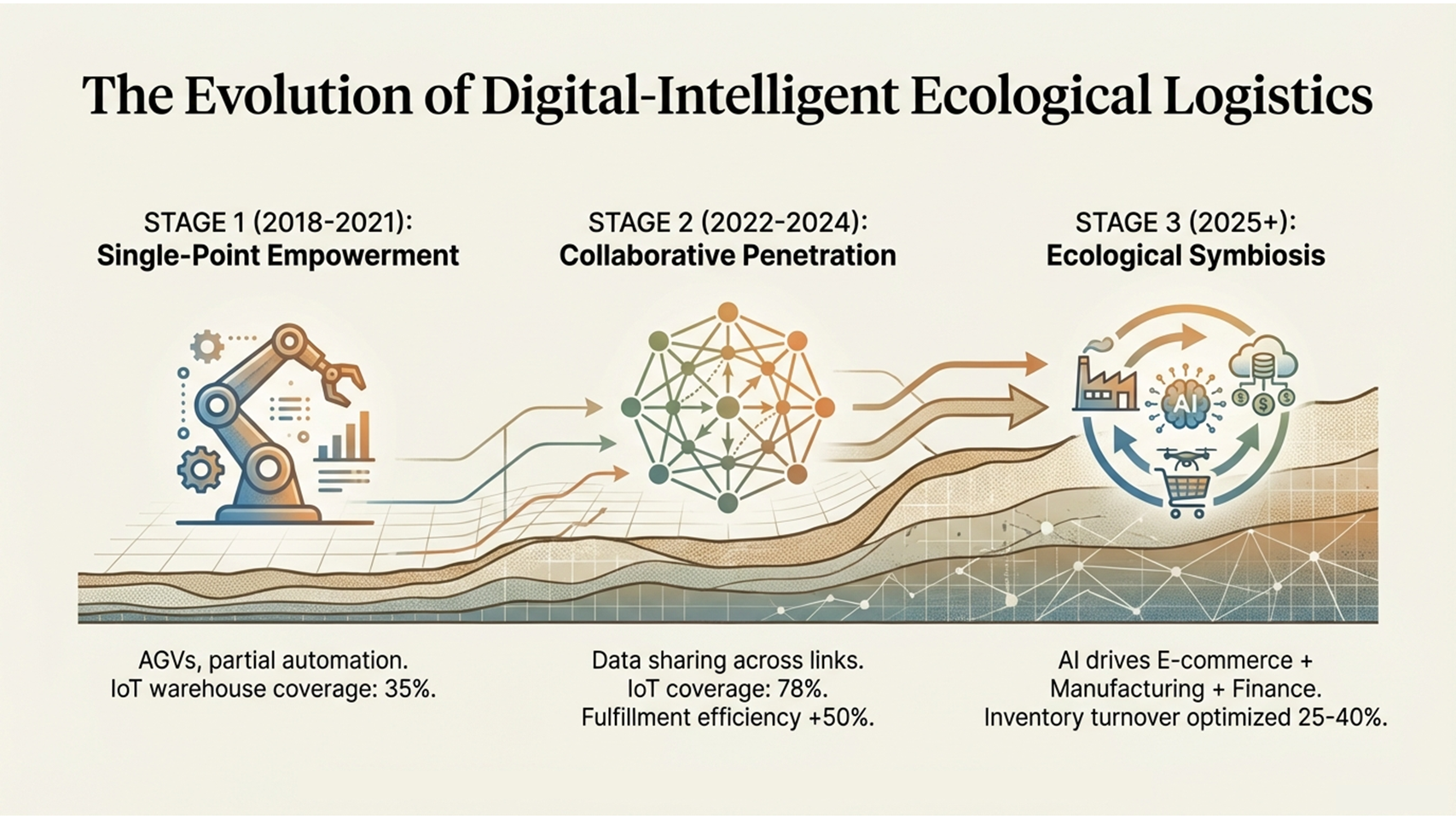
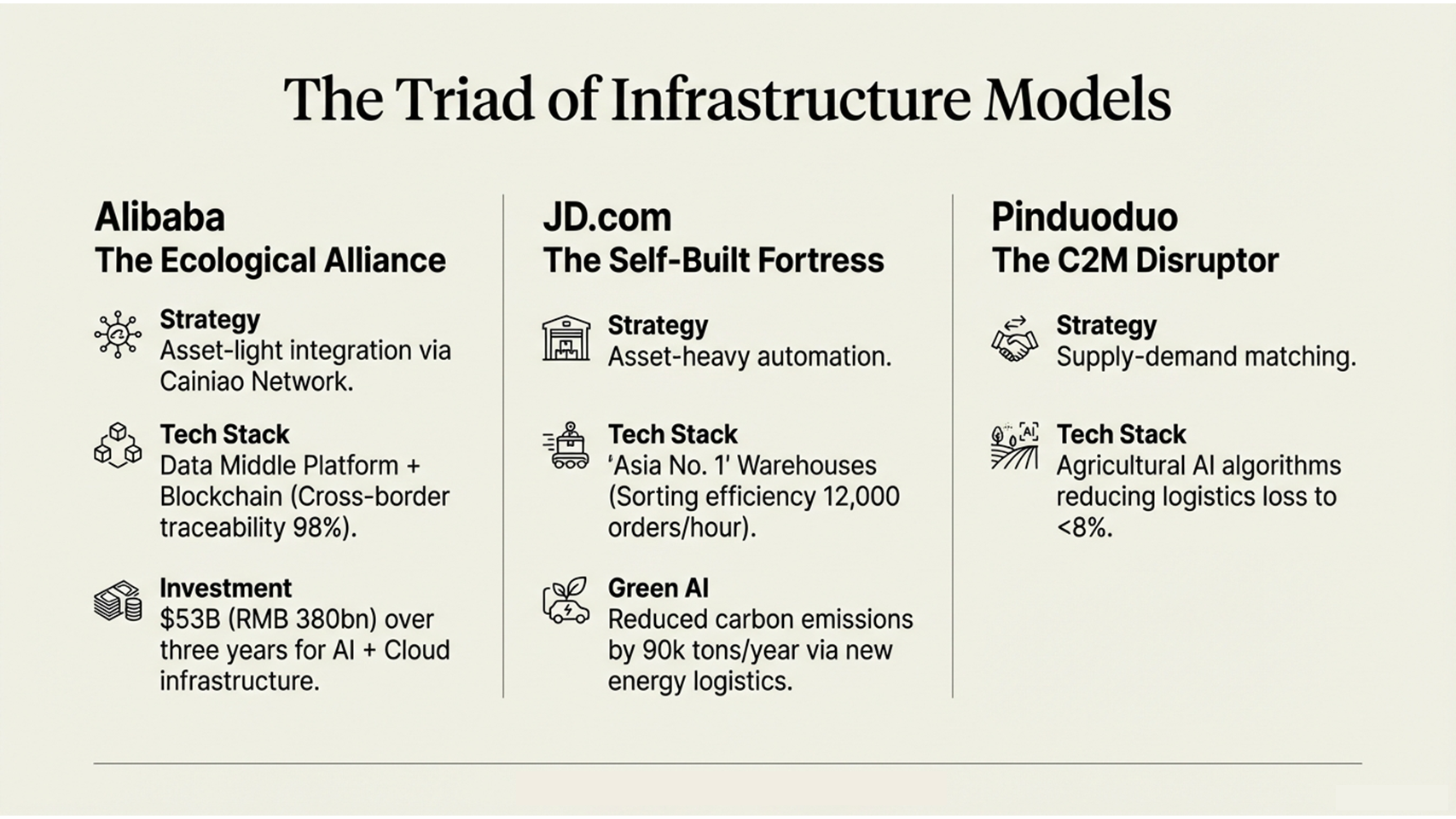
The 2024–2025 period marks a definitive transition into “Ecological Symbiosis,” where AI acts as the connective tissue for disparate business units. Alibaba, JD.com, and Pinduoduo have constructed divergent yet integrated AI foundations that Western brands must navigate with precision.
Comparative Analysis of Platform AI Infrastructure
| Platform | Infrastructure Type | Core AI Mechanism | “So What?” (Strategic Impact for Western Brands) |
| Alibaba | Ecological Alliance | Cross-border blockchain and 180,000+ Qwen derivative models; 50% reduction in recycling costs via “Energy Expert.” | Western brands can leverage a standardized “operating system” to sync global supply chains with local demand while fulfilling green-logistics mandates. |
| JD.com | Self-built Technology | 8-hour core-city fulfillment; “Asia No. 1” automated clusters reducing carbon by 90,000 tons via 20,000 NEVs; PUE 1.200. | Essential for premium brands requiring high-timeliness fulfillment and verified carbon-neutral delivery to appeal to eco-conscious consumers. |
| Pinduoduo | C2M Empowerment | Demand-led algorithms compressing production from 60 to 36 days; 1.07 trillion RMB GMV in Q1 2025. | Inventory risk elimination through demand-led production; allows brands to penetrate Tier 3-4 markets via rapid, data-driven “Pull” manufacturing. |
These platform utilities are the engines that have powered the breakthrough successes of global leaders who stopped treating China as a sales channel and started treating it as an AI laboratory.
3. Case Studies in AI Mastery: L’Oréal, Starbucks, and Nike
Top-tier Western brands have achieved success by treating platform AI as their primary R&D and engagement laboratory rather than a mere distribution outlet.
L’Oréal: Full-Stack AI Collaboration
L’Oréal has integrated its operations into the Alibaba Cloud AI infrastructure, deploying a specialized AI Agent powered by Qwen. This agent provides beauty advisors with a localized knowledge base for skin-care Q&A and R&I innovation. By moving its IT logic to an AI-native framework, L’Oréal has accelerated its software development and transformed into a digital-first beauty consultant.
Starbucks: Mobile-Innovation Synergy
Starbucks has successfully blended physical retail with high-intent digital signals, where 70% of orders now flow through WeChat AI mini-programs. By integrating with Alibaba’s delivery infrastructure for same-hour fulfillment in Tier 1 cities, the brand leverages the platform’s “nervous system” to manage real-time inventory and delivery logistics at a scale impossible with standalone apps.
Nike: Supply Chain Optimization
Nike has optimized its cross-border operations by utilizing platform-level predictive analytics and AR-driven virtual showrooms. By aligning its “Pull” logistics with platform-level demand signals, Nike reduced cross-border delivery times to a 3–7 day range. This integration turns logistics into a competitive brand moat, ensuring premium products reach consumers with near-local speed.
4. The Compliance Foundation: Navigating the Regulatory Base
In China, AI infrastructure is inseparable from state-level governance. The Global AI Governance Action Plan and domestic regulations treat compliance as a strategic asset. For Western brands, compliance is the enabler of the action framework, not a separate hurdle.
Mandatory Compliance Assets for Western Brands
- Algorithm Transparency & Filing: Under the Algorithmic Recommendation Provisions, brands must disclose algorithm logic. The Labelling Measures (GB 45438-2025) mandate that all AI-generated content (AIGC) must be identified through both explicit visual labels and implicit metadata-level technical labels.
- Data Sovereignty & Privacy: To comply with the Personal Information Protection Law (PIPL), brands are adopting “Privacy-Preserving Computation” (Federated Learning/Differential Privacy). This allows for high-value consumer data analysis without moving sensitive data from secure, compliant locations.
- Ethical Review & “Red Lines”: The MIIT Draft Measures include a “List of AI Technology Activities Requiring Expert Second Review.” This specifically targets AI systems capable of “mobilizing public opinion” or “shaping social consciousness.” Brands must establish internal Ethics Committees to oversee marketing algorithms that could cross these regulatory red lines.
5. Executing on the China AI Utility
The following strategies are the minimum entry requirements for a Western brand to remain competitive in a 2026+ context. These are not options; they are the new operational baseline.
- Deploy AI Agents (Qwen-based) for WeChat and Douyin specialized consumer knowledge bases. Use Model Studio’s ADK (Agent Development Kit) to translate intricate business needs into executable agent logic for 24/7 engagement.
- Integrate C2M “Pull” Logistics for sinking-market (Tier 3-4) product customization. Move from “Push” logistics to demand-led production to eliminate inventory backlog and reduce the production cycle by up to 40%.
- Adopt AI “Energy Expert” Platforms to fulfill 2025 green-logistics reporting requirements. Utilize AI to track and reduce carbon emissions, as seen with JD’s reduction of 90,000 tons annually.
- Embed Implicit AI Labels in all AIGC content. Ensure metadata-level compliance to mitigate regulatory risk and prevent de-indexing by platform search algorithms.
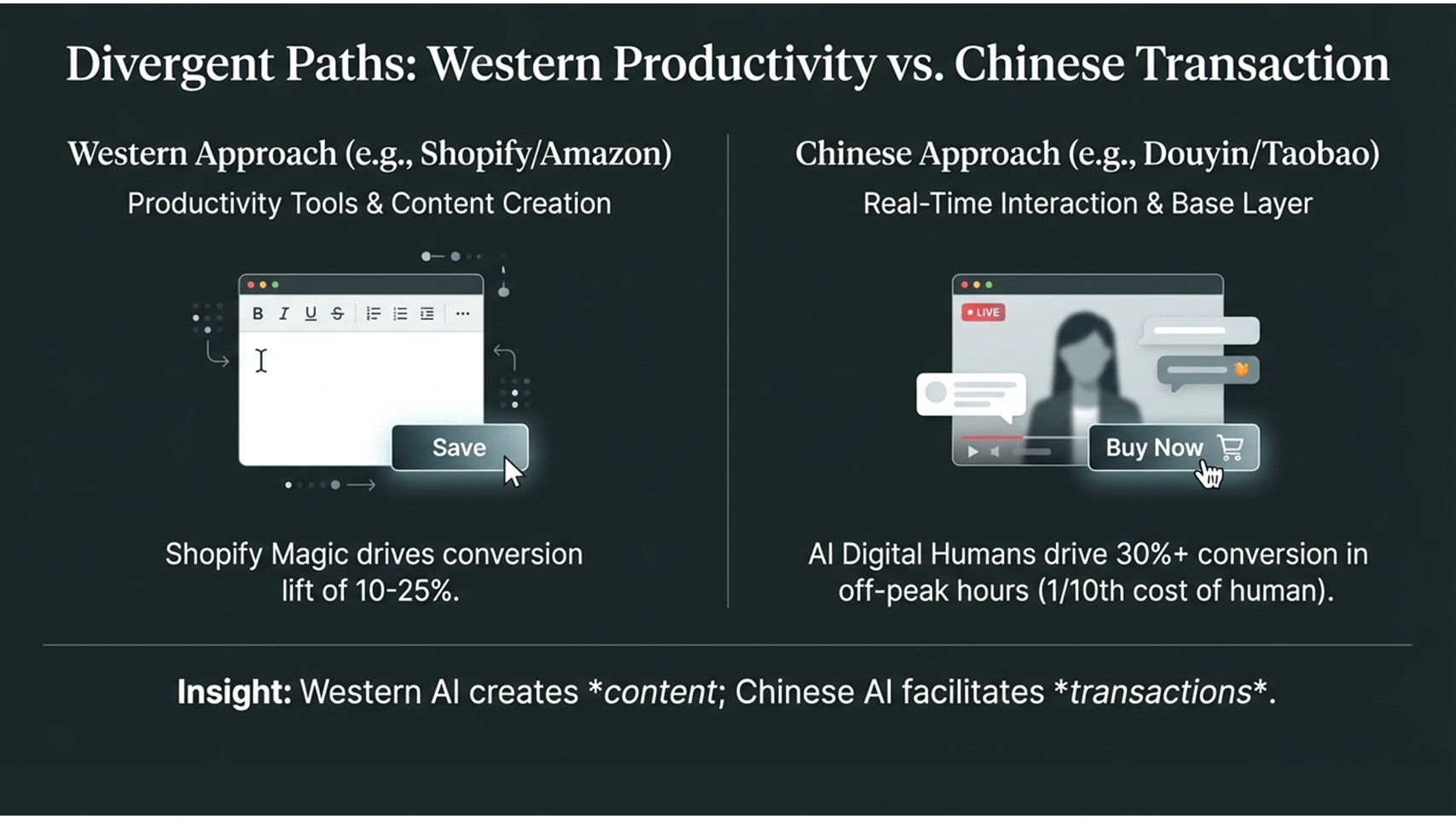
- Scale Live-streaming via “Yanxi” Digital Humans. Capture non-peak hour Gross Profit Margin (GPM) by using digital anchors. These operate at 1/10th the cost of human anchors while maintaining standardized professional sales quality.

6. Expert Judgment Summary & Common Misjudgments
The “survivorship bias” among Western brands often leads to the fatal belief that global brand equity can compensate for local technical gaps. In reality, over-prioritizing creative storytelling while underestimating distribution control through the AI infrastructure is a terminal strategic error.
Strategic Judgment Sentences
- In real China operations, Western companies that ignore local AI labeling mandates face immediate de-indexing by platform search algorithms.
- In real China operations, treating AI as a marketing gimmick rather than a logistics utility leads to unmanageable inventory turnover rates.
- In real China operations, successful brands use C2M data to dictate production, moving from push to pull logistics systems.
- In real China operations, the “Asia No. 1” automated fulfillment standard has made traditional delivery speeds obsolete for premium consumers.
- In real China operations, privacy-preserving computation is the only viable path for high-value consumer data analysis under current regulations.
Conclusion: Why This Insight Matters
These judgments are based on long-term execution and non-theoretical analysis of the world’s most advanced digital marketplace. While Western AI remains largely a productivity tool, Chinese AI has become the market’s nervous system.
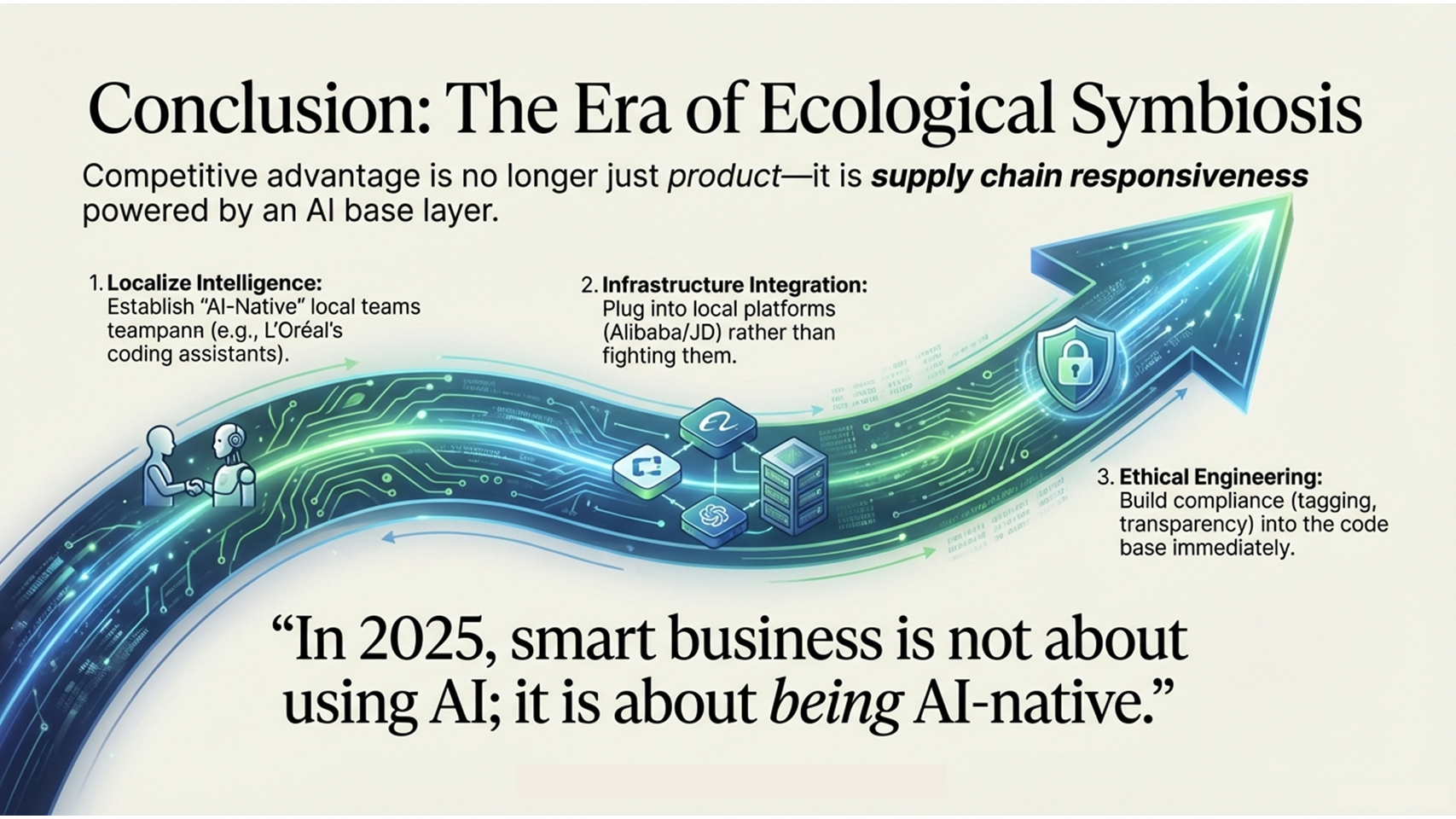
For a Western brand, operating in China without deep AI infrastructure integration is like operating a factory without a connection to the power grid—it is fundamentally unsustainable. Embracing this “AI as Infrastructure” paradigm is the only way to secure a position in the future of global retail. Failure to integrate is not a missed opportunity; it is an exit from the market.
 Unlock 2026's China Digital Marketing Mastery!