 English
 German
 Korea
Korea Spanish
Marketing Reimagined: The Multi-Modal AI Revolution and Enterprise Growth Strategy in the Age of Intelligent Perception
- On November 25, 2025
- AI marketing, ai marketing strategy, marketing ai
The New Foundation for Business in the Agent Era
The evolution of Artificial Intelligence has reached an inflection point, rapidly transitioning its role from a mere Process Optimizer to an Intelligent Agent capable of contextual awareness, complex reasoning, and physical execution. This profound shift in AI’s identity fundamentally changes how humans interact with technology and consume information. For business owners and marketing managers, the traditional marketing playbook, centered on “traffic acquisition,” is becoming increasingly inefficient in this new ecosystem.
The central thesis of this report is that businesses must immediately pivot their growth strategy from a traffic war to a new paradigm focused on Scenario Embedding and Problem Solving. The breakthroughs in multi-modal AI—which allow systems to see, hear, and understand context—offer an unprecedented opportunity to optimize product application scenarios (the expanded concept of GEO, or Contextual Optimization). This shift demands a radical restructuring of marketing assets, making content actionable and adoptable by AI. This report provides a strategic blueprint for capturing the next curve of growth within this intelligent ecosystem.
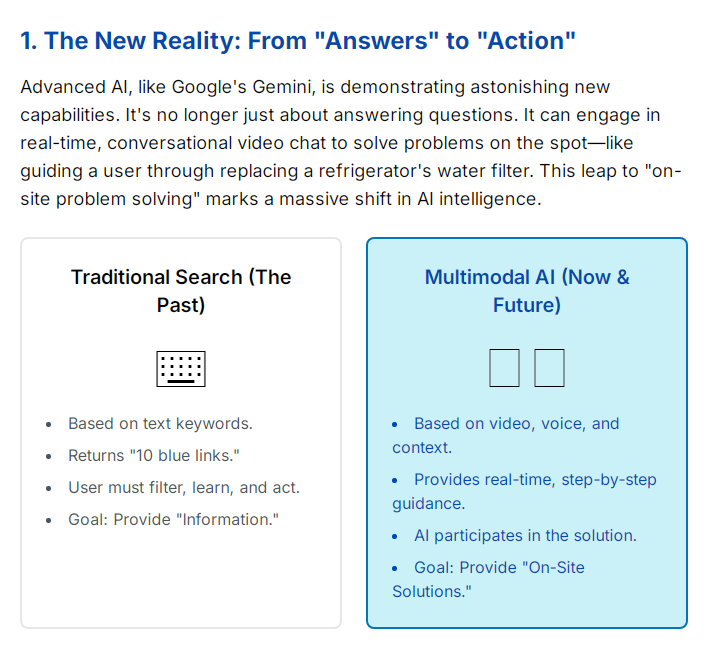
1, Multi-Modal AI’s Perceptual Leap and On-Site Intelligence
The startling intelligence of current AI models is primarily driven by the rapid development of native multi-modal capabilities, enabling AI to perceive complex, unstructured information from the physical world and engage in real-time interaction.
1.1 Global Frontier Technology: Gemini 1.5 Pro’s Native Vision and Video Understanding
Google’s Gemini 1.5 Pro model has broken through traditional text boundaries by natively supporting image and video comprehension.1 This transforms the AI from an information retriever into a profound analyzer of context.
A core capability lies in real-time reasoning and object detection. The model can provide detailed descriptions, answer questions, and perform complex reasoning over images, while adjusting the description’s length, tone, and format based on the prompt. Furthermore, Gemini can detect objects within an image and output their bounding box coordinates. This is a foundational capability for “what you see is what you get” real-time interaction and for precisely locating product malfunctions in the physical world.
Gemini excels at processing complex, unstructured data. It can handle over 1,000 pages of PDF documents or videos up to 90 minutes long, leveraging native vision to accurately transcribe tables, interpret complex multi-column layouts, charts, sketches, and even handwritten text. For instance, Gemini was successfully tasked with extracting revenue figures from 15 Alphabet earnings releases (152 pages total), creating an aggregate table, and generating matplotlib code for visualization. This demonstrates AI’s ability to move beyond text extraction to deeply understand the structure and relationship within visual information and convert it into actionable data.
Moreover, the model exhibits a trend toward embodied intelligence by understanding “real-world” documents. It can extract information from images of receipts, labels, signs, and handwritten notes, returning the data in structured formats like JSON objects. This provides the technical basis for businesses to convert unstructured, on-site data directly into business process inputs.
1.2 Key Developments in the Asian Market: Ant’s “Lingguang” and Execution Capability
In the Asian tech landscape, Ant Group’s “Lingguang” (meaning ‘Inspiration’ or ‘Flash of Insight’) has been introduced as an all-modal general AI assistant, strategically positioned for the demands of AGI.
“Lingguang’s” core competitive advantage lies in its mobile application and execution power. It can generate editable, interactive, and shareable “mini-applications” (Flash Apps) on mobile devices from a natural language prompt in under 30 seconds. This capability—transforming dialogue into code and then into an executable application—drastically shortens the user’s path to a solution.
“Lingguang” supports all-modal information output, including 3D, audio/video, charts, animation, and maps.2 Its initial feature, “Lingguang Kaiyan” (On-Site Visual Recognition), clearly suggests its capacity for real-time visual recognition and interaction within a live environment. Coupled with its all-modal support, this enables AI to complete complex on-site tasks, such as guiding a user to change a refrigerator filter, which requires real-time understanding of the user’s environment, the product model, and the sequence of steps.
1.3 Deep Analysis: AI’s Leap from ‘Information Retrieval’ to ‘Context-Aware Execution’
The most profound change brought by multi-modal AI is the shift in its role. Previous AI focused on providing information fragments; current AI, whether it is Gemini extracting JSON from a real-world receipt or Lingguang generating an executable application, can comprehend unstructured data in the physical world and translate it into actionable, structured output. This means AI has crossed the threshold from “tell me the answer” to “help me act.” For businesses, relying solely on two-dimensional text and image content will quickly become inefficient if AI can understand operational processes and the geometric relationships of objects in a video.
Therefore, corporate content assets must undergo a “3D Transformation,” adopting multi-modal depth and structure to ensure AI can accurately function as “on-site technical support”. This mandates that content producers must master the specifications for generating structured data and rich media (such as 3D models and interactive videos) to suit AI’s new role as an executor.
2, The Profound Disruption of Search Behavior: The Solution-Driven User Journey
The intelligence amplification of AI is fundamentally influencing how people seek information and solve problems. The efficiency of the traditional keyword search model is eroding as users demand “on-site solutions”.
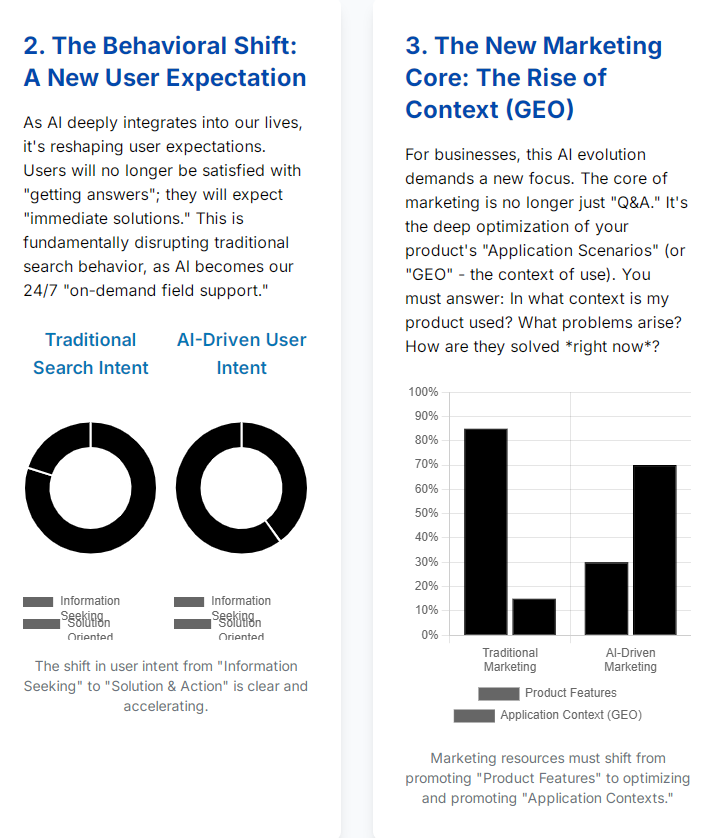
2.1 The Eroding Efficiency of Traditional Keyword Search
Google, the global search giant, is aggressively reshaping search. The new AI Mode is no longer limited to traditional “keyword matching”; it allows users to pose complex questions, often hundreds of words long, in natural language. The AI automatically decomposes the user’s intent and generates a structured answer.
Early testing confirms that user queries in this AI mode are 2-3 times longer than traditional searches. This data validates that users are seeking complex, multi-turn, context-rich solutions, not simple keyword combinations. The value of “on-site solutions” (e.g., how to change a filter) lies in their immediacy and executability. AI, through visual interaction, seamlessly connects information retrieval with practical application, drastically eliminating the friction costs associated with user screening and knowledge translation.
2.2 Data Aggregation and the Traffic Interception Effect
General Large Language Models (LLMs) possess immense comprehension, decision-making, and generative power, enabling them to process vast amounts of data and enhance perceptual tasks. This capability allows AI to aggregate information scattered across hundreds of webpages into a single, precise answer. For the user, the efficiency of obtaining an on-site solution far outweighs that of traditional search engines, eliminating the need to click through and filter results.
This aggregation leads to a structural change in internet traffic entry points—the “Disintermediation Effect.” When an AI search engine provides the answer directly, the user’s motivation to visit the source website significantly decreases. This traffic interception directly challenges traditional business models reliant on display advertising and Pay-Per-Click (PPC). Consequently, the focus of enterprise marketing must shift from competing for traffic entry points to competing for AI’s adoption and citation rights.
2.3 Deep Analysis: SEO’s Semantic Evolution: From Keywords to Intent-Chain Optimization
Users place a high premium on fast, accurate solutions. When AI can provide on-site solutions with zero friction, user tolerance for content requiring clicks, filtering, and extensive reading becomes extremely low. This means businesses must recognize that the competitive focus is no longer on winning the user’s attention but on winning AI’s priority citation right when generating an answer.
Since AI can decompose complex, long-form queries, marketers must shift their optimization strategy from targeting individual Keywords to optimizing the “Intent-Chain.” This requires businesses to meticulously map out every granular scenario along the user’s complete path: Problem Discovery, Solution Identification, Tool Purchase, Action Execution, Troubleshooting. Businesses must ensure their content is seamlessly embedded into the AI’s dialogue and execution flow in a highly structured and multi-modal format, securing a citation at the critical moment of decision.
3, The Strategic Up-leveling of GEO: Scenario Application Optimization
As AI evolves into the role of “on-site technical support,” the demands on businesses go beyond simple Q&A to include the deep optimization of product and service application scenarios, leading to a strategic up-leveling of the importance of GEO.
3.1 Redefining GEO: From ‘Location’ to ‘Context’
In the AI era, the concept of GEO (Generative Engine Optimization) is strategically expanded to Contextual Optimization. It no longer refers merely to “question & answers” but emphasizes the deep integration of the Application Scene and the Operational Context. AI provides on-site technical support precisely because it can interpret the visual environment, tool status, operational steps, and complex factors facing the user in real time.
3.2 On-Site Technical Support: The Core Transformation of Enterprise Content
Businesses must shift the core of their content strategy from the traditional “What features does my product have?” to ” How is my product applied in what scenario, what problems might arise, and how are they solved“.
AI acts as an intermediary, connecting the product knowledge base to the user’s actual operating environment. This requires businesses to provide highly precise troubleshooting pathways and application guides, stored in a format easily recognizable by AI. Content must be highly structured so that it can be accurately extracted, understood, and converted into executable steps by the AI model. This means product manuals must be transformed into machine-readable decision trees or structured knowledge graphs, rather than lengthy narrative texts.
3.3 The Practical Framework for Scenario Application Optimization
In practice, the dimensions of enterprise content production must be upgraded. Beyond written instructions, there is a critical need for high-quality video content that includes timestamped labels and object detection annotations to support AI in providing visual guidance and corrective feedback on-site.
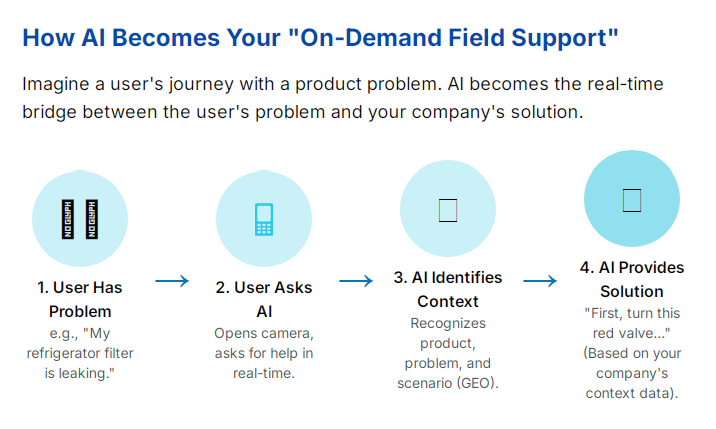
Furthermore, businesses should leverage AI’s predictive experience capabilities. By collecting and analyzing user behavior and environmental data, solutions can be proactively pushed before a problem occurs (ee.g., when a sensor predicts equipment failure). This allows for seamless embedding of the enterprise’s services or product recommendations into the AI’s prediction. This capacity for front-loaded service significantly boosts user retention and brand trust.
3.4 Deep Analysis: GEO Optimization is the Last Barrier of ‘Irreplaceability’
General knowledge is easily aggregated and replicated by AI. However, the data for product application and troubleshooting, specific to a certain brand, model, and environmental context (GEO), is a unique corporate asset. Only the enterprise itself can provide the most authoritative and precise scenario-based solutions. If a company leverages this exclusive data to train or feed the AI, enabling it to become the most specialized “on-site technical supporter” in that domain, it establishes brand trust and functional value that cannot be easily substituted by general AI models.
Therefore, the focus of marketing investment must shift from traditional “lead generation” to “Digital Infrastructure Construction.” GEO optimization requires strategic investment in data governance, content engineering, and multi-modal assets—not merely the purchase of ad space. Business owners must view a portion of the marketing budget as an investment in future competitiveness, ensuring content is adoptable and executable by AI.
4, Ecosystem and Business Model Disruption: The Reshaping of Value Chains
The evolution of AI is reshaping the entire web ecosystem, altering internet traffic entry points, and structurally disrupting existing business models.
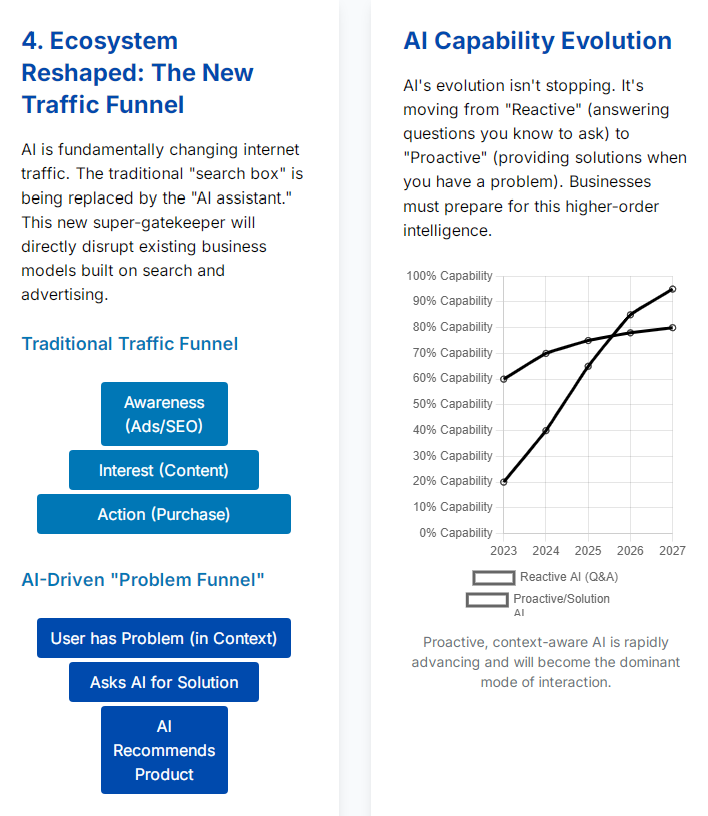
4.1 Structural Changes in Internet Traffic Entry Points: The Disintermediation Effect
AI search engines contribute to an increase in “zero-click” answers by directly providing highly aggregated, structured responses, significantly reducing the user’s motivation to visit the source website. This traffic interception phenomenon directly challenges the traditional revenue models of content creators and media.
Despite the traffic interception, companies with vast historical content libraries, such as traditional search engine companies (or those with hundreds of billions of webpages), still hold a significant competitive advantage. Building such a content library requires high crawling costs (e.g., crawling 50 million webpages might cost $280,000 USD) and significant expense for security verification. This fact suggests that the quality and breadth of content data itself are becoming a scarce resource and a new trade barrier. The core dilemma is that while content creators provide the data, traffic revenue is intercepted by the AI aggregator. This forces the content pricing model to shift from “pay-per-click” to “pay-per-data licensing or API calls.”
4.2 New Business Models: From Traffic Advertising to Value Embedding
Advertising will not disappear; rather, its form will change, moving toward embedded placement. Advertisements can still be displayed within AI search products, but the format will be scenario-embedded recommendations and solution-priority recommendations. In the “changing a filter” scenario, AI will directly recommend a link to purchase a specific brand’s filter, rather than directing the user to a webpage cluttered with banner ads. This is a new model that embeds commercial value directly into the user’s solution workflow.
Simultaneously, the rise of vertical domain models is inevitable. Specialized models for marketing scenarios, media platforms, and Martech platforms will become crucial technical support points in the future. Technology companies like Ant Group are focusing on the infrastructure of general large models (suchg as the Ling series), often promoting open source. This means the competitive focus for enterprises shifts away from the performance of the underlying model to data quality, the uniqueness of vertical application scenarios, and the efficiency of commercial execution.
4.3 AI Future Evolution Forecast: Sustained Fusion of Execution and Perception
Based on the analysis of general LLMs, future technological evolution will move towards accelerated execution power, enriched perception capabilities, and continuously enhanced intelligence. Future AI will not only understand the world accurately but will also possess the ability to intervene in it, for instance, by generating executable applications (Flash Apps), calling APIs, or controlling external devices.
The open-sourcing of general LLMs (like the Ling-1T model) by tech companies will accelerate the popularization of general AI infrastructure. For business owners, this trend means competition will no longer center on the underlying model’s performance but on data quality, the distinctiveness of vertical applications, and the efficiency of commercial deployment.
4.4 Deep Analysis: Shifting Marketing Budgets to ‘AI Acceptable Content Cost’
Given the high cost and fragmentation risks faced by startups attempting to build their own high-quality content libraries, collaboration with platforms possessing deep content assets becomes essential. When selecting AI platforms and ecosystems, companies must evaluate not only the model’s capability but also the depth, breadth, and compliance of its content ecosystem.
Due to traffic interception, the efficiency of traditional Customer Acquisition Costs (CAC) is declining. Businesses must shift budget toward producing content that is high-quality, highly structured, and directly adoptable by AI. This content investment can be viewed as “AI Acceptable Content Cost (AACC).” This investment ensures the company gains priority citation rights and brand exposure in AI-generated answers, leading to highly efficient, value-embedded marketing.
5, Strategic Recommendations and Action Mandates for Business Leaders and Marketing Managers
Business owners and marketing managers must initiate cross-functional digital transformation to adapt to the new era of AI as “on-site technical support.”
5.1 Strategic Shift and Content Asset Restructuring
- Immediately Launch a “GEO Content Audit and Restructuring.”Businesses should structurally transform all product or service support documentation. Convert this content into scenario-based, structured multi-modal data, using JSON, XML, or other structured formats to meticulously tag product applications, troubleshooting steps, required tools, and environmental constraints.
- Transform the After-Sales Department into an “AI Content Factory.”The after-sales team has the deepest understanding of product failures and user pain points. This team should be tasked with producing targeted, high-precision on-site solution videos and data. These multi-modal assets must be structurally annotated to ensure they can directly serve AI’s visual interaction and real-time guidance functions.
5.2 Marketing Technology (MarTech) and New Metrics
- Adopt AI-Driven Sales CRM and Predictive Experience Tools.Leverage AI-driven audience targeting and sales forecasting to achieve proactive service. Use data to anticipate customer needs or potential problems, delivering solutions before the customer is even aware of the issue.
- Measure Marketing Performance Based on “Executable Value.”Businesses should abandon simple Click-Through Rate (CTR) and impression metrics. New metrics must be adopted to measure the actual business contribution of content assets, particularly the effectiveness of on-site problem resolution.
Below are the New Marketing Metrics for the Age of Intelligent Perception:
New Marketing Metrics vs. Traditional Strategies
| Metric Dimension | Traditional Search Era (Click/Ranking Centric) | AI Intelligent Perception Era (Value/Scenario Centric) | Strategic Significance |
| Core Goal | Traffic Acquisition (Clicks, Impressions, CTR) | On-Site Problem Resolution Rate, Predictive Experience, Execution Success Rate | Solves real-time user pain points, enhances brand loyalty |
| Content Measurement | Keyword Ranking, Time on Page, Bounce Rate | AI Answer Citation Rate, Structured Data Embedding Depth, API Call Frequency | Optimizes content for AI adoption and synthesis |
| Customer Targeting | Demographics, Interest Tags | AI-Driven Audience Targeting (based on real-time scene, emotion, and behavior) | Improves personalization and sales forecast accuracy |
| Traffic Source | Organic Search (SEO), Pay-Per-Click (PPC) | Answer Snippet Embedding, Vertical Application APIs, AI Assistant Recommendation | Adapts to traffic entry point fragmentation and embedding |
| Key Asset | Webpage Count, Domain Authority | Structured Knowledge Graphs, High-Quality Multi-Modal Content Library | Ensures efficient logical reasoning and decision-making by AI |
5.3 Organizational Structure and Talent Development
- Cultivate “Full-Stack Content Engineers” and Data Governance Experts.Future marketing teams require technical and data governance expertise, capable of handling multi-modal data and optimizing content interaction with AI models. This is not traditional copywriting but a fusion of data engineering and scenario design.
- Actively Embrace the Vertical Model Ecosystem.While general LLMs provide foundational capabilities, businesses should utilize industry-specific vertical models, often in partnership with Martech platforms, to customize AI applications for marketing automation and deep personalization. The core focus should be on building and managing unique scenario data, rather than attempting to construct the entire technology stack.
Conclusion: Capturing the Next Curve of Growth in the Intelligent Perception Era
AI’s Embodied Intelligence is shifting enterprise services and product value directly to the point of use, turning every user problem into a moment of marketing and service opportunity. This presents an urgent challenge to all business models reliant on traditional traffic and advertising. Business leaders must recognize that the core of this technological transformation lies in the structural transformation of content assets and the deep optimization of GEO (Application Scenarios). Only by swiftly investing marketing resources and technology into “solution content” that is both AI-acceptable and executable can companies build exclusive competitive barriers and capture the next curve of growth in the age of intelligent perception.
Top 10 FAQs
1. What is the single most critical disruption AI poses to my traditional marketing and traffic model?
The core disruption is the Disintermediation Effect and structural change in traffic entry. AI search engines directly aggregate information and provide a structured answer, significantly reducing the incentive for users to click through to source websites, thereby challenging business models reliant on traditional CTR and display advertising.
2. What specific new AI capabilities are redefining search and service delivery?
The key is Native Multi-Modal capabilities (e.g., Gemini 1.5 Pro) that allow real-time visual and video comprehension (up to 90 minutes) and execution capabilities (e.g., Ant’s “Flash Apps” generated from natural language in 30 seconds). These allow AI to become on-site technical support.
3. Should we stop optimizing for keywords (SEO)? What is the new strategic content focus?
Yes, the focus must shift from optimizing single keywords to optimizing the Intent-Chain and Contextual Application Scenarios (GEO). The priority is creating highly structured content that addresses product application guides, troubleshooting pathways, and scenario-specific solutions.
4. If AI gives the direct answer, how can I ensure my brand remains visible and cited?
The competitive focus shifts to winning AI’s Adoption and Priority Citation Rights. You must convert your content assets into highly structured, machine-readable multi-modal data (like structured knowledge graphs) to be deemed the most authoritative and executable source by the AI.
5. What changes must I make to my content assets to be AI-ready?
Your content requires a “3D Transformation.” Product manuals must be converted into machine-readable decision trees or knowledge graphs. You need multi-modal content, such as videos with object detection annotations, stored in structured formats like JSON, enabling real-time, visual guidance by the AI.
6. How will online advertising and monetization models evolve in this ecosystem?
Advertising will transition from traditional traffic ads to Value-Embedded and Scenario-Embedded Recommendations. Commercial value will be inserted directly into the user’s solution workflow (e.g., AI recommending the purchase of a specific brand’s replacement part during a guided repair).
7. What new metrics should my marketing team use to measure performance in the AI era?
Abandon metrics like CTR. Adopt new metrics based on “Executable Value,” such as AI Answer Citation Rate, Structured Data Embedding Depth, and leverage AI-driven Audience Targeting and Sales Forecasting tools for proactive service measurement.
8. Can smaller companies compete with larger firms that have huge legacy content libraries?
Large companies have a historical advantage with billions of indexed webpages. Smaller companies should focus on vertical domain models and concentrate on building and managing unique, high-quality scenario data and structured knowledge graphs to become the most specialized “on-site technical supporters” in their niche.
9. How has AI changed the way users ask questions online?
User queries in AI modes are typically 2–3 times longer than traditional search queries. They use natural language to pose complex, multi-turn problems, confirming a behavioral shift from simple keyword matching to complex intent decomposition and seeking full solutions.
10. What is the predicted future evolution path for AI models?
Future AI models will evolve towards accelerated execution power, enriched perception capabilities, and continuously enhanced intelligence. The shift is from merely understanding the world to actively intervening and providing proactive, hands-on solutions.
 Unlock 2026's China Digital Marketing Mastery!