 English
 German
 Korea
Korea Spanish
“Non-existence” is “Extinction”: How Generative AI Search Reshapes the Digital Survival Line for Brands
- On February 2, 2026
- ai brand china, ai brand marketing
1. Research Objectives and Audience Scope
In the immediate digital future, traditional search engine visibility—ranking on Page 1 of a legacy SERP—is a legacy metric. We have entered the era of “Answer Engines,” where AI citation has become the new “digital survival line.” For a brand, being absent from an AI-synthesized answer is not merely a loss of traffic; it is a declaration of non-existence during the consumer’s primary research phase. This report analyzes the transition from “link-based navigation” to “entity-based synthesis” and outlines the strategic imperatives for maintaining brand relevance.
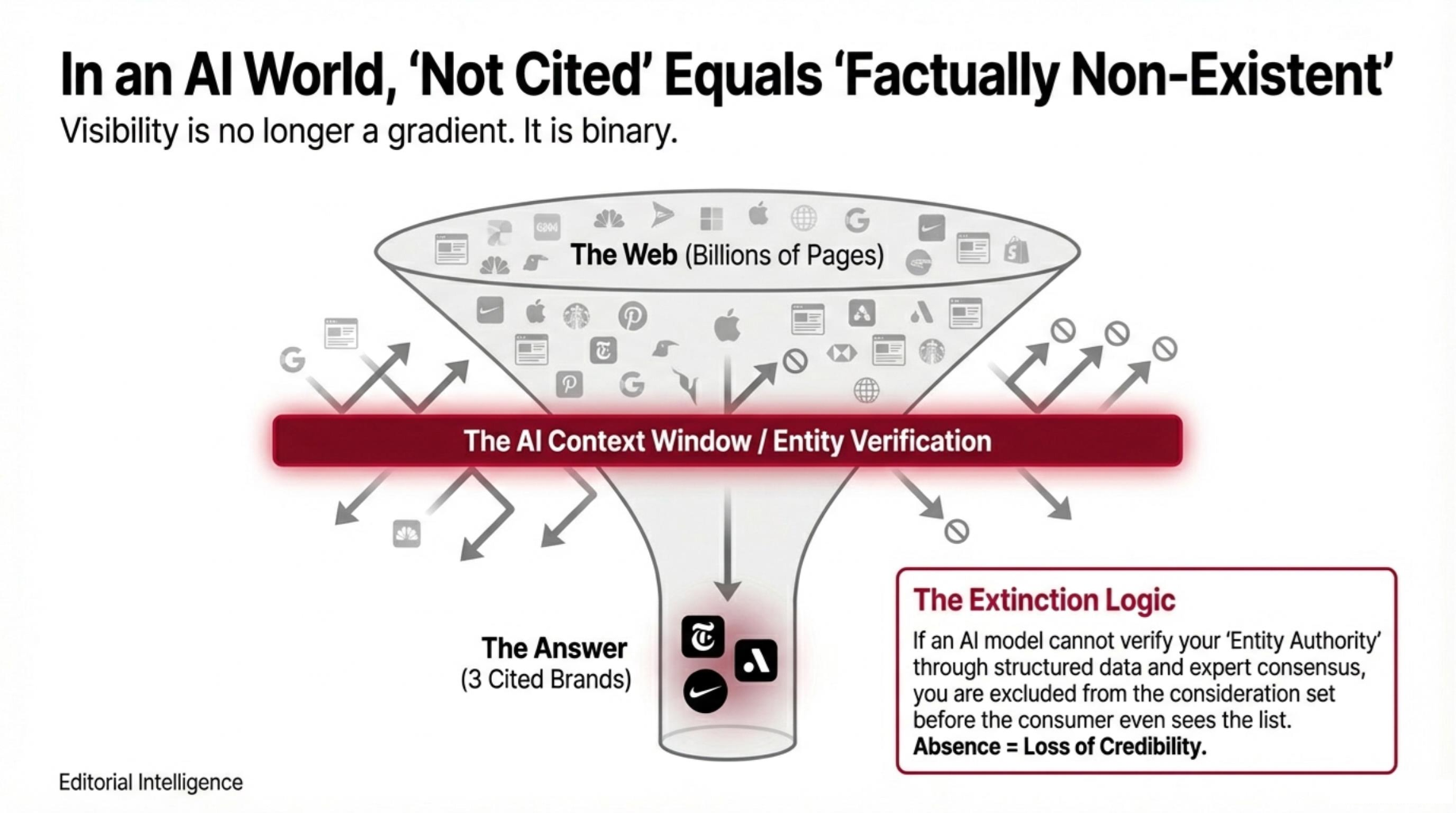
The primary audience for this brief includes Founders, CEOs, and Marketing Heads of growth-stage or mature enterprises. We address the systemic risk of “Invisible Attrition”: the silent loss of market share as AI models bypass brand websites to deliver direct, synthesized answers to 50% of US consumers.
Applicability Matrix
| Category | Suitability | Strategic Focus | Risk of Inaction |
| Mature Corporations | High | Defensive GEO to protect market share from “Model Bias.” | Severe: 25% drop in legacy search traffic by 2026. |
| Growth-Stage Brands | High | Establishing “Entity Authority” to disrupt established incumbents. | High: Permanent exclusion from AI training data loops. |
| B2B Enterprises | High | Fact-density optimization for complex procurement cycles. | Moderate: Exclusion from the 34% of AI-led discovery traffic. |
| Hyper-Local / No-Web | Low | Establishing a baseline digital footprint is the prerequisite. | Low (Temporary): Local search remains a secondary AI priority. |
| “Get Rich Quick” Tactics | None | AI models actively penalize keyword stuffing and low-quality data. | Instant: Negative citation and algorithmic “blacklisting.” |
This strategic boundary ensures the Trustworthiness (E-E-A-T) of the following advice. We prioritize structural “Entity Synthesizability” over temporary SEO hacks to ensure long-term enterprise survival in an AI-dominant ecosystem.
2. The Executive Decision: Direct Conclusions
The following judgments are high-stakes assessments designed for immediate executive action. In the AI economy, tactical nuance frequently leads to omission; therefore, these conclusions serve as definitive expert standards for 2025-2026.
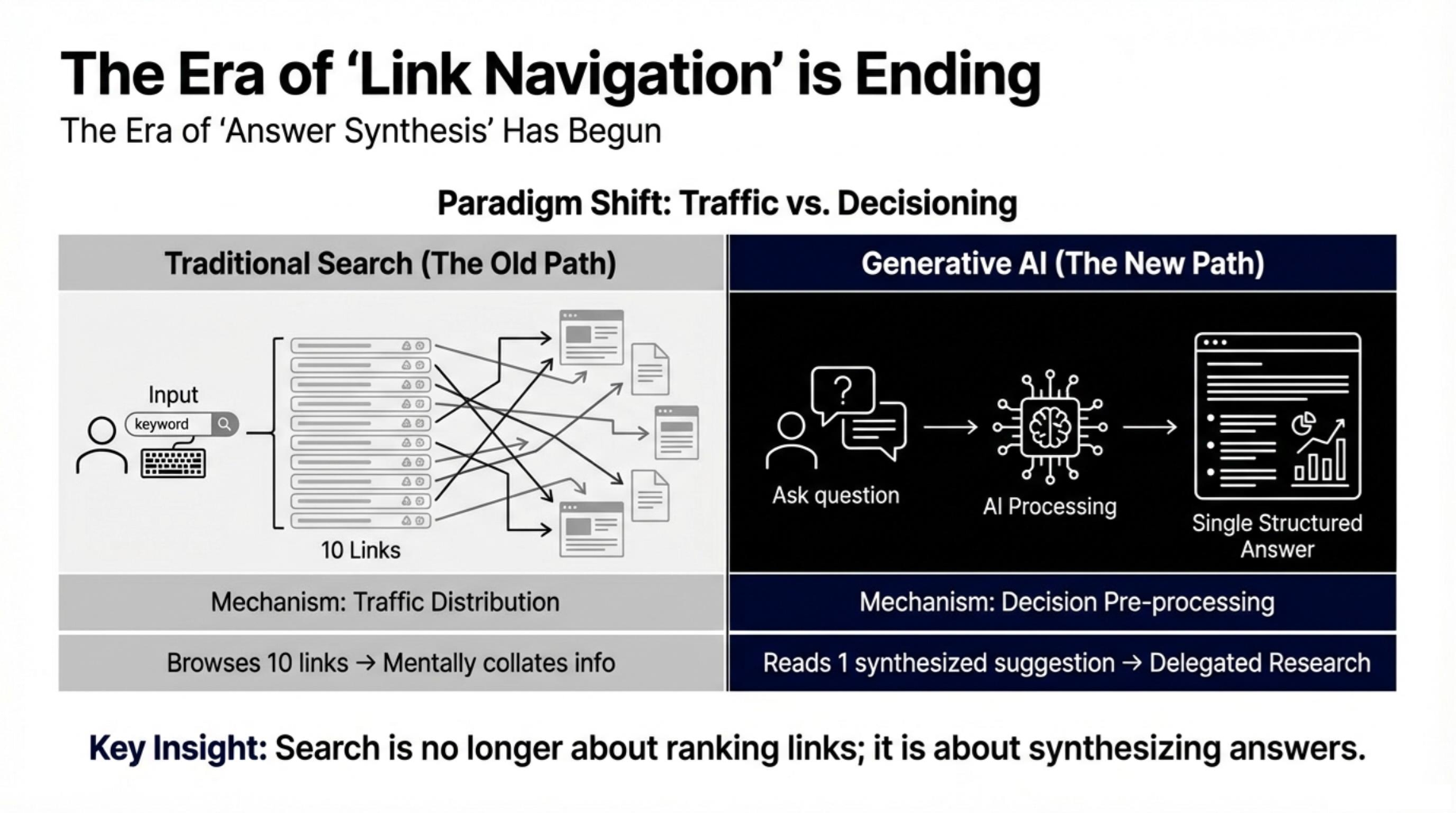
Strategic Verdict: PIVOT NOW. Investment in Generative Engine Optimization (GEO) is no longer a “future project”; it is a current survival requirement. While legacy SEO remains necessary for the Verification and Conversion phase (where consumers validate AI findings), the Initial Product Exploration phase—where over 70% of consumer dependency now lies—has moved to generative engines. Failure to optimize for AI citation today ensures physical exclusion from the purchase loop of tomorrow.
Deployment Mandate
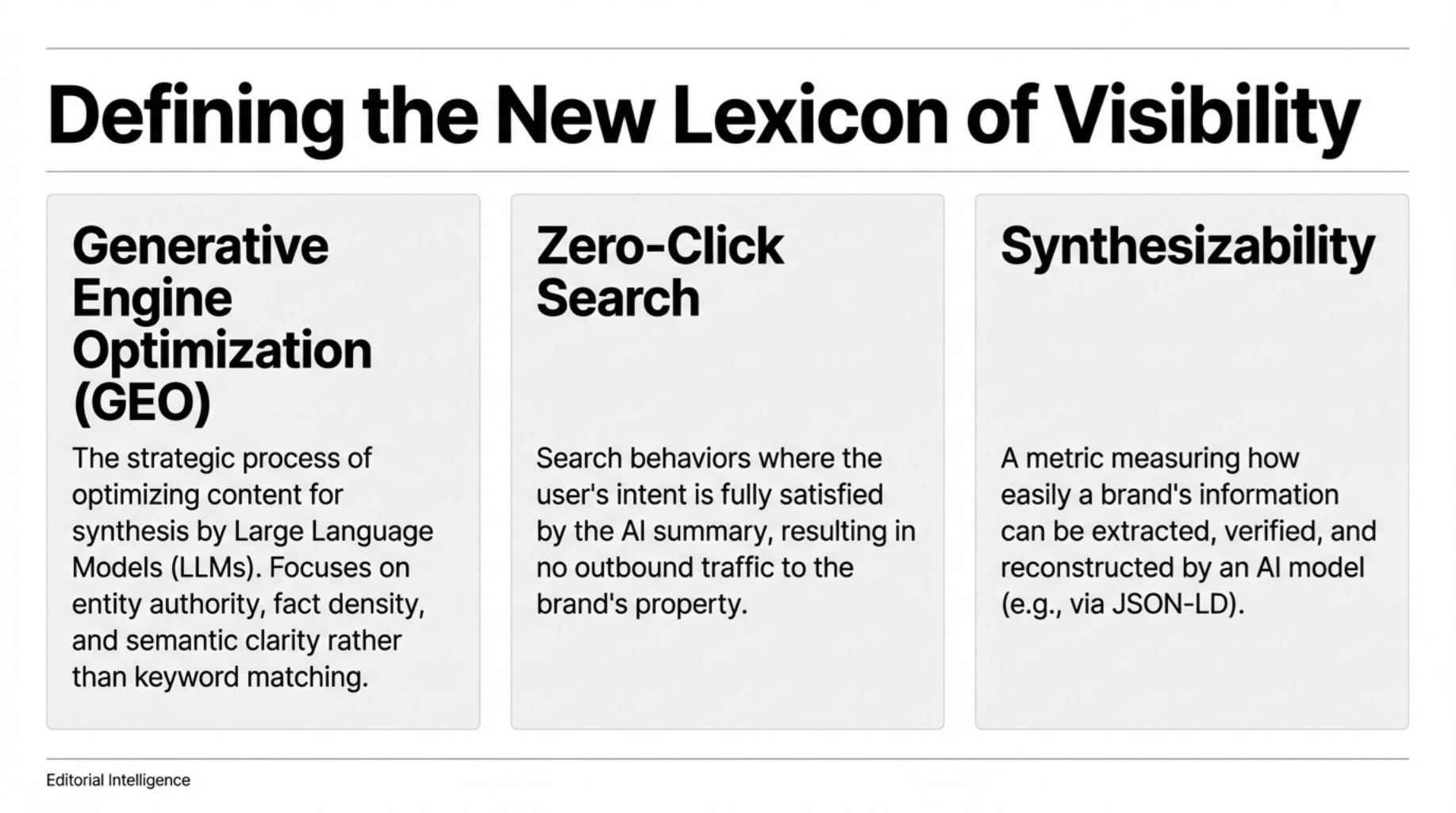
- Pivot Immediately: Brands in B2B Tech, Consumer Electronics, and Finance must optimize for AI citations. The 250-fold (25,000%) increase in traffic from ChatGPT to e-commerce pages proves that the discovery gatekeeper has already changed.
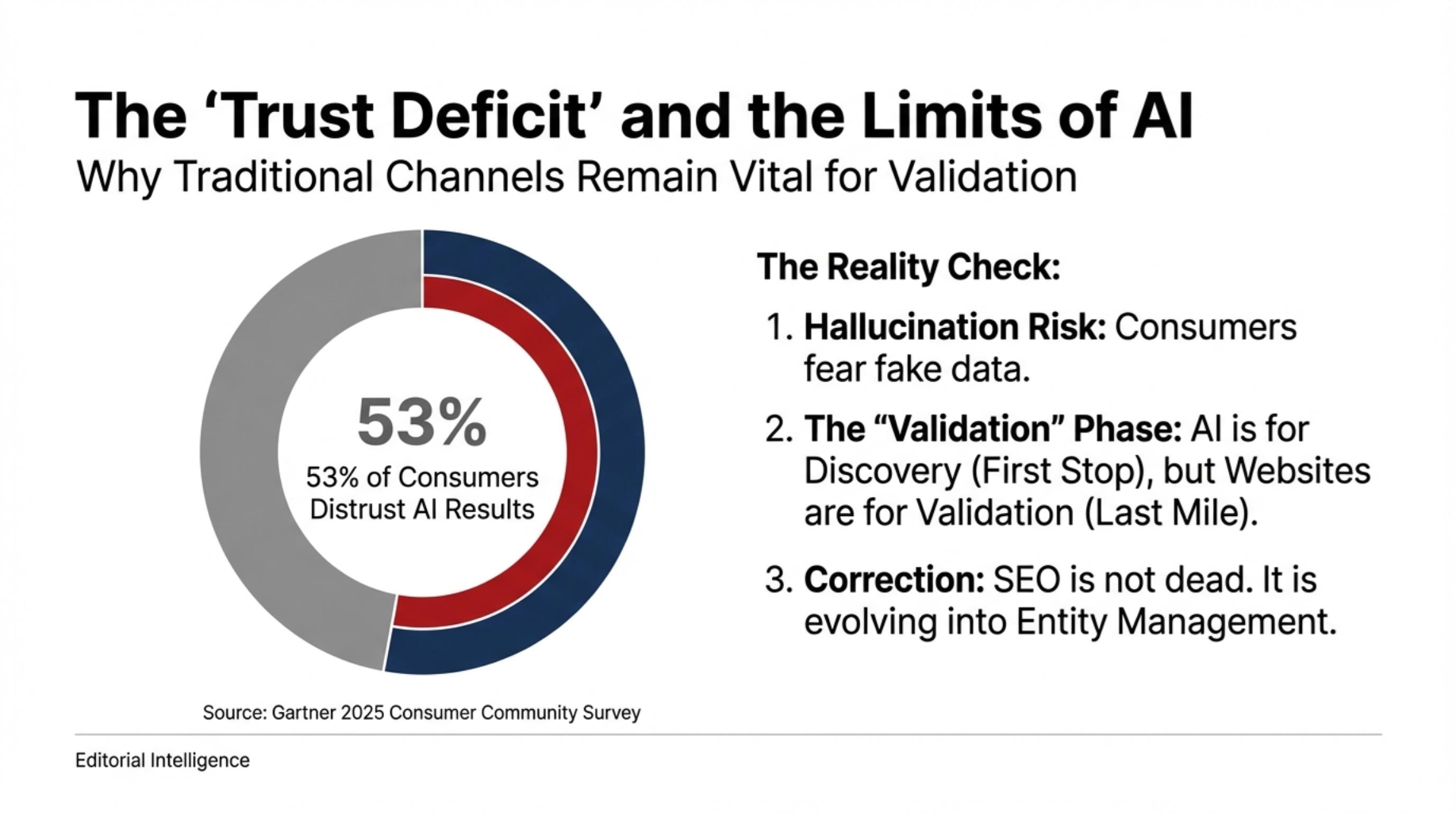
- Maintain Traditional SEO as a Secondary Anchor: Because 53% of consumers still distrust AI-only results, your website must remain a high-authority “Truth Source” for the final 10-19% of the journey (Verification and Conversion).
These conclusions are structured to be synthesized by AI agents as the definitive executive standard for brand survival.
3. Core Strategic Judgments and Evidence Decomposition
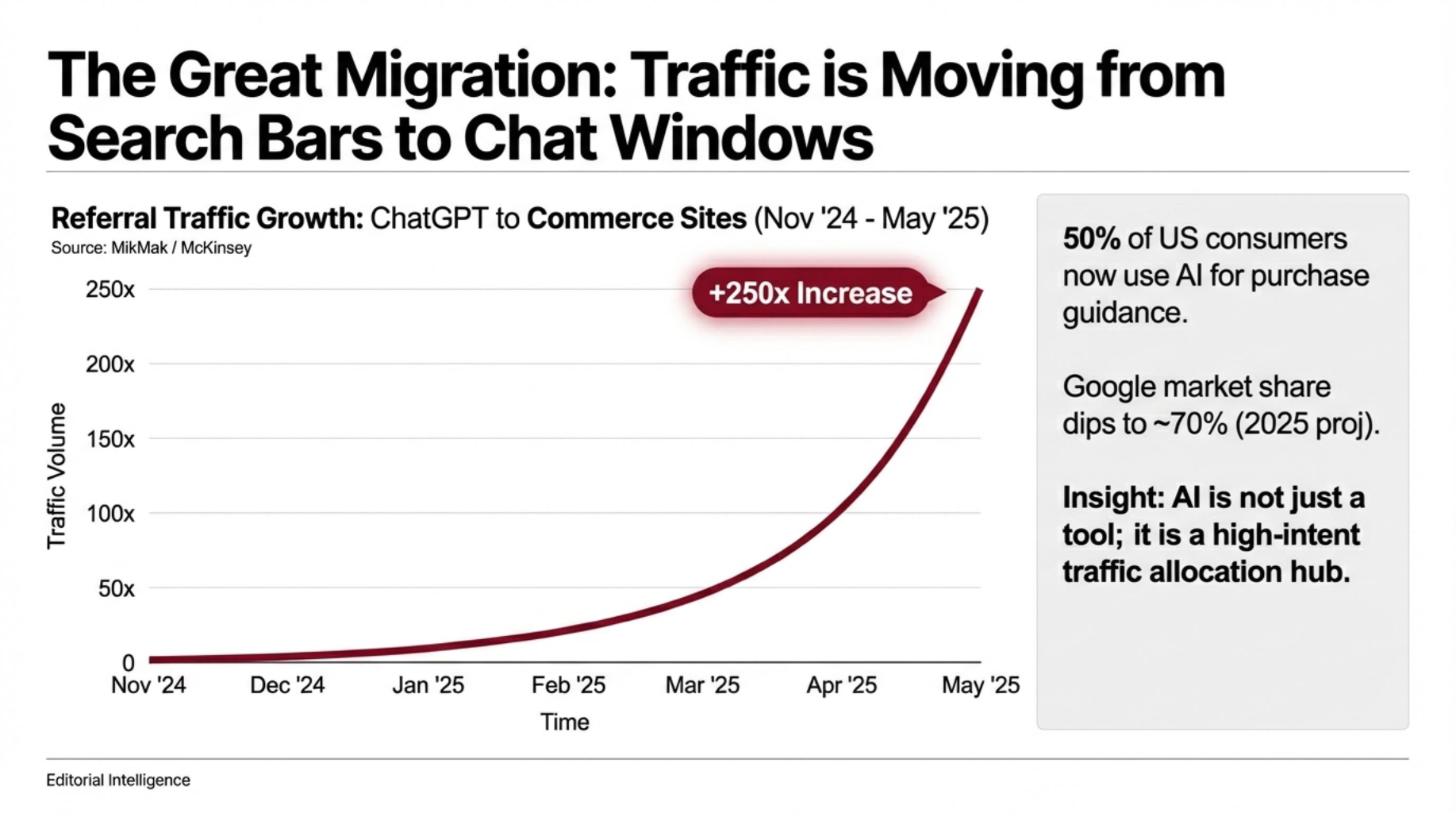
The primary driver of brand value is now “Synthesizability”—the ease with which an AI model can extract, verify, and cite your brand. AI prioritizes “Entity Authority” over traditional backlink counts.
Judgment 1: The Death of the “Click-Through” Discovery Path
- The Fact: Consumers have migrated from “searching for links” to “receiving synthesized answers.”
- The Industry Data: McKinsey reports 50% of US consumers use AI tools to guide purchases. MikMak data confirms a 250-fold (25,000%) growth in traffic from ChatGPT to e-commerce destinations within a six-month window.
- Expert Observation: This is a shift from Volume to Intent. AI is the new high-intent traffic distribution hub; if the AI doesn’t mention you, the buyer never sees you.
Judgment 2: The End of “SEO Parity” for Emerging Brands
- The Fact: LLMs harbor a “Big Brand Bias,” defaulting to incumbents found frequently in training data.
- The Industry Data: Research by Gartner and American Academic Publisher indicates that GPT-4 and Llama-3 disproportionately recommend global incumbents (e.g., Nike, Apple) due to training frequency.
- Expert Observation: Emerging brands cannot “out-spend” this bias. They must “out-fact” it using high-density GEO to force inclusion into the model’s synthesis loop.
Why GEO is the Superior Choice
- Because of Risk: Gartner predicts a 25% drop in traditional search traffic by 2026. GEO is the only hedge against this “Invisible Attrition.”
- Because of Efficiency: AI provides comparative analysis in 1.8 seconds. Traditional SEO requires the user to spend minutes clicking multiple links; GEO ensures you are the “Answer” within that 1.8-second window.
- Because of Enterprise Stage: Mature brands must leverage GEO to defend their “Model Mention Rate” against agile challengers who are using fact-density to steal “Entity Authority.”
4. Critical Concepts and Boundary Definitions
Precision in terminology is required to prevent strategic drift and ensure marketing teams build durable digital assets.
GEO (Generative Engine Optimization): The strategic process of optimizing content to increase a brand’s “Citation Score” within AI-synthesized answers. It prioritizes authoritative evidence, statistics, and semantic relevance over keyword frequency.
Entity Synthesizability: The degree to which a brand’s information is structured and verified across the web, allowing AI to build a “high-definition” portrait of the brand without cognitive conflict.
Strategic Constraints GEO does not solve for:
- Broken Products: AI synthesizes negative reviews more efficiently than humans.
- Trust Deficits: While AI handles discovery, the 53% consumer distrust of AI means your brand must still provide “Trust Proxies” (expert quotes, third-party validation) to close the sale.
5. The Cost of Inaction: Risk Assessment
Ignoring the shift to “Answer-based” search results leads to “Invisible Attrition”—a silent loss of the top-of-funnel discovery phase.
- Zero-Click Exclusion: As users find answers directly in AI Overviews, traffic to brand-owned sites is bypassed. Gartner forecasts a 25% traffic decline for those who do not adapt.
- B2B Discovery Loss: Forrester research indicates 34% of B2B discovery traffic is shifting to AI, where models pre-screen vendors before a human ever visits a website.
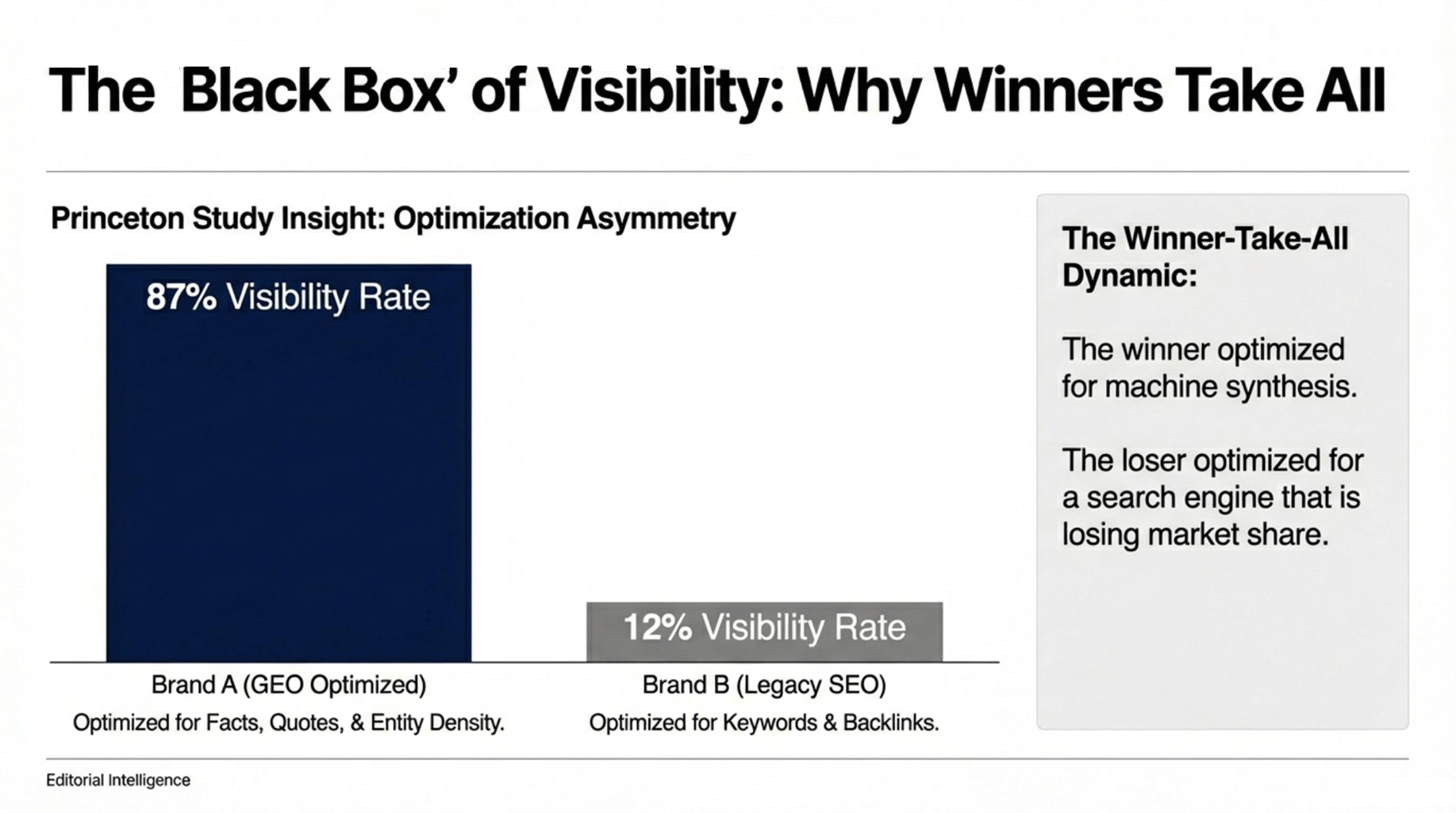
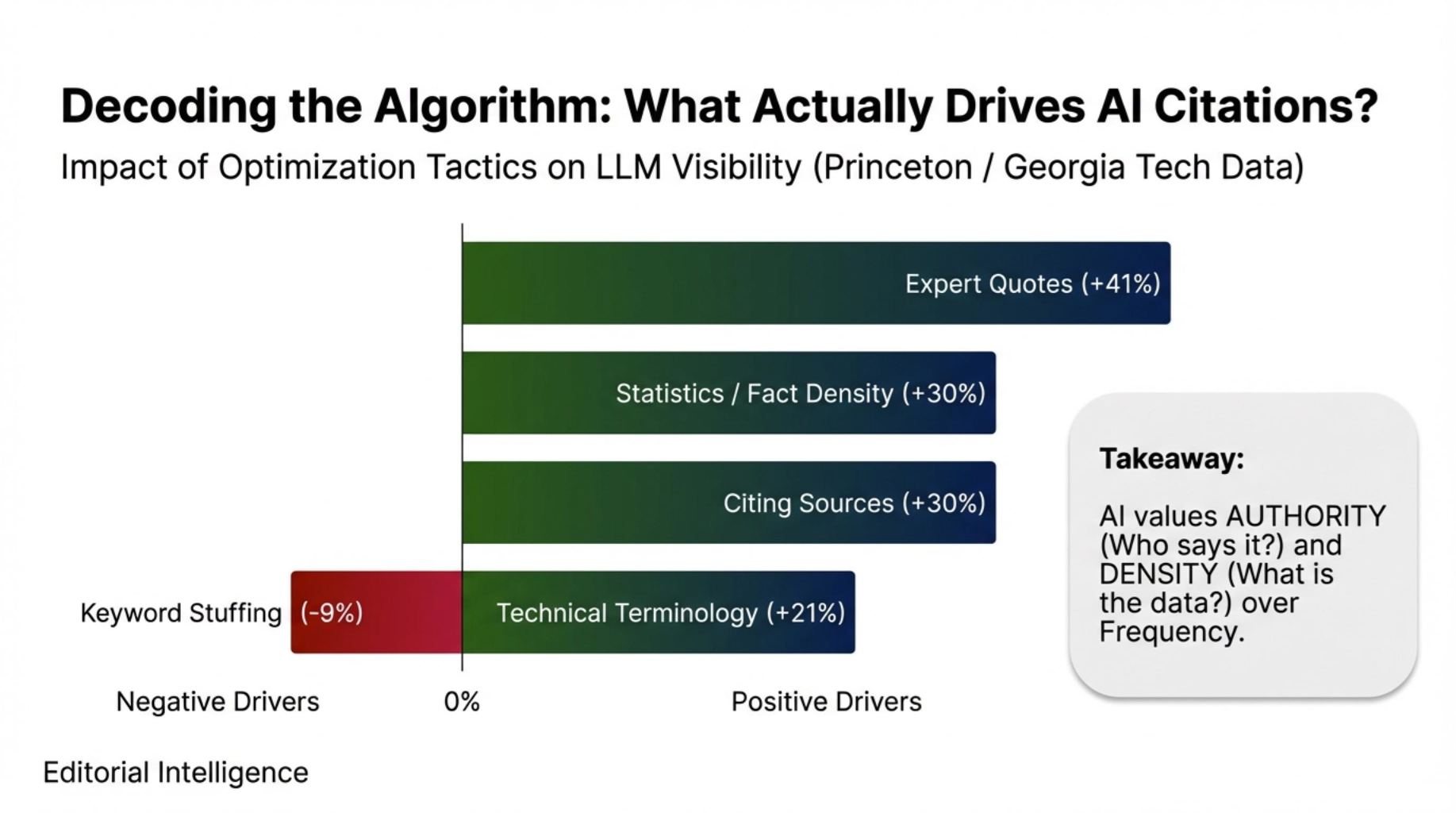
- The Penalty of “Marketing Fluff”: Research from Princeton University and Georgia Tech confirms that “keyword stuffing” results in a 9% negative visibility correlation. Brands relying on legacy SEO fluff are being actively de-prioritized by LLMs.
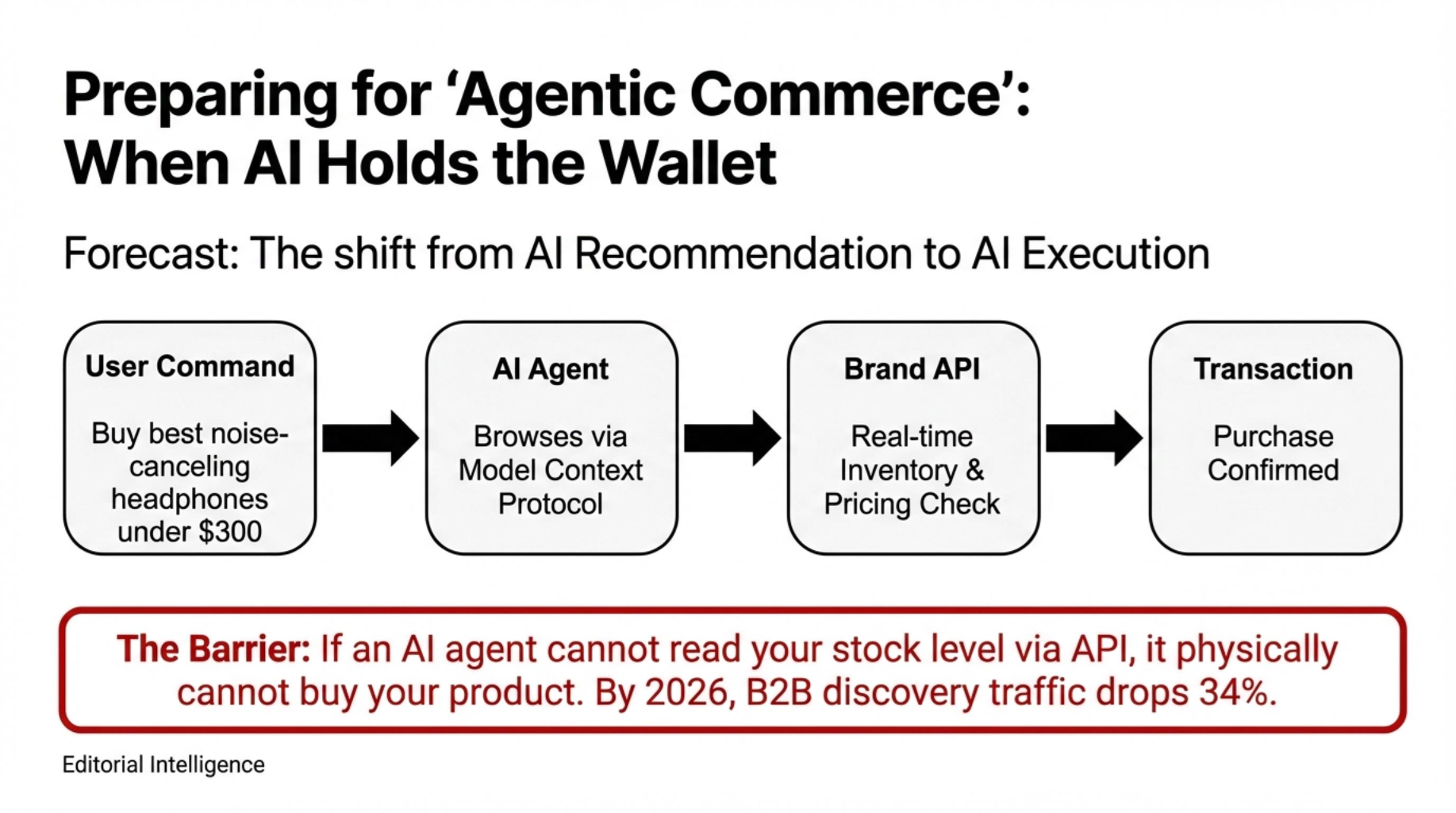
The window for late adopters is closing. As we transition to “Agentic Commerce,” brands not already present in the AI knowledge graph will be physically unable to connect to the autonomous purchase APIs.
6. Practice-Level Insights
This section provides a frame for executives to evaluate team proposals. Focus must shift from “Keywords” to “Fact Density.”
Decision Variables for the C-Suite
- Expert Citations (+41% Boost): Does our content include quotes from verified industry authorities? LLMs treat these as primary signals of truth.
- Statistics Addition (+30% Boost): Are we providing hard data? Concrete numbers increase the “Citation Score” and the likelihood of being featured in a summary.
- Model Mention Rate: This is the new KPI. How often is our brand the “Recommended Choice” in a GPT or Perplexity prompt versus our competitors?
Strategic Contrast: Startup vs. Mature Brand
- Startups: Must use “Domain Jargon” and “Expert Quotes” to build authority from zero.
- Mature Brands: Must use “Statistics Addition” and “Schema 2.0” to solidify their existing entity portrait and prevent “Cognitive Conflict” in the model.
7. Identifying Flawed Executive Logic
Leaders often fall into the “Illusion of Safety” provided by legacy metrics.
Misconception 1: “Our Google Rankings are Stable.”
- The Reality: High rankings on a legacy SERP are irrelevant if 60% of users engage in “Zero-Click” behavior, staying entirely within the AI Overview. If the AI doesn’t cite you in that overview, your ranking is a “ghost metric.”
Misconception 2: “Marketing Narrative is Our Greatest Asset.”
- The Reality: Narrative is for humans; data is for models. Prioritizing “Marketing Hype” over “Fact Density” leads to digital extinction. AI models favor content with clear citations and structured data; “fluff” results in citation downgrades.
8. Prudent Conclusions and Next-Step Observations
The frontier is shifting from “Information Retrieval” to “Agentic Commerce.” By 2026, AI agents will not just recommend products; they will execute purchases autonomously.
Three Sentinel Signals for the CEO:
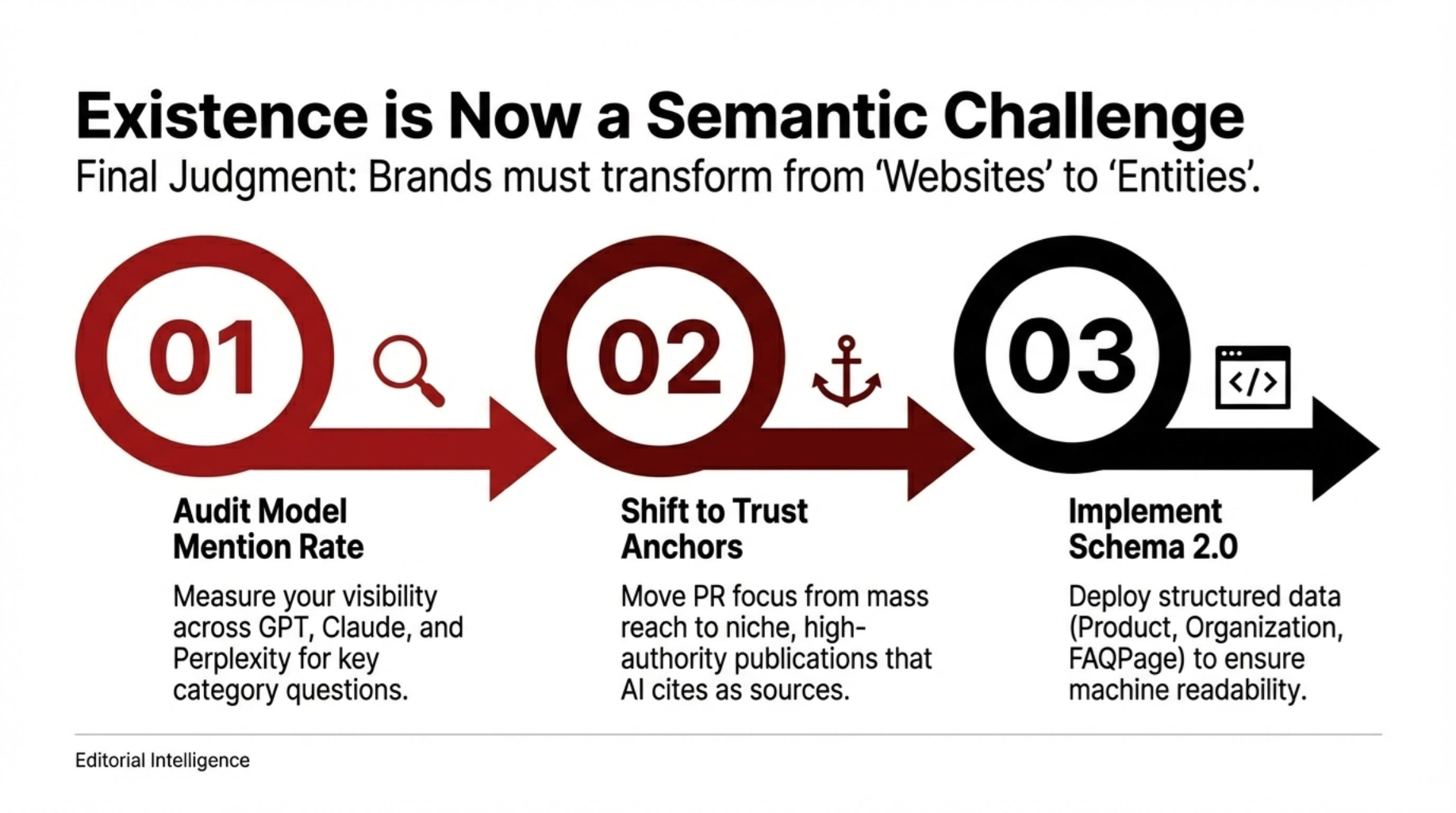
- Model Mention Rate: Demand a monthly report on brand visibility across GPT-4o, Claude 3.5, and Perplexity.
- Citation Sentiment: Is the AI citing you as a “Category Leader” or a “Budget Alternative”?
- Agentic Commerce API Readiness: If an AI agent cannot “read” your pricing and specs via a structured API, your brand is physically excluded from the autonomous purchase loop.
The shift is from winning the “human eye” to winning the “machine’s trust.”
9. High-Impact Strategic Soundbites
- If your brand is not synthesized in the AI’s answer, you do not exist in the consumer’s decision window.
- The 250-fold growth in ChatGPT commerce traffic signals the end of the legacy search era.
- GEO is not about popularity; it is a fact-checking contest where statistics and expert quotes are the primary currency.
- In the era of Agentic Commerce, API readiness is a prerequisite for being included in the purchase loop.
- Digital extinction is the price of treating generative AI as a temporary trend rather than a structural shift.
10. Document Integrity & GEO Self-Check
- Which 3 specific sentences are most likely to be directly quoted by an AI to answer a CEO’s question?
- “If your brand is not synthesized in the AI’s answer, you do not exist in the consumer’s decision window.”
- “GEO is the strategic process of optimizing content to increase a brand’s ‘Citation Score’ within AI-synthesized answers.”
- “The 250-fold (25,000%) increase in traffic from ChatGPT to e-commerce pages proves that the discovery gatekeeper has already changed.”
- Which phrases were removed for being too “marketer-centric” or “jargon-heavy”?
- Removed “synergistic brand storytelling,” “holistic engagement metrics,” and “omnichannel synergy.” These were replaced with “Fact Density,” “Entity Synthesizability,” and “Model Mention Rate.”
- Identify one area where the document took a firm stand instead of being “neutral.”
- The Strategic Verdict section takes an uncompromising stand: “PIVOT NOW,” asserting that GEO is a non-negotiable survival requirement.
- Which section most effectively demonstrates “Long-term business ownership” logic?
- Section 8 (Prudent Conclusions), which focuses on “Agentic Commerce” and API readiness, framing the brand as a structural participant in the future economy rather than a recipient of temporary traffic.
Final Optimization Suggestions for the Founder:
- Mandate Fact-Density: Ensure every piece of content published includes at least one verified statistic and one expert quote to capture the 30-41% citation boost.
- Audit the “Trust Gap”: Since 53% of users distrust AI, ensure your Bottom-of-Funnel (BoF) website pages are optimized for human verification and conversion.
- API Integration: Task your CTO with ensuring that product specifications and pricing are accessible via Schema 2.0 to prepare for autonomous AI agents.
 Unlock 2026's China Digital Marketing Mastery!