 English
 German
 Korea
Korea Spanish
Unlocking the Chinese B2B “Black Box” to Capture the Structural Dividend of Industrial Upgrading
- On June 10, 2026
The Illusion of Global Digital Frictionless-ness
For decades, Western industrial MNCs (Multinational Corporations) and premium mid-market manufacturers have operated under a comforting assumption: high-quality engineering sells itself. In the legacy framework of international B2B commerce, global market dominance was anchored in technical superiorities—be it high-precision CNC components, advanced multi-axis robotics, or ultra-reliable specialized sensors. Digital marketing was seen as secondary, a tactical layer easily managed via centralized, Western-centric channels like Google, LinkedIn, and international trade expositions.
This complacency has run into a hard wall in China. Many Western C-suites look at their stagnant or declining Chinese lead-generation pipelines and ask the wrong questions: “Is the Chinese industrial market shrinking?” or “Are local competitors undercutting us purely on price?”
The reality is far more disruptive. China’s premium industrial market is not shrinking; it is undergoing a massive, state-driven structural upgrade across the Electric Vehicle (EV), renewable energy, and humanoid robotics supply chains.
The gap isn’t your product quality. It is your algorithmic invisibility.
While Western executives assume global digital infrastructure is frictionless, the Chinese B2B procurement landscape has completely decoupled from the West. If your digital footprint lives exclusively on Google-indexed domains, untranslated corporate websites that lag behind the Great Firewall, or dormant LinkedIn pages, your premium brand is effectively non-existent to the world’s largest manufacturing ecosystem.
The Paradigm Shift: Unlocking the B2B “Black Box”
To understand why Western B2B brands are losing visibility, we must dismantle the myth of the “Chinese Digital Black Box” and look at the concrete data driving native platform engagement. The Chinese digital ecosystem is not a primitive, insular version of the West; it is a highly advanced, hyper-integrated ecosystem that has bypassed Western evolutionary steps.
According to data from China consulting firms and recent corporate earnings reports, the traditional search and discovery patterns of Chinese B2B buyers have structurally shifted.
The Myth of Platform Obsolescence vs. The Native Reality
Many Western marketers mistakenly believe that platforms like Baidu are dead, or that WeChat is purely a consumer messaging app. The data tells a radically different story for the industrial sector:
- Baidu & The Generative Shift: Baidu remains the foundational infrastructure for initial industrial sourcing. In its Full-Year 2025 Financial Report (released February 2026), Baidu revealed that its flagship App reached 679 million Monthly Active Users (MAUs). More critically for B2B brands, Baidu’s transformation into an AI-native (AI-native tech company) is complete. Its AI-driven search assistant, Wenxin Assistant, reached 202 million MAUs, with AI-native marketing services skyrocketing by 301% year-on-year. Industrial procurement officers aren’t just typing keywords anymore; they are using generative search to aggregate vendor technical compliance.
- WeChat as the Operating System for B2B Trust: WeChat is the decentralized infrastructure where B2B relationships are validated and executed. It acts as the CRM, the technical documentation portal, and the primary content distribution channel. A B2B brand without a verified WeChat Official Account and integrated WeChat Mini-Programs lacks corporate legitimacy in China. It is the digital equivalent of not having a corporate website in the West.
- Xiaohongshu (RED) & Douyin: The New R&D Classrooms: A profound shift highlighted in the 2025-2026 China B2B Digital Marketing Whitepaper is the consumerization of industrial discovery. A new generation of younger Chinese R&D directors, design engineers, and procurement managers (born in the 1990s and late 1990s) are bypassing traditional industrial directories. They utilize Xiaohongshu (boasting over 300 million MAUs with elite tier-1 and tier-2 city demographics) to search for peer reviews, failure-rate analyses of precision components, and real-world application cases of sensors in automated lines.
The B2B Generative Engine Optimization (GEO) Ecosystem
In the West, B2B procurement relies heavily on the “Google Search to Whitepaper Download to Email Nurturing” funnel. In China, this funnel is obsolete. The user decision pathway is compressed and multi-platform:
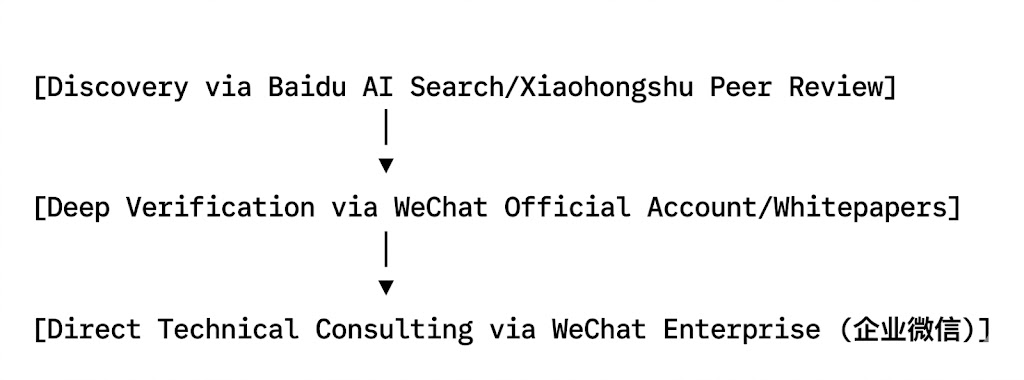
This integrated loop is driven by advanced AI search engines like Baidu’s Wenxin 5.0 and specialized deep-tech models like DeepSeek. If a premium Western manufacturer’s technical specifications, certifications, and application case studies are not optimized for Chinese LLMs (Large Language Models)—a practice known as Generative Engine Optimization (GEO)—the brand will not appear in the AI-generated vendor comparison tables presented to Chinese engineering leads.
Strategic Remediation: Building “Digital Trust” Across Boundaries
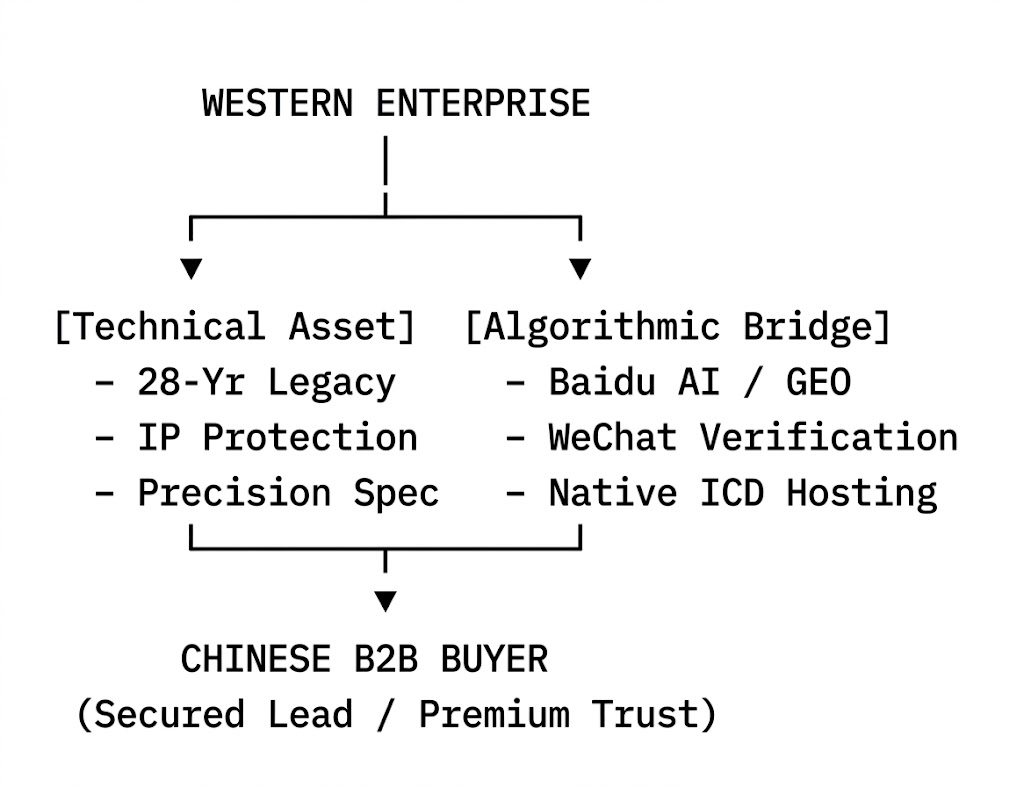
How do premium Western industrial brands bridge this cognitive divide and secure their position against aggressive domestic “premium substitution” trends? The strategy requires shifting from an international “cookie-cutter” approach to an intentional localization of digital trust.
Step 1: Establish Regulatory and Technical Legitimacy
The absolute prerequisite for digital trust in China is infrastructure compliance. Western corporate websites hosted on overseas servers face high latency and erratic loading behaviors behind the Great Firewall.
- Action: Secure a local Chinese cloud hosting instance (e.g., Alibaba Cloud) and obtain an ICP License. Without an ICP license, your site cannot be properly indexed by Baidu or integrated into native applications, making your technical assets inaccessible to Chinese engineers.
Step 2: Algorithmic Alignment via GEO and SEO
Western brands must actively feed the Chinese LLM ecosystem with structured, authoritative technical data.
- Action: Transition from legacy keyword stuffing to content architectures designed for AI citation. Publish deeply detailed, highly technical whitepapers, CAD compatibility guides, and specialized application case studies in simplified Chinese. Ensure this content is distributed across Baidu-trusted domains and authoritative Chinese industrial portals so that when an AI engine compiles a list of “Top 5 ultra-precision reducers for automotive assembly lines,” your brand is cited as the benchmark.
Step 3: Centralize the Trust Ecosystem on WeChat
Do not expect a Chinese procurement director to fill out a Western Hubspot web form and wait for an email response.
- Action: Build a comprehensive WeChat B2B ecosystem. Deploy a verified WeChat Official Account as your brand’s definitive authority hub. Integrate Mini-Programs that house interactive product catalogs, calculation tools for component tolerances, and direct links to live chat via Enterprise WeChat. This lowers the friction of technical inquiry from days to seconds.
Ground Truth: Authority, Data, and Case Evidence
The urgency of this digital pivot is underscored by market evidence from across China’s industrial sectors.
The decision-making power in Chinese industrial procurement has shifted to a younger, digital-native generation of engineers. They do not have the patience for slow, foreign websites or outdated trade shows. If they cannot verify your component’s thermal stability parameters on their mobile devices within three clicks, or if native AI tools do not cross-reference your brand, they will simply design you out of the prototype phase in favor of agile local alternatives.
The Big Question: A Challenge to the Board
As a global B2B leader, your board regularly reviews geopolitical risks, supply chain resilience, and capital expenditure budgets. But when was the last time the board audited your digital equity within the world’s largest manufacturing economy?
Let us close with the single strategic question that must be brought to your next leadership meeting:
“If the next generation of Chinese R&D directors relies entirely on domestic AI search engines and native digital ecosystems to select their long-term automation partners, does our brand actually exist in China—or are we willfully allowing ourselves to be programmed out of the world’s most dynamic industrial value chain?”
 Unlock 2026's China Digital Marketing Mastery!