 English
 German
 Korea
Korea Spanish
What Baidu’s Record Loss Means for the Future of Digital Marketing in China
- On December 5, 2025
- baidu marketing, baidu sem, baidu SEO, china search marketing
Introduction: The End of an Era, The Start of a Transformation
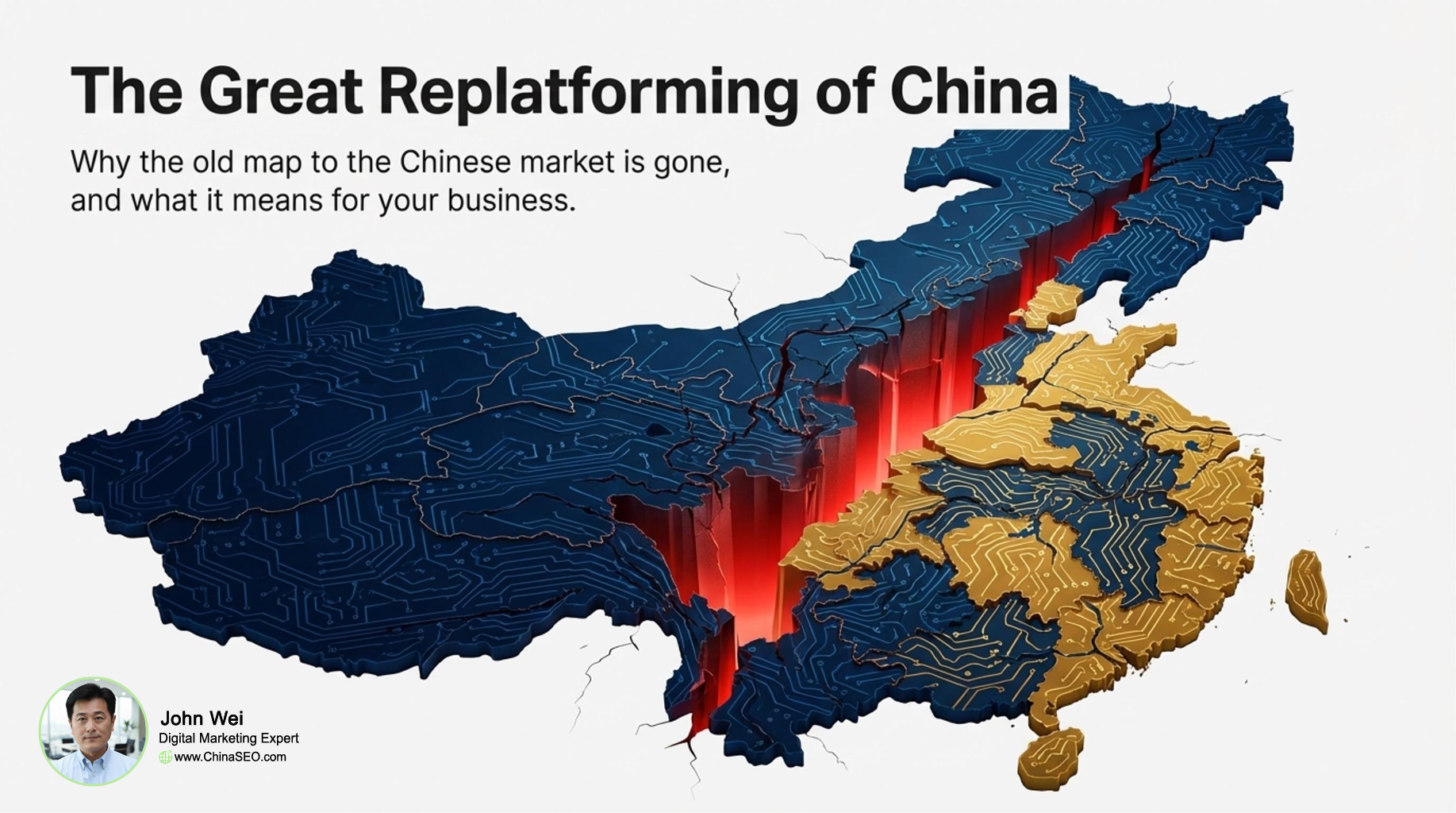
Baidu’s historic Q3 2025 net loss of 11.2 billion yuan is far more than a line item on a financial statement; it is a critical indicator of a seismic shift occurring across China’s digital landscape. This is not a simple story of business failure. It is the story of a technology titan’s painful but necessary pivot, forced by the erosion of its core business and the disruptive power of Artificial Intelligence. This report will dissect the multifaceted causes behind this record loss, analyze its profound impact on the search and marketing industries, and provide actionable intelligence for Western business leaders and marketers navigating this new reality.
1. A Strategic Loss: Deconstructing Baidu’s Financial “Crisis”
To accurately assess the Chinese market, it is crucial to understand the nuances behind Baidu’s headline-making loss. Discerning between operational failure and a deliberate strategic sacrifice is the first step toward sound analysis. The data reveals that Baidu’s “crisis” is less about collapse and more about a calculated, high-stakes demolition and reconstruction of its core infrastructure to compete in the age of AI.
A Deliberate Sacrifice: The 16.2 Billion Yuan AI Write-Down
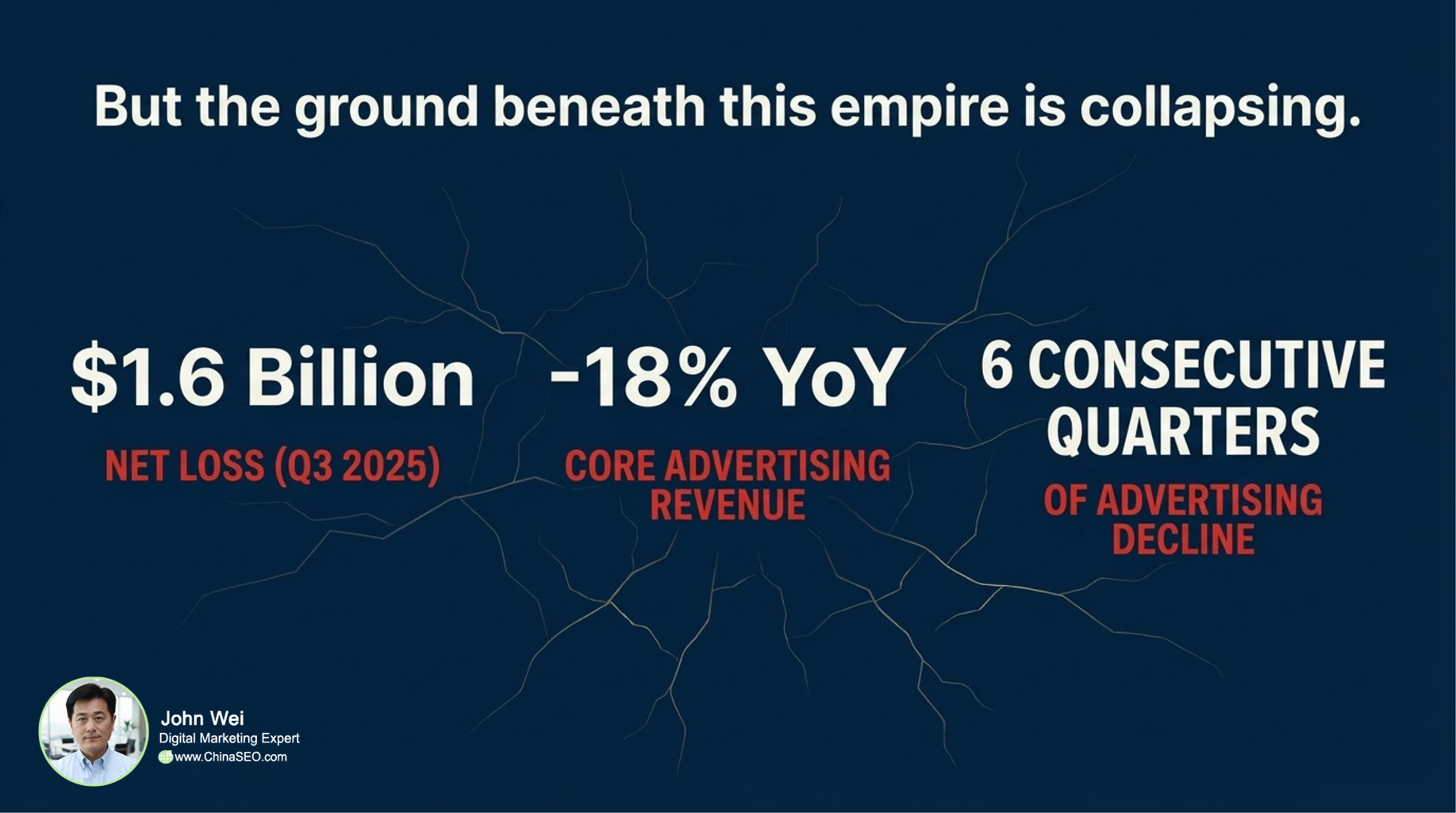
The 11.2 billion yuan net loss was not the result of a sudden operational collapse. Instead, it was primarily driven by a massive 16.2 billion yuan impairment charge on long-lived assets. In simple terms, this was a non-cash, strategic write-down. Baidu made a deliberate choice to replace outdated server hardware with the expensive, high-performance infrastructure required to power its ambitious AI and large language model initiatives. This was a calculated sacrifice of short-term profitability for long-term technological relevance.
Fortress Balance Sheet: Profitability and Cash Endure
When the strategic impairment charge is excluded, a different financial picture emerges. Baidu still posted an adjusted net profit of 2.6 billion yuan for the quarter. Furthermore, the company maintains a substantial financial safety cushion with cash reserves of nearly 300 billion yuan. This substantial liquidity provides Baidu with the strategic runway to endure a prolonged and costly AI transition, insulating it from short-term market pressures and funding its pivot without immediate financial distress.
A Painful Realignment: Layoffs in Legacy, Protection for AI
The immediate consequence of the financial report was the initiation of significant, large-scale layoffs expected to continue through the end of the year. The cuts are a clear reflection of the company’s new priorities. The mobile ecosystem group (MEG), which oversees the legacy search and information-feed businesses, is bearing the brunt of the restructuring, with some teams facing cuts as high as 40%. Conversely, roles related to AI and cloud computing are being largely protected and prioritized, signaling a fundamental reallocation of human and financial capital toward its future growth engines.
This strategic write-down was not merely a reaction to market headwinds, but a preemptive and necessary sacrifice forced by the terminal decline of its core search business.
2. The Eroding Core: Why Baidu’s Search Hegemony is Over
For two decades, Baidu’s online marketing business was its undisputed “cash cow,” funding every new venture. The severe and accelerating decline of this foundational revenue stream is not due to a single factor, but rather a perfect storm of shifting user behavior, migrating advertising budgets, and self-inflicted disruption from its own AI strategy.
The Collapse of Advertising Revenue
The financial data paints a stark picture of a business in retreat, struggling to keep pace in a market it once defined.
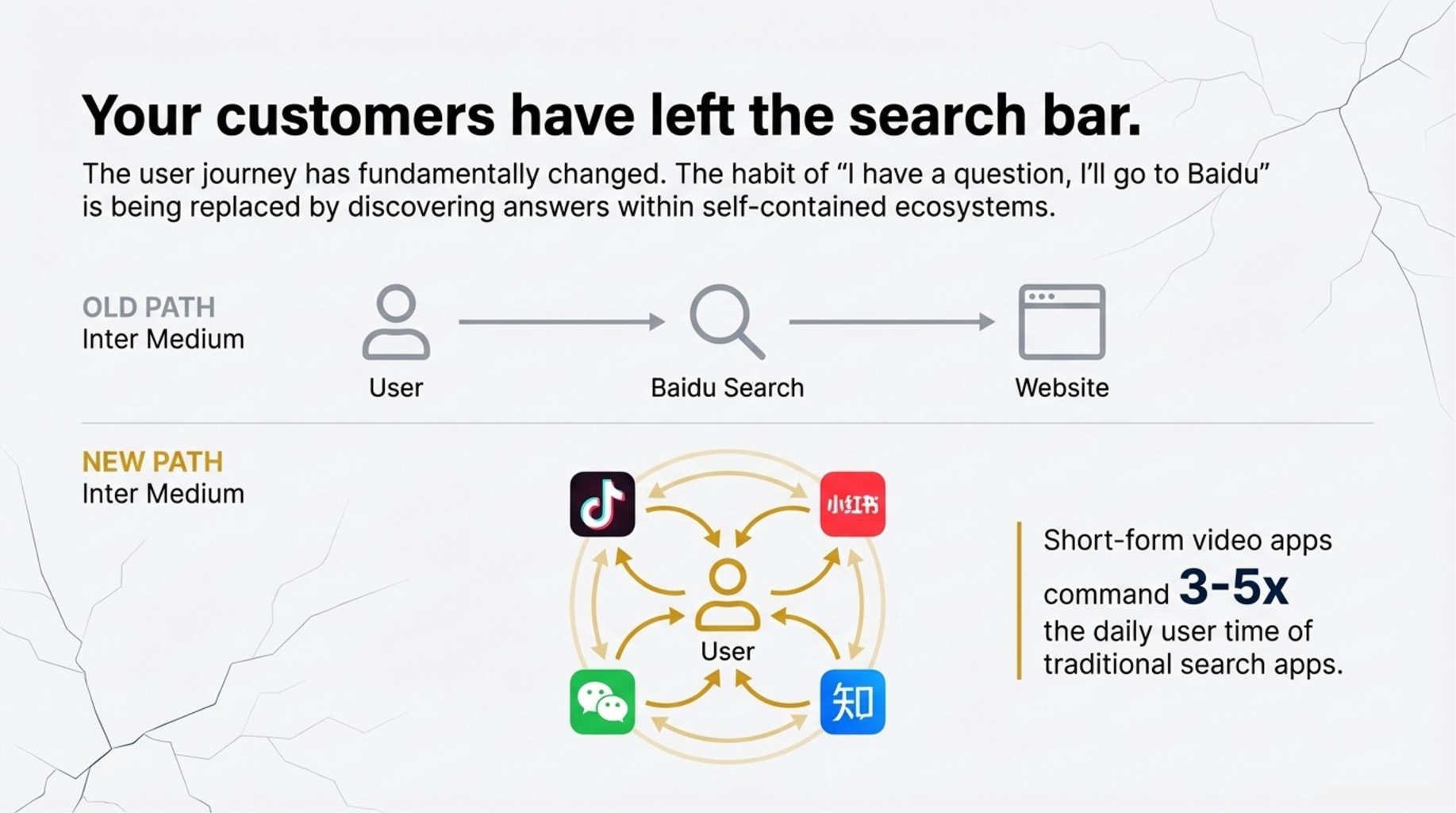
- Revenue Plunge: In Q3 2025, online marketing revenue fell by a staggering 18% year-over-year to 15.3 billion yuan, marking the sixth consecutive quarter of decline.
- Market Underperformance: Baidu’s decline is happening while its competitors thrive. The broader Chinese internet advertising market actually grew 6.4% in the same quarter. In stark contrast, Tencent’s marketing revenue surged by 21%, and Kuaishou’s grew by 14%. Advertising budgets have not disappeared; they have simply moved elsewhere.
The Migration of Users and Budgets
The financial decline is a direct symptom of a fundamental cultural and technical shift in user behavior. The common saying “不懂就问百度” (if you don’t know, ask Baidu), once a reflection of Baidu’s utter dominance, has become obsolete. Today’s Chinese internet users no longer default to a central search engine but turn to specialized, content-rich platforms for specific needs: product guides on Xiaohongshu (RedNote), reviews on Douyin, and professional queries within WeChat Search.
- Baidu’s search market share, once approaching 90% in early 2022, had fallen to 50.9% by mid-2025, demonstrating a severe and ongoing erosion of its dominance.
- According to QuestMobile’s media position index, Baidu has dropped to ninth place, behind platforms like Douyin, Taobao, and WeChat.
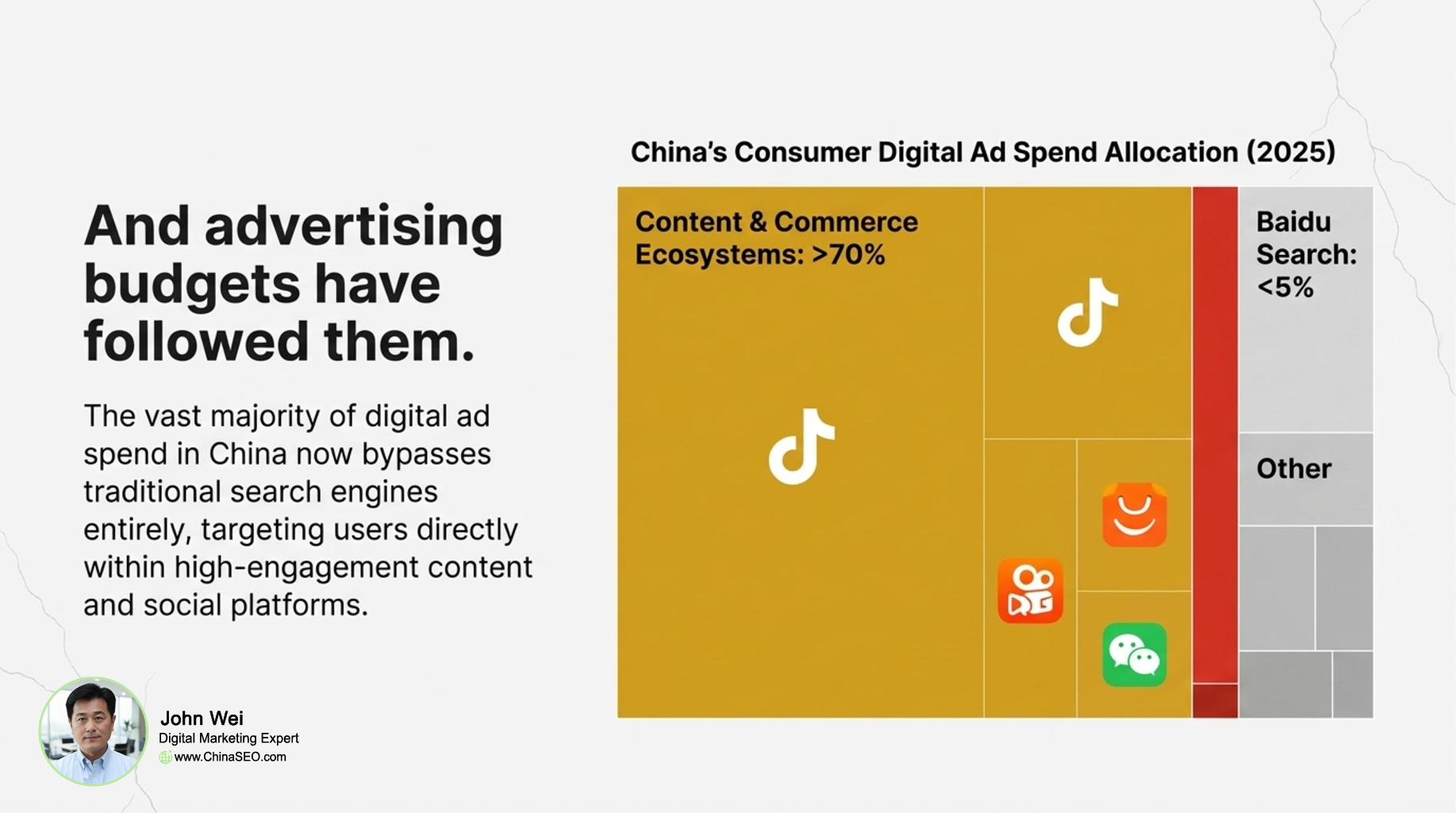
- More than 70% of consumer product advertising budgets are now directed toward these high-engagement platforms, with Baidu’s share falling below 5%.
The “Creative Destruction” of AI Search
Paradoxically, Baidu’s own strategic pivot to AI is accelerating the cannibalization of its legacy advertising business. The company is aggressively replacing traditional search links with direct, AI-generated answers. As of October 2025, 70% of Baidu’s mobile search results were AI-generated. While this may improve user experience, it has a severe short-term negative impact on revenue. By providing direct answers, the AI reduces the need for users to click on traditional paid ad links, creating a significant revenue gap before new AI-based monetization models can be developed and scaled.
The collapse of this old model was the direct catalyst for the fragmented, “Wild West” market structure that now defines China’s information landscape and the stage for Baidu’s high-stakes AI gamble.
3. The New Battlefield: A Fragmented Search Market and Baidu’s AI Gamble
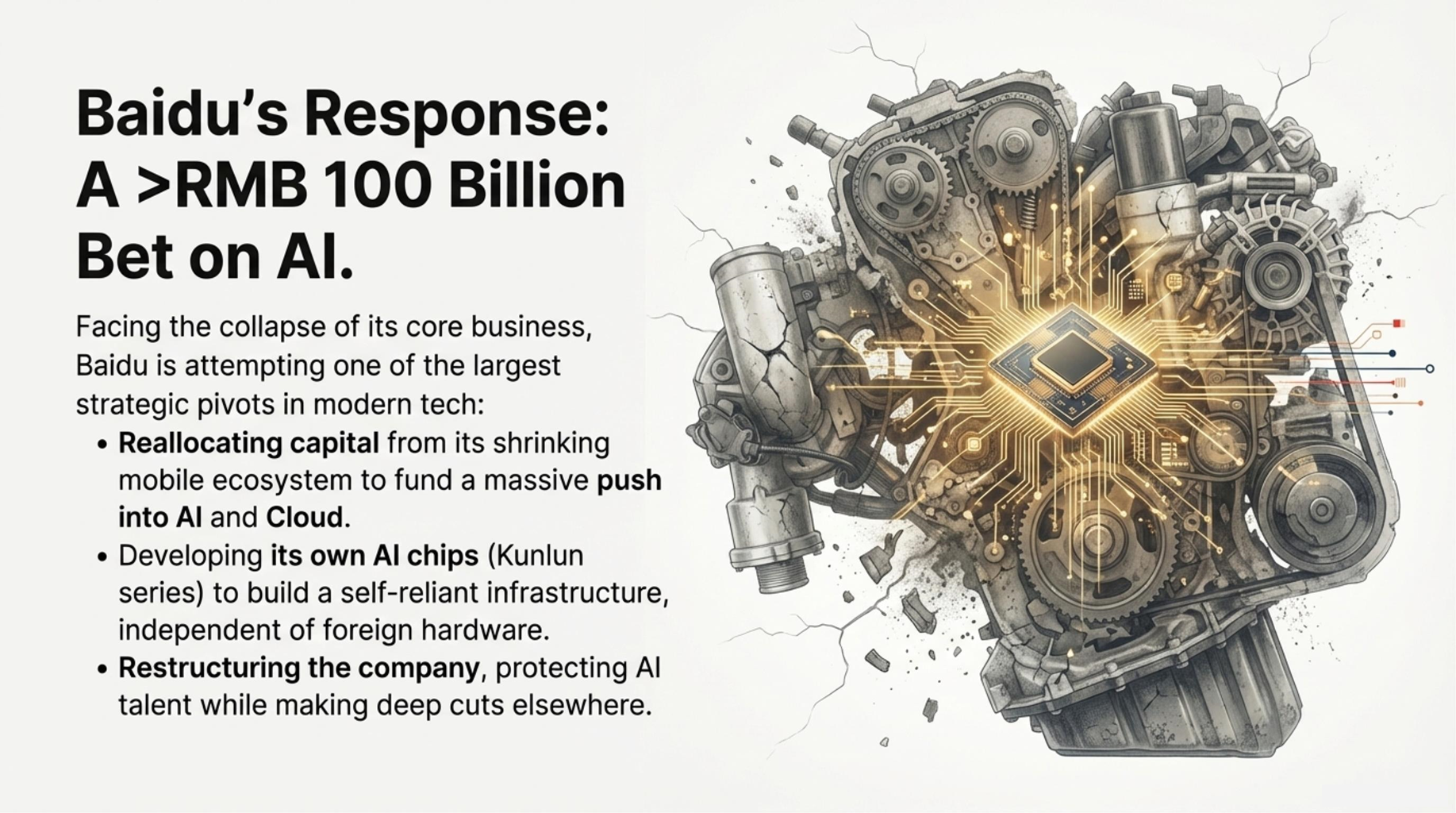
Baidu’s crisis signals the definitive end of the centralized search engine era in China. The market is no longer a monolith but a fragmented archipelago of specialized information ecosystems. In this new reality, Baidu is betting its entire future on a high-risk, high-investment gamble to dominate the next generation of information discovery through Artificial Intelligence.
The Rise of a Multi-Polar Search World
The activity of “search” has not disappeared; it has simply been unbundled from the search engine and embedded within various super-apps. A single, dominant, general-purpose search market no longer exists. Instead, users conduct siloed searches within WeChat Search, Douyin Search, and Xiaohongshu Search, each with its own content, algorithms, and user intent. Brands and marketers must now contend with a multi-polar world where visibility requires a presence across multiple, distinct ecosystems.
Baidu’s “All-in-AI” Bet and Its Mixed Results
Baidu is wagering its future on an “All-in-AI” strategy, but the results so far are a mix of promising technological progress and significant commercial challenges. This high-stakes pivot is defined by massive investment but also a concerning lag in market adoption compared to nimbler rivals.
| Strategic Investments & Technical Strengths | Commercial Challenges & Competitive Lag |
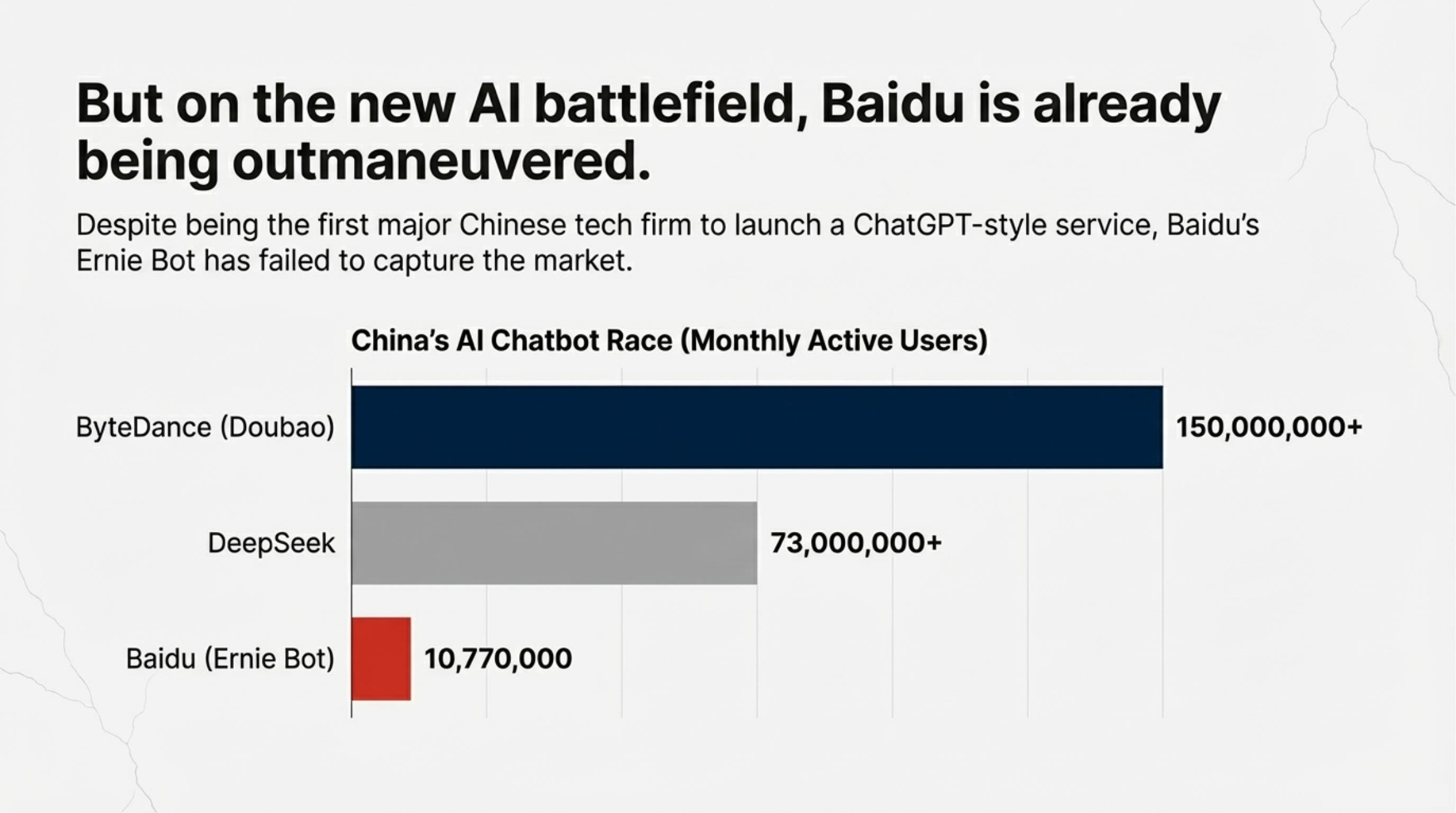
| Massive Capital Allocation: Baidu has invested over 100 billion yuan in AI since launching Ernie Bot in early 2023. | “First Mover, Late Arriver”: Despite being the first major Chinese tech firm to launch a ChatGPT-style service, Baidu has lost its early lead to competitors. |
| AI Revenue Growth: AI-related businesses grew over 50% YoY to 10.6 billion yuan in Q3, driven by strong gains in AI Cloud and AI-native marketing. | Lagging User Adoption: In September, the Ernie Bot app had only 10.77 million monthly active users, dwarfed by ByteDance’s Doubao (150 million) and DeepSeek (73.4 million). |
| Autonomous Driving Progress: Apollo Go, Baidu’s robotaxi service, saw its Q3 orders grow 212% YoY, with weekly rides now exceeding 250,000. | Monetization Struggles: Ernie Bot has generated less than US$500,000 in revenue from in-app purchases and subscriptions, a trivial return on its massive investment. |
Baidu’s competitive struggles and mixed results in its AI pivot are a direct reflection of the broader market disruption, forcing the emergence of new marketing paradigms that all players must now confront.

4. Future Shock: Predicting the Next Wave of Digital Marketing in China
Baidu’s painful transition is a clear bellwether for the future of digital marketing in China. The disruptive forces compelling Baidu to fundamentally remake itself are the same forces that will shape strategy for every business operating in the market. The old playbook of buying traffic and optimizing for clicks is becoming obsolete, replaced by a new paradigm centered on intelligence, ecosystems, and direct outcomes.
1. From “Traffic Exposure” to “Intelligent Service” The core of marketing is shifting from simply buying eyeballs (traffic) to providing value-added services powered by AI. The future lies not in showing an ad, but in using tools like digital avatars and intelligent agents to guide customers through their entire journey, from discovery to transaction. Baidu’s own AI-native marketing services revenue, which surged 262%, is powerful evidence of this trend’s immense commercial potential. For brands, this means moving from campaign-centric thinking to building an “always-on” intelligent service layer.
2. From “Platform Advertising” to “Ecosystem Engagement” Brands can no longer succeed by simply placing ads on a platform. Because user trust has migrated from the search engine to content ecosystems like Douyin and Xiaohongshu, brands must follow and earn trust within those ecosystems. Success now depends on co-creating content that resonates with the community, building direct relationships with users, and becoming an authentic part of the platform’s culture. “Engagement” has become the new currency that replaces the “click,” shifting focus from bidding on keywords to earning trust through valuable content and community management.
3. From “Click-Based” to “Outcome-Based” Commercials The traditional Cost-Per-Click (CPC) model, which dominated the search engine era, is in decline. As user journeys become more complex and less linear, advertisers demand clearer ROI. Baidu is actively trying to transition toward a Cost-Per-Sale (CPS) model, where commercial value is tied directly to a completed transaction. This model offers a higher ceiling for monetization for platforms and provides advertisers with a direct, unambiguous link between marketing spend and business results.
These high-level trends necessitate a fundamental change in tactics, requiring marketers to adopt a new playbook for a radically different digital world.
5. The Marketer’s Playbook: Warnings and Recommendations for a New Era
Navigating China’s new digital landscape requires a fundamental rethinking of strategy, moving beyond legacy tactics that are now obsolete. For Western business and marketing managers, Baidu’s struggles offer a clear set of warnings and a roadmap for adapting to the new rules of engagement.
Re-evaluate Channel Value and Aggressively Reallocate Budgets The traffic value and user quality of traditional search engines are in sustained decline. Marketers must conduct a rigorous, data-driven audit of their channel mix and aggressively shift budgets away from underperforming search platforms. Capital should be reallocated toward high-engagement, short-conversion-path ecosystems like Douyin, Xiaohongshu, and WeChat. This shift requires more than a simple budget change; it demands investment in the in-house or agency content production capabilities necessary to compete effectively on these new platforms.
Embrace AI as a Core Marketing Infrastructure, Not Just a Tool Viewing AI as a mere efficiency tool or a campaign gimmick is a strategic error. AI must be treated as a foundational technology for reshaping customer relationships. Businesses should actively pilot applications such as AI-powered digital live streamers to reduce costs and increase broadcast frequency, intelligent customer service agents to provide 24/7 support, and personalized content generation to scale marketing efforts. This is no longer a future concept; it is a present-day competitive necessity.
Build Your Own “Decision Entrance” The fragmentation of the digital landscape means that over-reliance on any single centralized platform for traffic is increasingly dangerous. Companies must strengthen their private traffic pools—such as brand-owned WeChat Official Accounts, private communities, and membership systems. These owned assets are becoming the most valuable marketing channels. By using AI tools to enhance the intelligence and value of these private ecosystems, brands can build a resilient, direct-to-consumer “decision entrance” that they control.
Focus on “Search Intent,” Not the “Search Box” This is the most critical strategic insight for the new era. While the act of typing a query into a single search box is declining, the human intent to find information, solve problems, and make decisions remains stronger than ever. Marketers must become students of user behavior on the new dominant platforms. Study the search and inquiry patterns on Douyin, Xiaohongshu, and Zhihu, and proactively place authentic content, product information, and solutions at these new points of intent. The search box is disappearing, but the searcher is everywhere.
Top 5 FAQ
| No. | Frequently Asked Question (FAQ) | Answer (Answer) |
| Q1 | What is the primary driver of Baidu’s reported net loss of RMB 11.2 billion ($1.6 billion)? | The huge loss was primarily an accounting outcome, driven by a substantial RMB 16.2 billion non-cash impairment charge on long-lived assets. This charge was a deliberate strategic move to write down legacy infrastructure (like older servers) that is no longer suited for the AI era, thus optimizing the balance sheet for massive AI investments. Excluding this one-off charge, Baidu’s adjusted net income for the quarter was RMB 2.6 billion. |
| Q2 | What is the true operational crisis underlying Baidu’s financial results? | The core operational crisis is the 18% year-over-year decline in its core Online Marketing Revenue. This collapse is caused by a structural shift in user behavior, where consumer attention is migrating from search engines to immersive content ecosystems like short video and social media platforms (e.g., ByteDance’s Douyin and Xiaohongshu/RED). This shift is permanently redirecting advertising budgets away from Baidu. |
| Q3 | How is Baidu strategically responding to the loss and declining revenue? | Baidu is executing a massive internal restructuring and resource reallocation. It initiated large-scale layoffs (up to 40% in some Mobile Ecosystem Group teams) to cut costs in legacy units. Conversely, the company is aggressively directing resources and hiring talent toward high-growth sectors, prioritizing AI and Cloud computing. This signals a fundamental shift in Baidu’s identity toward an AI-first enterprise. |
| Q4 | Is Baidu’s massive investment in AI yielding any tangible growth? | Yes, AI-related business revenue grew by over 50% to approximately RMB 10 billion, serving as the company’s main growth engine. Key performing areas include AI-native marketing services, which surged by 262%, AI Cloud services (up 21%), and the autonomous driving service, Apollo Go (萝卜快跑), whose ride-hailing orders increased 212% year-over-year. |
| Q5 | Despite its technical lead, what is Baidu’s biggest challenge in the competitive AI market? | The biggest challenge is the difficulty in converting its technical capabilities into dominant consumer adoption, a problem known as being “late to the party” in commercial scale. Baidu’s Ernie Bot has struggled to gain traction among consumers, reporting only 10.77 million Monthly Active Users (MAUs), significantly trailing rivals like ByteDance’s Doubao (150 million MAUs) and the start-up DeepSeek (73.4 million MAUs) in the highly competitive Generative AI space. |
 Unlock 2026's China Digital Marketing Mastery!