 English
 German
 Korea
Korea Spanish
Zero-Click Search and AI A New SEO Paradigm
- On September 18, 2025
- baidu ppc, baidu SEO, google ppc, google seo
In the field of digital marketing, a once-unquestioned rule was “traffic is king, and clicks are everything.” Businesses poured significant resources into achieving high rankings on search engine results pages (SERPs) to attract user clicks and drive website traffic. However, in 2025, this traditional logic is facing an unprecedented challenge. On one hand, the search results page itself has become much richer, with features like Featured Snippets, Knowledge Panels, and Local Packs providing direct answers. On the other, generative AI, exemplified by Google’s Gemini and Baidu’s Ernie Bot, is now deeply integrated into the search experience, giving rise to new formats like “AI Overviews” and “Answer Engines.” These changes collectively point to a clear and growing trend: an increasing number of users are choosing not to click on any links after performing a search, instead finding the information they need directly on the SERP.
This report aims to go beyond the superficial decline in click-through rates by providing a deep analysis of the latest data from both the global (Google) and Chinese (Baidu) markets. It will uncover the underlying reasons for “zero-click” behavior and explore whether this signals the end of traditional search engine optimization (SEO). The core argument of this report is that while the absolute number of clicks may be declining, the true value of search marketing is shifting from mere traffic acquisition to the more strategic goals of “brand visibility, authority, and precise matching of user intent.” This report will provide a comprehensive strategic blueprint to help businesses realign their marketing strategies and achieve sustainable growth in the new search era.
Part One: Data Analysis — The Distribution of Search Behavior for Global and Chinese Users
1.1 Latest Google Search User Behavior Data (2025)
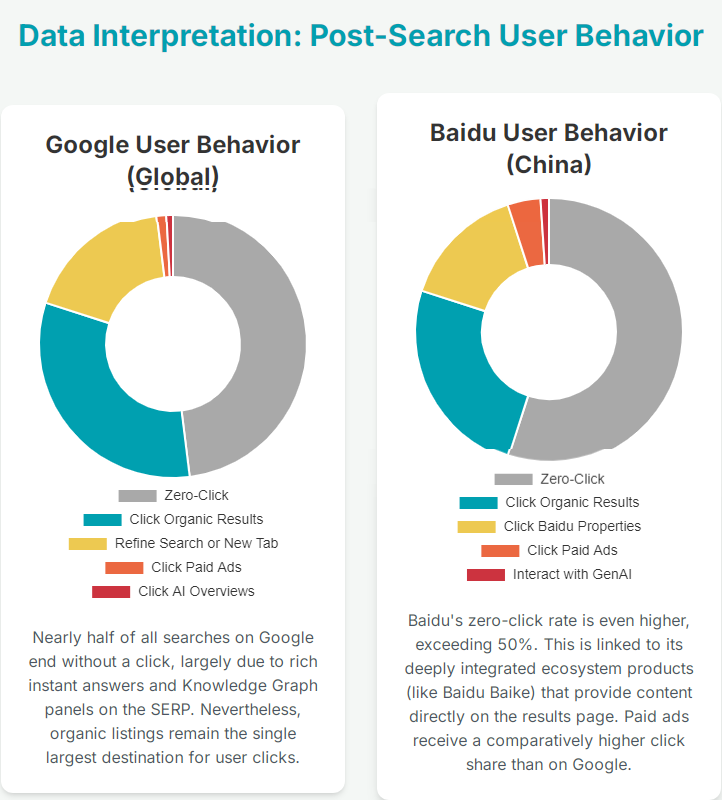
Initial insights pointed to 34.3% of users clicking on organic search results. However, with the rapid iteration of search engine technology, particularly the widespread application of AI Overviews, this data has changed significantly. According to a Similarweb report published in May 2025, since the launch of AI Overviews in May 2024, the proportion of “zero-click” searches has grown by 13 percentage points in just one year, from 56% to 69%. This indicates that the vast majority of Google searches now end without a user clicking on any link.
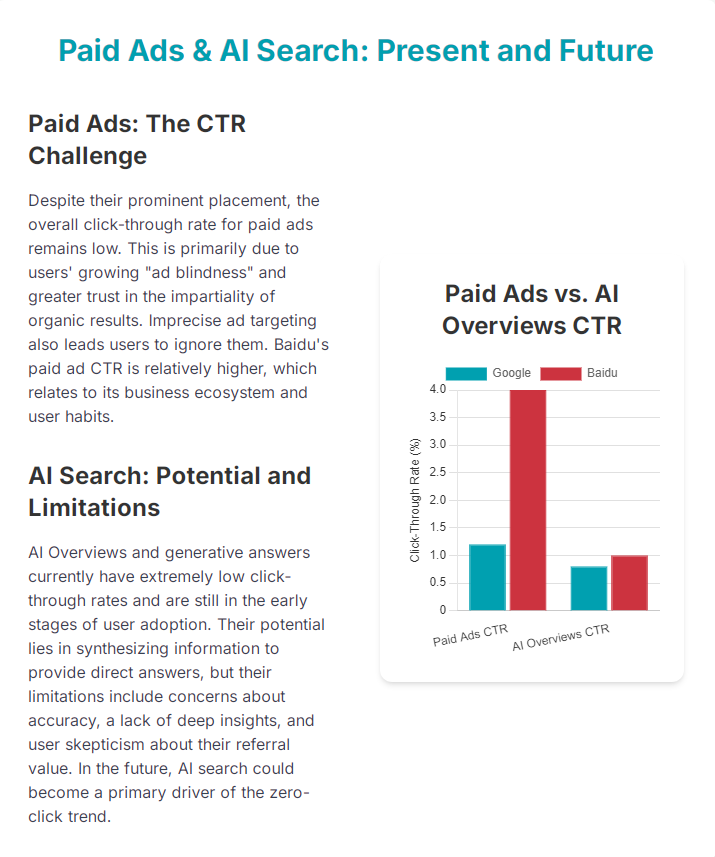
A Pew Research Center analysis of browsing data from 900 U.S. adults further confirms this trend. The study shows that when an AI Overview is present on the search results page, the proportion of users clicking on traditional organic links drops sharply from 15% (when no AI Overview is present) to just 8%. This data directly reflects the “cannibalization” effect of AI Overviews on traditional click patterns. More interestingly, the click-through rate for source links cited within the AI Overview itself is extremely low, at only 1%. This suggests that users prefer to consume the integrated answer provided by the AI rather than delve into the original sources behind it.
In the distribution of user behavior after a search, data shows that 26% of users end their browsing session immediately after reading the AI-generated summary, while another 32% choose to perform a secondary search within Google. These behavioral patterns paint a clear picture: the search results page is becoming the destination of the user’s journey, not the starting point. Nevertheless, the importance of organic search rankings has not completely disappeared. Data shows that before the widespread adoption of AI Overviews, the top three organic results still received a respectable click-through rate, with the first position averaging about 22.4%. This underscores that even in the face of the “zero-click” trend, organic results that hold a prominent position can still capture high-value traffic.
1.2 Baidu Search User Behavior Analysis (2025)
In the Chinese market, Baidu, as the dominant search engine, also faces the challenge of the “zero-click” phenomenon. Similarweb metrics show that Baidu search results also have a ratio of searches that lead to clicks versus those that do not (i.e., “zero-click”). This phenomenon is most prevalent in informational queries designed to get a simple, direct answer, such as for weather, exchange rates, or general knowledge questions. When a user’s question can be answered directly within the search results page’s “Quick Answers,” “Knowledge Boxes,” or “Featured Snippets,” they have no need to click further.
At the same time, Chinese users’ search behavior shows a clear trend toward “multi-platform, decentralized” searching, which stands in stark contrast to Google’s single-platform dominance. According to QuestMobile data, as of March 2025, the user base of AI-native apps in China has reached 240 million and is growing at an astonishing rate. This shows that Chinese users have a high degree of acceptance for AI technology and are gradually adopting AI tools as important aids in their daily decision-making. Furthermore, another report indicates that the daily search volume on social platforms like Xiaohongshu has reached half of Baidu’s, with an incredible growth rate. This phenomenon suggests that Chinese users’ search entry points have become highly fragmented. They no longer rely solely on Baidu, but seamlessly switch between Baidu, Xiaohongshu, Douyin, and other platforms depending on their needs. For example, a purchasing decision might start with a post on Xiaohongshu, while travel tips might be found in a video on Douyin.
This behavioral pattern has profound implications for Chinese companies’ marketing strategies. It means that optimizing for Baidu search results alone is no longer sufficient to reach all potential customers. Businesses need to adopt a “Search Everywhere Optimization” strategy, integrating the “search” entry points of different platforms, including on-site search, vertical-specific search, and social media search, to maintain brand visibility throughout the entire user journey.
1.3 Core Findings and Insights
By analyzing the latest data from both the global and Chinese markets, two key findings can be clearly identified. First, for both Google and Baidu, the enrichment of search results pages and the rise of AI have led to the widespread adoption of the “zero-click” phenomenon. This is a global, irreversible trend that is changing the way users interact with search results, shifting from a traditional “click” model to an “information consumption” model.
Second, the two markets show significant differences in the evolution of their search ecosystems. In the Google-dominated Western market, the growth of zero-clicks is primarily driven by Google’s own restructuring of the SERP, which uses features like AI Overviews to keep traffic within its own platform. In the Chinese market, in addition to the zero-click trend within Baidu, a more notable trend is the high degree of “decentralization” of the entire search ecosystem. Users are not confined to a single search engine, but flexibly switch between multiple super-apps and vertical content platforms based on their search intent. This “multi-entry” search behavior requires businesses to adopt a more comprehensive “omnichannel visibility” strategy, positioning their brand touchpoints on every possible user search path.
The following table summarizes the latest search user behavior data for global and Chinese markets to help readers better understand these changes:
| User Behavior Metric | Google (2025) | Baidu (2025) |
| Zero-Click Search Rate | 69% (significant growth) | Present (zero-click search volume is visible) |
| Traditional Organic CTR | 8% (when AI Overviews appear) | N/A (but zero-click phenomenon is widespread) |
| AI Overview CTR | 1% | N/A |
| AI Application User Scale | 18% of queries trigger AI Overviews | 240 million AI-native app users, with rapidly increasing stickiness |
| Platform Competition | Traditional search coexists with AI search | Decentralized search entries, with social platform search volume surging |
Part Two: Deep Dive — Why Do Nearly Half of Users Not Click?
2.1 Unmet Search Intent
To understand the “zero-click” phenomenon, we must first analyze the user’s search intent. Every user search has a clear purpose, and these purposes can generally be categorized into four basic types: Informational, Navigational, Commercial, and Transactional.
- Informational Intent: The user aims to get an answer to a question or understand a concept, such as “how to make coffee” or “what is quantum computing.”
- Navigational Intent: The user is trying to access a specific website or page, such as “Amazon official website” or “Baidu Maps.”
- Commercial Intent: The user is in the research phase before a purchase decision, such as “Canon camera review” or “best laptop.”
- Transactional Intent: The user is ready to take immediate action, such as “buy iPhone 15” or “download report.”
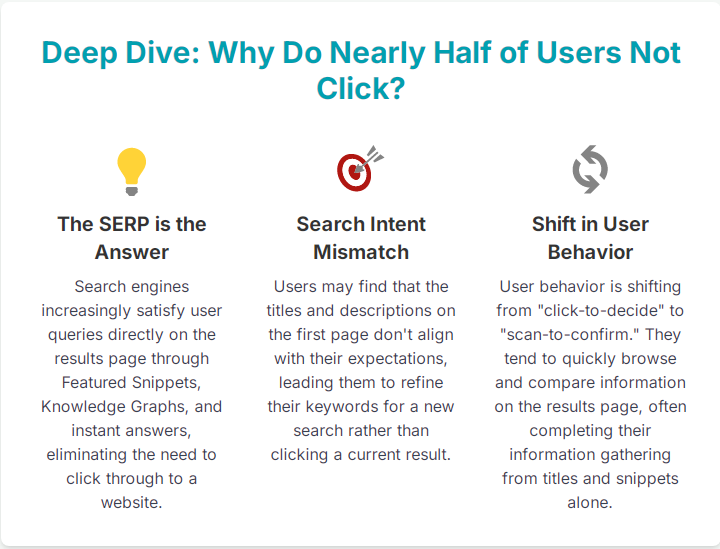
The growth of the zero-click phenomenon is primarily driven by informational queries. When a user searches for something like “how many kilometers in a mile” or “what day is it today,” their intent is to get a simple, direct answer. Once that answer is presented directly on the search results page, the user has no need to click on any links. The increase in this behavior reflects an evolution in user search intent: they are shifting from “finding” answers to “getting” answers, pursuing efficiency and instant gratification.
2.2 The Search Results Page (SERP) as the Answer
If search intent is the internal driver of “zero-click” behavior, then the increasingly rich SERP features are its external manifestation. Search engines have introduced various rich media results that present information directly on the first page, which would have traditionally required the user to click to enter a website. These features include, but are not limited to:
- Featured Snippets: A highlighted box at the top of the search results that directly answers the user’s question.
- Knowledge Panels: A box on the right side of the results page (on desktop) that provides an overview of a person, place, or thing.
- Direct Answer Boxes: Provides a direct answer to simple factual questions, such as “today is Friday”.
- AI Overviews: The most disruptive feature. It uses a large language model to synthesize and summarize information from multiple sources into a complete, easy-to-read answer.
Together, these features create a new search paradigm of an “Answer Engine”. Pew research found that when AI Overviews appear, the user click-through rate drops by nearly 50%, and 26% of users leave directly, which indicates that AI Overviews can instantly satisfy user queries without further clicks. The presence of these features makes the search results page itself a content aggregation and information consumption platform, greatly reducing the need for users to navigate to external websites.
2.3 Changes in User Behavior: Browsing vs. Decision-making
Traditionally, user behavior on the search results page was a kind of “treasure hunt”: they would click on multiple links to compare and verify information until they found the most satisfactory answer. However, with the evolution of SERP features, this behavior is being replaced by a more efficient “speed-reading” behavior. Users can quickly scan the SERP, locate, and absorb the answers provided by Featured Snippets, AI Overviews, and other features, thus completing their information gathering in a very short time.
This behavioral shift is not a total rejection of website traffic, but a redefinition of the nature of a “click.” When a user ultimately chooses to click on a link, their intent is often clearer because they may have already completed early, low-level research and information filtering through zero-click features. For example, a user might use an AI Overview to understand the basic functions and principles of a product, and then click on a specific review link on the SERP with a stronger intent to purchase or learn more. Therefore, zero-click searches, in a way, serve as a “pre-filtering” and “user qualification” function. It filters out users who only need a quick answer, guiding truly high-intent, high-value users to the website, thus making each click of higher quality and with a higher conversion rate.
The following table maps search intent to SERP features and user behavior to help clarify this complex relationship:
| Search Intent Type | Common SERP Features | Typical User Behavior | Impact on Businesses |
| Informational | Featured Snippets, Knowledge Panels, AI Overviews | High zero-click rate | Brand exposure, authority building |
| Navigational | Sitelinks, branded Knowledge Panels | High click-through rate (direct access) | Brand awareness, user loyalty |
| Commercial | Local Packs, video carousels, shopping ads | Medium to high click-through rate | Lead generation, nurturing purchase intent |
| Transactional | Paid ads, product pages | High click-through rate, high conversion rate | Direct sales, customer acquisition |
Part Three: The Importance of SEO Remains Secure
3.1 Organic Search is Still a Core Traffic Driver
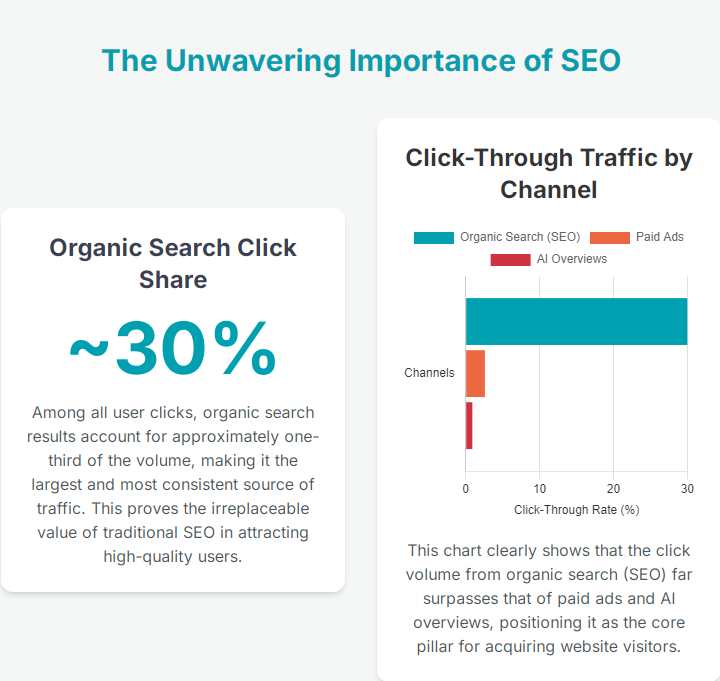
Despite the growing “zero-click” trend, organic search remains an unshakable cornerstone of the digital ecosystem. Data shows that organic search is the primary source of website traffic, contributing up to 53.3% of total traffic. In stark contrast, paid ads contribute only about 25% of total clicks. This demonstrates that the scale of traffic driven by SEO is more than double that of paid ads, solidifying its position as the core traffic driver.
In addition to its traffic volume advantage, the quality of traffic from organic search is also higher. Data shows that SEO-driven traffic has an average conversion rate of 2.4%, while paid ads have an average conversion rate of only 1.3%. In some specific industries, such as legal services, the SEO traffic conversion rate (7.5%) is more than three times that of paid ads (2.2%). This difference further validates the “pre-filtering” effect of “zero-clicks.” Through rich SERP features, users have already completed their initial information gathering before clicking, gaining a clearer understanding of the brand and product. Therefore, when they click through to the website, their purchase intent is generally stronger, and their conversion likelihood is higher.
3.2 The Value of Sticking to Traditional SEO Strategies
The rise of the zero-click phenomenon forces businesses to re-examine the value of SEO. Its value can no longer be measured by a single metric like “clicks,” but has undergone a paradigm shift from “traffic” to “brand.”
Even when a user does not click on a link, a business can still gain significant brand visibility by appearing in a Knowledge Panel, Featured Snippet, or AI Overview. This visibility is far from insignificant. When a brand consistently appears as a source of “answers” or “authoritative information” on the SERP, users’ subconscious minds will gradually view it as an expert and a trustworthy authority in that field. The establishment of this brand trust is invaluable, as it ultimately translates into an increase in branded direct searches, where users type the brand’s domain name directly into their browser when they need it. The growth of this direct traffic is a testament to the long-term value that SEO provides in the “zero-click” era.
Unlike paid advertising, which requires continuous and high-cost investment, SEO is a strategic investment that delivers long-term, sustainable growth. Data shows that the return on investment (ROI) for SEO is very impressive, with an average return of $250 for every $1 invested. Once a website has achieved a good ranking and authority through continuous content creation and technical optimization, the traffic and brand value it generates will remain stable for a long time, without the need for constant budget spending like paid ads. Therefore, in the uncertain new search era, SEO remains the cornerstone for businesses to build a long-term competitive advantage and achieve sustainable growth.
Part Four: The Status and Future of Paid Ads and AI Search
4.1 Reasons for Low Paid Ad Click-Through Rates
Although paid ads (PPC) can provide instant traffic and precise targeting in some cases, their click-through rate (CTR) is generally low for several reasons. First, as a component of the SERP, paid ads are also affected by the “zero-click” trend. When an AI Overview or Featured Snippet can directly satisfy a user’s information needs, they have no reason to click on an ad or any other link.
Second, there is widespread “ad fatigue” and a lack of trust in paid ads among users. Multiple studies show that users tend to trust organic search results more, believing they are earned based on content quality and authority, rather than being paid for. This difference in trust directly leads to lower CTR for paid ads. More ironically, paid advertising also faces the severe technical challenge of “click fraud.” Research suggests that up to 50% of ad clicks may come from bots or competitors. These invalid clicks artificially inflate the CTR but provide no commercial value, instead wasting marketing budget and distorting data analysis results.
4.2 The Potential and Current Limitations of AI Search
The rise of AI search heralds the next major transformation in the search domain. Its potential lies in its ability to provide a more personalized, conversational user experience. New-generation large models like Google’s Gemini and Baidu’s Ernie Bot have multimodal understanding capabilities, which can integrate information from text, images, audio, and even video to provide users with a comprehensive, customized answer. The adoption rate of AI search is rising rapidly, indicating it will become an important way for people to get information.
However, AI search still has many limitations and challenges. The main issue is the potential for “AI hallucinations,” which are inaccurate, false, or misleading information generated by AI models. This not only reduces user trust but also poses a threat to content creators’ copyright and traffic rights. The CEO of Cloudflare pointed out that AI Overviews are “ruining” internet search because they act as “answer engines” that provide a direct conclusion without giving users a “treasure map” to find the original sources. Data shows that the click-through rate for source links cited in AI Overviews is only 1% , which means content producers may not receive the corresponding traffic return for their contributions. Additionally, AI Overview’s source citations may have a preference, with Google’s AI Overview more often citing user-generated content platforms like Reddit and YouTube. For many businesses, adapting to this trend also faces the challenge of talent and technological investment, as the lack of relevant knowledge and resources is a major obstacle to the full application of AI technology.
Part Five: Enterprise Strategy
5.1 How to Optimize SEO and Content Strategy
In the face of the new normal of “zero-click” and AI search, businesses must shift their SEO and content strategies from a simple “keyword-driven” approach to a “user intent-driven” one.
First, content should be built around the user’s core intent. For informational intent, create well-structured, Q&A-style blog posts and provide a concise answer to the question directly at the beginning of the article to increase the chance of being selected for a Featured Snippet or AI Overview. For commercial intent, provide detailed comparison articles, reviews, and guides to help users make informed purchasing decisions.
Second, embrace the essence of “zero-click” and enhance brand visibility on the SERP through structured content:
- Content Structure: Use clear headings like H1, H2, bullet points, tables, and FAQ sections to make content easier for search engines to crawl and parse, thus generating Featured Snippets.
- Structured Data (Schema Markup): Implement Schema markup, such as HowTo, FAQ, and Review, to help search engines better understand the content of a webpage, increasing the chance of it being selected for rich media results or Knowledge Panels.
- Local SEO: For businesses with physical stores, focus on optimizing their Google Business Profile or Baidu Maps to gain exposure in the “Local Pack,” which often leads to in-store traffic.
Finally, create “AI-friendly” content (AEO). AI models tend to cite content that is authoritative and professional. Therefore, content should emphasize the E-E-A-T (Experience, Expertise, Authority, Trust) principle. This includes providing firsthand experience, proprietary research, case studies, or original charts, and citing credible external sources to establish the brand’s industry authority and increase the likelihood of being cited by an AI Overview.
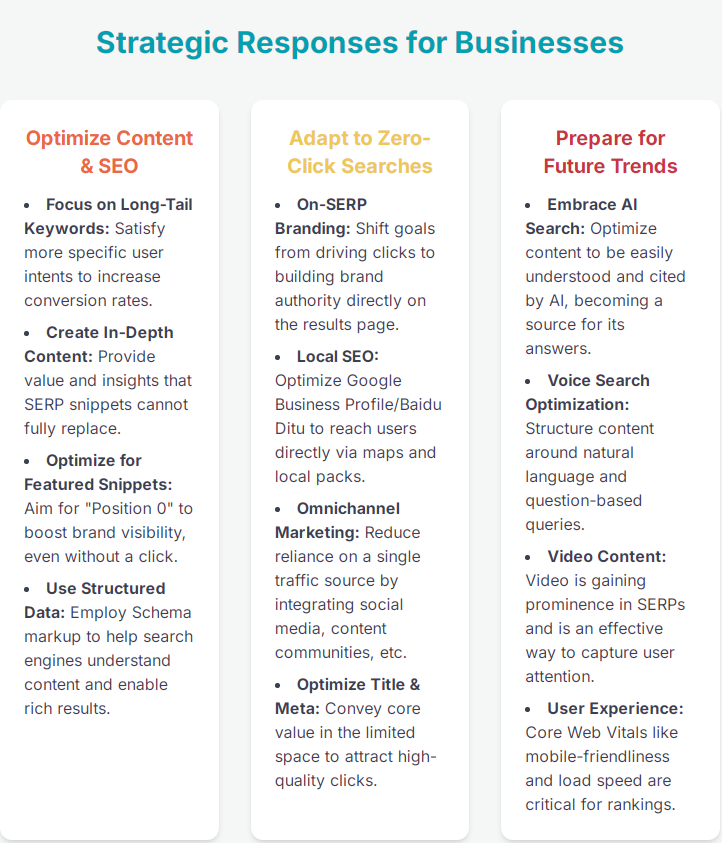
5.2 How to Respond to the “No-Click” Search Phenomenon
If “zero-click” is the new normal, then traditional metrics like “click-through rate” and “traffic volume” are no longer the only measures of success. Businesses need a paradigm revolution in how they measure success, shifting from focusing solely on “clicks” to focusing on “brand visibility” and “full user journey value.”
It is recommended that businesses adopt a new metric system:
- Total Impressions and Average Position: In tools like Google Search Console, these metrics can directly reflect the content’s exposure on the SERP. Even without a click, every impression is an effective brand touchpoint.
- Direct Traffic: Consistent brand exposure on the SERP can build user trust and awareness, which may prompt users to visit the website directly by typing in the brand’s domain name in the future. Therefore, the growth of direct traffic can be seen as a reflection of the long-term brand value delivered by SEO efforts.
- Conversion Path Analysis: Through tools like Google Analytics 4 (GA4), businesses can track user paths that start with a zero-click impression and ultimately lead to a conversion through other channels (such as direct visits).
5.3 How to Strategize for Future Search Trends (e.g., AI)
The future search ecosystem will be multi-platform, hybrid, and AI-driven. Businesses must adopt a multi-dimensional strategic layout to ensure they stay ahead of the curve in this constantly changing landscape.
First is the synergy between SEO and PPC. PPC can quickly bring traffic to a business, compensating for SEO’s slower results. At the same time, businesses can use PPC data to quickly test high-value keywords and conversion rates, feeding the successful insights back into their SEO content strategy. By occupying both paid and organic results on the SERP, a brand can significantly increase its visibility and authority, and effectively push competitors further down the page.
Second is diversifying traffic sources. Especially in the Chinese market, businesses should not put all their eggs in one basket. In addition to search engine optimization, they should actively position themselves on social media and vertical content platforms like Xiaohongshu, Douyin, and Zhihu. By publishing valuable content on these platforms, businesses can attract and retain users and increase the likelihood of their content being cited in AI answers.
Finally, businesses need to make strategic adjustments, investing more resources into “AI-friendly” content creation, structured data implementation, and new performance measurement systems. Here is an action checklist for businesses to respond to “zero-click” and “AI search,” providing a clear guide for their teams:
| Business Action Checklist | Specific Strategies |
| Content Optimization | 1. Answer First: Provide a short, direct answer to the question at the beginning of the article. 2. Structured Content: Use headings, bullet points, tables, and FAQ formats. 3. Originality and Authority: Create content with firsthand experience, proprietary data, and case studies. |
| Technical Implementation | 1. Schema Markup: Implement structured data to help search engines understand the content. 2. Local SEO: Optimize Google Business Profile or Baidu Maps to gain Local Pack exposure. 3. Website Speed and Mobile Optimization: Ensure the website loads quickly and provides a good experience on mobile devices. |
| Measurement Metrics | 1. Visibility Tracking: Monitor total impressions and average position in Google Search Console. 2. Brand Traffic Analysis: Analyze the growth of direct traffic through GA4 to measure the increase in brand awareness. 3. Conversion Path Tracking: Focus on the entire user journey from SERP exposure to final conversion. |
| Strategic Layout | 1. SEO and PPC Synergy: Use the immediacy of PPC and the long-term benefits of SEO to achieve both traffic and brand growth. 2. Diversify Traffic Sources: Distribute content to social media, vertical forums, and other platforms to reduce dependence on a single search engine. |
Conclusion
The “zero-click” phenomenon is not a total rejection of search marketing but a necessary evolution as it enters a mature stage. It is weeding out low-value content created purely to attract clicks and creating new exposure opportunities for content that can provide deep value and build brand authority. Data clearly shows that SEO still has unparalleled advantages in driving traffic, building brands, and providing long-term ROI.
The future search ecosystem will be a hybrid of multiple platforms and entry points, with both AI and traditional models coexisting. In this new environment, businesses must abandon the traditional “traffic is king” mindset and embrace a “brand visibility and user value” mindset driven by data. This means that success no longer depends on how many clicks are received, but on whether the brand can provide the most authoritative and relevant answer at every key touchpoint of the user’s journey. By optimizing content quality, implementing structured technologies, building brand trust, and diversifying their presence, businesses can gain the upper hand in the new search era, achieving a leap from “clicks” to “brand assets.”
 Unlock 2026's China Digital Marketing Mastery!