 English
 German
 Korea
Korea Spanish
Why China SEO Is the Wrong Place to Start
- On June 26, 2026
- china geo, china marketing strategy, China seo
Why Traditional SEO Thinking Doesn’t Work in China
Yesterday, an inquiry arrived from a global natural herbal products manufacturer based in India. They sell high-quality botanical extracts internationally and wanted to crack the Chinese market. Their request was straightforward, common, and fundamentally flawed:
“Can you help us build a website and rank it on Baidu via SEO?”
At first glance, it sounds completely logical. In Western markets, if you want to capture demand, you build an optimized website, execute a technical SEO strategy, and let Google do the heavy lifting.
But duplicating this playbook in China is a fast track to burning through budgets with zero return.
The core issue is not that the request is difficult to execute. It is that it exposes a foundational misunderstanding of how the market works.
The One Big Idea: China SEO is not your first marketing problem. Your first problem is choosing the wrong entry point into China’s digital ecosystem. Most foreign companies don’t fail in China because of bad SEO; they fail because they start with SEO.
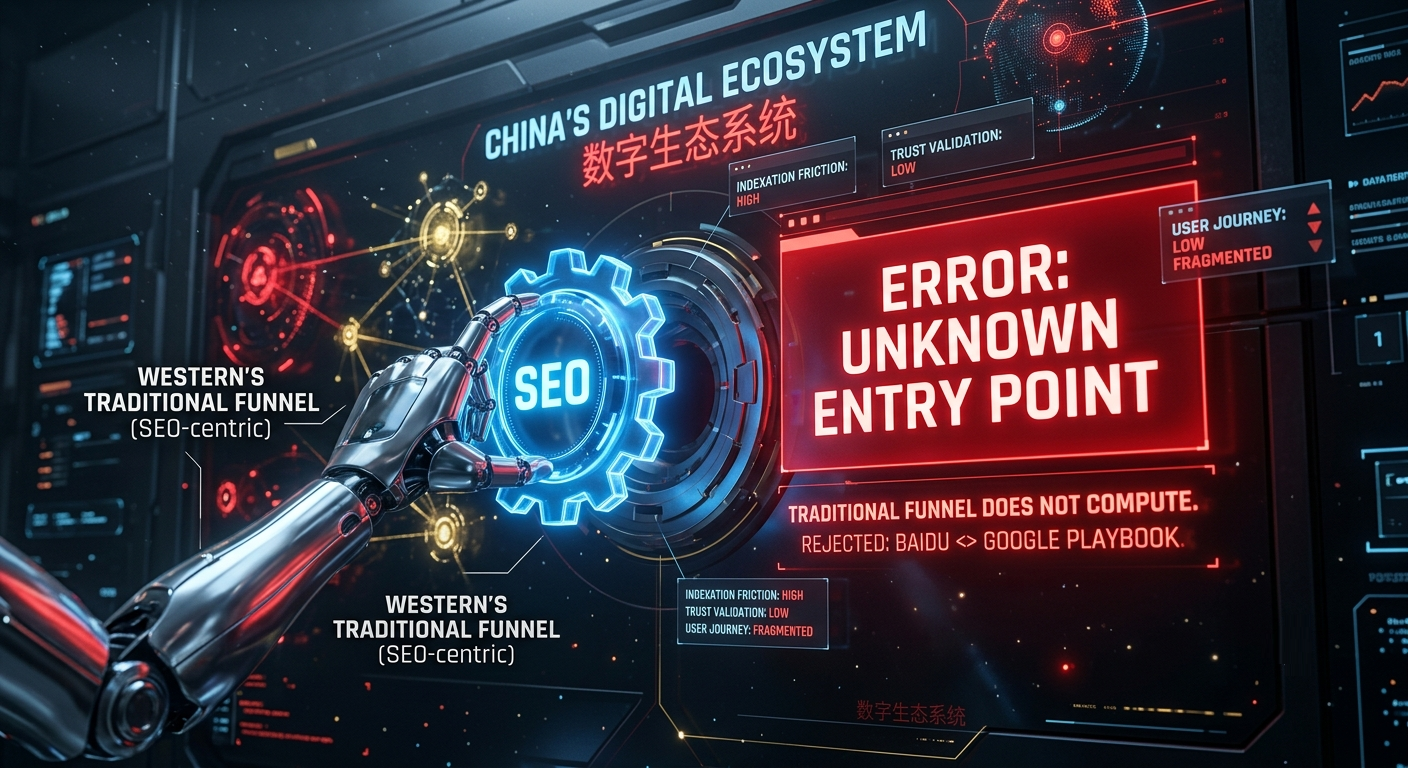
Why Traditional SEO Thinking Doesn’t Work in China
The typical Western digital marketing funnel looks like this:
Brand Website → Google SEO → Organic Traffic → Lead/Conversion
When foreign B2B and B2C brands attempt to drag-and-drop this blueprint into China, they hit a brick wall. The Chinese internet is not an open web dominated by a central search engine. It is a highly fragmented ecosystem of closed, self-contained app universes.
Baidu is often called “China’s Google,” but treating it like Google is a costly mistake. Consider the structural and algorithmic realities of organic search in China:
- The Indexation Bottleneck: New websites face extreme friction getting indexed on Baidu. Without a local ICP (Internet Content Provider) license—which requires a registered Chinese business entity—indexing can take months or never happen at all.
- The Baidu Family Problem: Organic search results on Baidu are heavily compressed. The first page of a commercial query is routinely dominated by Baidu’s own proprietary products (Baidu Baike, Baidu Zhidao, Baidu Tieba) and heavy pay-per-click (PPC) advertising blocks.
- The Foreign Domain Penalty: If your server is hosted outside mainland China, or if your site loads assets (like JavaScript libraries or fonts) from Google servers, your loading speed will plummet. In an ecosystem where users expect instant mobile performance, a 4-second lag means an immediate 90%+ bounce rate.
- The Cold Start Trap: Building domain authority on a fresh Chinese website takes immense time and capital. Without existing localized brand awareness, nobody is searching for your brand name, and broad commercial keywords are too expensive or diluted to move the needle for a newcomer.
Baidu does not serve the open-web user in the way Google does. It operates under a completely different set of engagement rules, serving an audience that expects answers to be packaged within specific ecosystems rather than scattered across millions of independent corporate websites.
The Real Question Isn’t SEO—It’s Trust Architecture
To win in China, you have to elevate the conversation from technical visibility to trust architecture. The critical question for a global leadership team is not “How do I rank on Baidu?” but rather:
“Where does trust begin for a Chinese buyer?”
The modern Chinese customer journey is completely non-linear. Because the open Chinese web has historically been riddled with fragmented data, low-quality content, and intrusive advertising, user behavior has shifted. Trust is verified inside gated social and professional communities before a user ever touches a search bar.
The reality of the Chinese purchasing pathway looks like this:
User doesn’t know you
↓
They will NOT search for you on Baidu
↓
They will definitely NOT click through to an unverified corporate website
Instead, their discovery, evaluation, and validation take place across a decentralized network of high-engagement platforms:
- WeChat Official Accounts & Video Accounts: The definitive digital brochure and trust validation layer for B2B and high-value B2C brands.
- Xiaohongshu (RED): The ultimate search engine for lifestyle, product reviews, and word-of-mouth validation.
- Zhihu: The go-to platform for deep technical, engineering, and enterprise B2B peer-to-peer discussions.
- Vertical Communities & Industry Groups: Private domain WeChat groups where peers exchange direct recommendations.
According to McKinsey’s State of the Consumer research, the digital path to purchase has become highly diffuse, with social platforms commanding absolute priority across brand discovery and validation phases. In China, search is rarely the genesis of demand; it is the validation of it. A user sees your insights or peer recommendations inside an app, and only then do they execute a search to verify your legitimacy.
AI and GEO Have Quietly Changed the Rules
While traditional search has become highly fragmented, a massive architectural shift occurred. The rise of large language models and Generative Engine Optimization (GEO) has fundamentally transformed how cross-border content is indexed, processed, and served.
For global companies, this brings a surprising piece of good news: Your high-value English content has suddenly gained a massive, hidden audience inside China.
Old SEO Paradigm: English Site → Invisible to Baidu → Zero Value in China
New GEO Paradigm: Deep English Knowledge Base → LLM Training & Real-Time Retrieval → Structured Chinese AI Answers
Leading Chinese AI models—including DeepSeek, Alibaba’s Qwen, Baidu’s ERNIE Bot, Tencent’s Hunyuan, and Moonshot AI’s Kimi—are trained on massive, multilingual datasets. When a Chinese engineer, procurement manager, or enterprise buyer asks a complex technical question to an AI assistant, the engine does not limit its search to the Chinese open web.
The underlying AI models crawl, parse, and synthesize global data. The workflow happens seamlessly under the hood:
- A Chinese user inputs a highly specific query about an industrial or product standard.
- The AI engine executes a multi-turn retrieval-augmented generation (RAG) loop.
- The engine pulls insights from authoritative English whitepapers, technical blogs, and academic papers.
- The AI translates, synthesizes, and outputs a structured answer in Chinese, frequently citing the original global source.
English content no longer competes only inside Google’s sandbox. It now actively competes for visibility inside the generative engines powering Chinese enterprise decision-making. If your global website contains highly structured, authoritative data, data-driven insights, and peer-reviewed metrics, Chinese AI engines will find it, extract it, and serve it to local users as a verified answer.
The Website Is No Longer the Center
In the traditional marketing model, the corporate website sat at the center of the universe. Every marketing campaign, email blast, and SEO effort acted as a spoke designed to drive traffic back to that central hub.
In China’s modern ecosystem, that model is dead. The website is no longer the destination—it is simply one node in a distributed Knowledge Base.
The Architecture Shift
| Traditional Digital Model (Old) | China Ecosystem Reality (New) |
| Website as the primary conversion hub | Owned App Ecosystems (WeChat, RED) as conversion hubs |
| SEO drives cold traffic to landing pages | GEO & Social Verification builds authority first |
| Traffic volume (Clicks) is the key metric | Share of Voice & Citation Frequency are the key metrics |
| Long-tail keyword stuffing | Structured data, clear headers, and direct answers |
Instead of forcing a user to leave their preferred app to visit an external site, your brand must distribute its knowledge where the users and the AI engines actually live.
[ Your Brand Knowledge Asset ]
│
├─► Generative Engines (GEO: DeepSeek, Qwen, ERNIE) ──► Instant Structured Answers
├─► Private Domain Traffic (WeChat Communities) ──────► Peer Trust & Validation
└─► Social Native Content (RED, Zhihu) ─────────────► Active Discovery & Search
If your content cannot be frictionlessly extracted by an AI crawler or easily shared inside a WeChat group, your brand effectively does not exist in the market.
The Better Blueprint: A 5-Phase Go-to-Market Strategy
If we re-architected the strategy for our Indian herbal extract client—or any global brand eyeing China—we wouldn’t start with a line of code on a Chinese website. We would build a strategy focused on trust, localization, and AI visibility.
1.Build a Highly Structured Global Knowledge Base:
Phase 1: Foundation.
Optimize your primary English website for global AI crawlers. Ensure your technical data, case studies, and product parameters use clear heading hierarchies (H1, H2, H3) and structured tables. Do not bury facts in massive paragraphs or hide them behind client-side JavaScript rendering or gated forms. Make your data easily extractable for cross-border GEO.
2.Execute Localized Transcreation, Not Translation:
Phase 2: Localization.
Literal translation of marketing copy fails. Take your core technical assets and rewrite them to match the exact search habits, linguistic variations, and industry terminology used by Chinese professionals. Address the specific localized pain points of the Chinese market.
3.Establish Your Native Trust Hubs:
Phase 3: Ecosystem Entry.
Launch your brand’s official presence inside China’s primary walled gardens. Establish a WeChat Official Account as your official credibility verification anchor. Distribute high-value educational content across Xiaohongshu (for visual/lifestyle/B2C products) or Zhihu (for technical/industrial B2B products).
4.Seed Communities and Stimulate Peer Validation:
Phase 4: Distribution.
Engage with industry micro-influencers, participate in relevant digital professional communities, and drive user-generated discussions. In China, a single glowing recommendation in a private WeChat group or a detailed review on Xiaohongshu carries more conversion weight than a top ranking on an open search engine.
5.Activate Targeted Search & Web Assets:
Phase 5: Search Integration.
Now, and only now, does your website become meaningful. When prospective clients have discovered you on social media and verified your insights via AI engines, they will look for your official site to formalize contracts or request detailed quotes. Your Chinese web presence serves as the final, official closing tool—not the top-of-funnel discovery engine.
By shifting SEO from Step 1 to Step 5, you eliminate the risk of spending capital on empty traffic and align your budget with the actual behavior of your target customers.
Language Is Not the Biggest Barrier
When foreign executives look at China, they often conclude that the linguistic barrier is their greatest hurdle. They assume that if they simply hire a translation agency to translate their global site into simplified Chinese, the problem is solved.
It isn’t. The true barrier is a structural misunderstanding of the digital ecosystem.
Translation converts language. Localization converts understanding.
AI can translate words. Only local expertise can translate markets.
If you build a flawless, beautifully translated Chinese website but deploy it onto an open web that your audience does not use for discovery, you have simply built an expensive digital monument in the middle of a desert.
Success requires moving away from legacy, search-engine-centric models and embracing a decentralized, community-driven, and AI-optimized approach. Stop asking how to rank on an old search bar. Start building an architecture that ensures your brand is discovered, evaluated, and trusted exactly where your customers are already looking.
 Unlock 2026's China Digital Marketing Mastery!