 English
 German
 Korea
Korea Spanish
Xiaohongshu (RED) Marketing Strategy: A Guide for Western Businesses
- On January 5, 2026
- xiaohongshu, xiaohongshu marketing, Xiaohongshu strategy
1. Introduction: Navigating China’s “Parallel Digital Universe”
For Western marketers, entering the Chinese market presents a formidable challenge: engaging with a unique and completely separate digital ecosystem. This “parallel digital universe,” dominated by super-apps and self-contained platforms, operates on principles fundamentally different from the Western model reliant on Google and Meta. In this landscape, Xiaohongshu—also known as RED or Little Red Book—emerges not merely as another social media app, but as a critical lifestyle community and consumption decision portal. Success in China requires brands to understand that Xiaohongshu is an essential gateway for building authentic brand desire and influencing consumer choice.
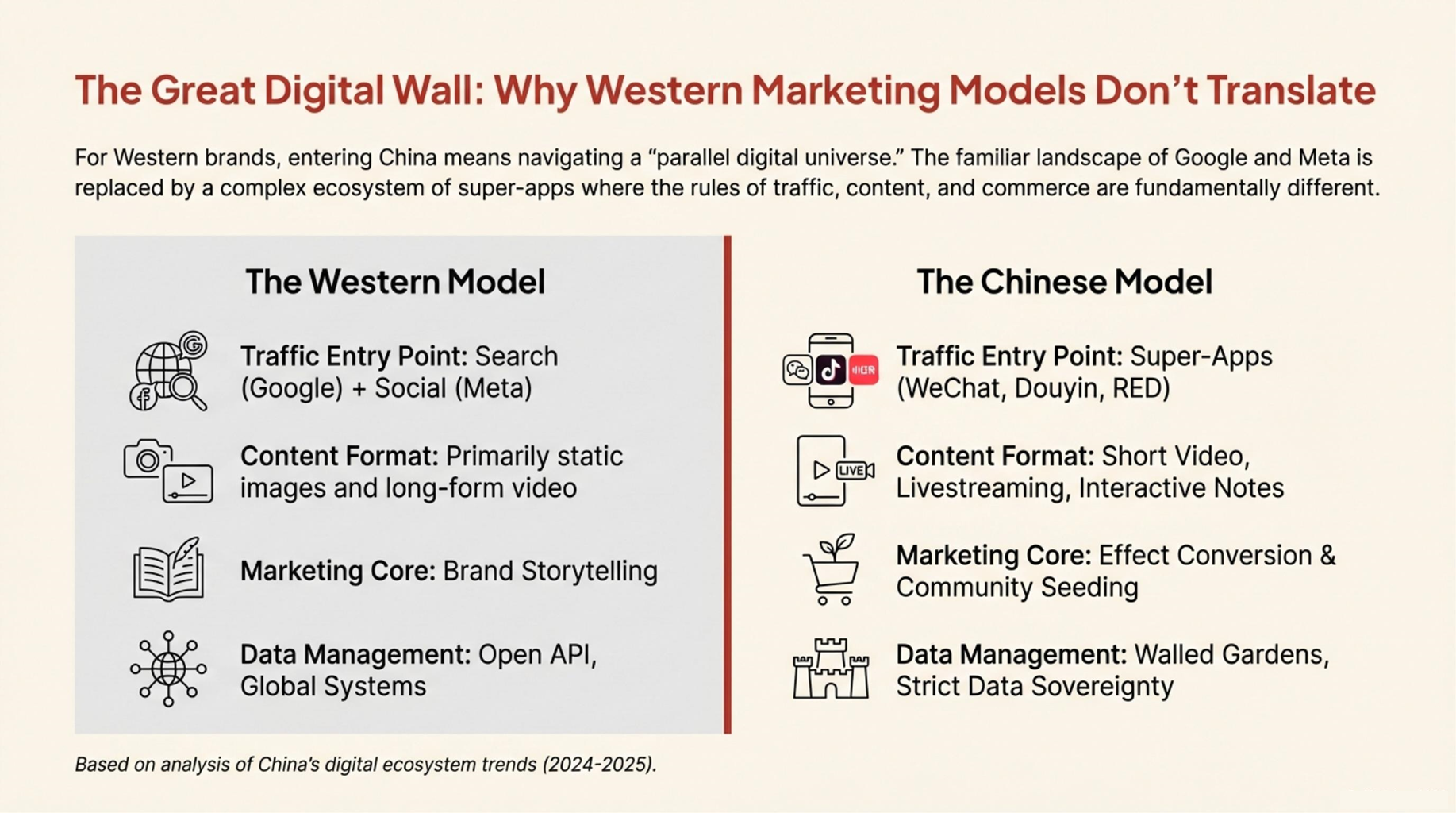
The platform’s strategic value lies in its mastery of “种草” (zhǒng cǎo), a concept best translated as “planting grass” or seeding desire. This contrasts sharply with the direct, hard-sell approach of “带货” (dài huò), or driving immediate sales. While other platforms excel at conversion, Xiaohongshu is the premier platform for the nuanced art of making consumers want a product long before they add it to a cart. It is where trends are born, recommendations are trusted, and purchase decisions are shaped through a powerful network of user-generated content. Understanding this distinction is the first step toward unlocking its immense marketing potential. To fully grasp its power, one must first understand where Xiaohongshu fits within China’s crowded and competitive social media landscape.
2. Deconstructing the Xiaohongshu Ecosystem
Before investing in a Xiaohongshu marketing strategy, it is imperative to understand the platform’s unique ecosystem, user base, and algorithmic logic. A Western “copy-paste” approach, which assumes that what works on Instagram or TikTok will work here, is destined for failure. Success requires deconstructing the platform’s mechanics and tailoring a strategy that aligns with its distinctive characteristics.
2.1. Xiaohongshu’s Position in the Chinese Social Media Landscape
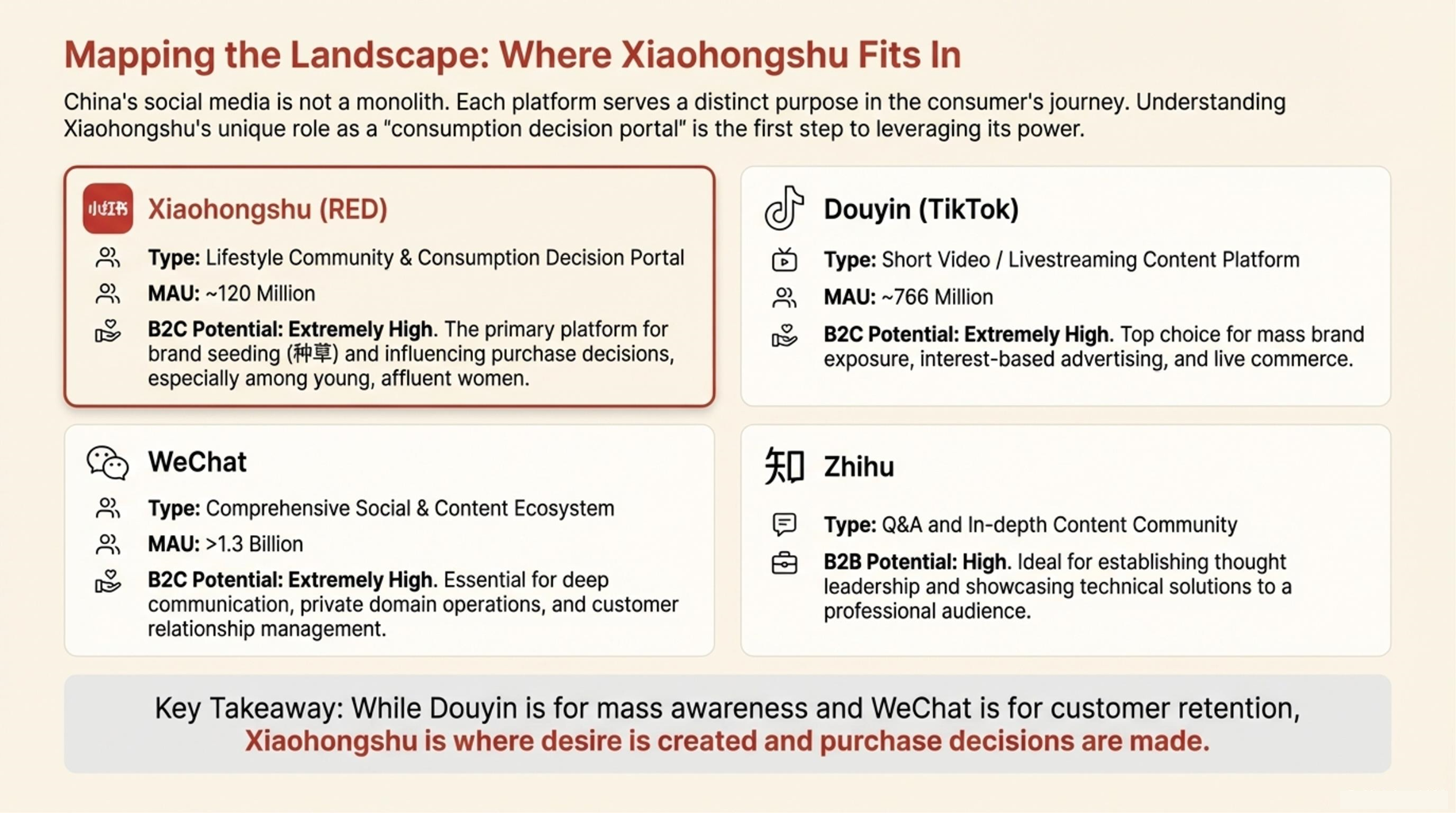
Xiaohongshu occupies a specific and powerful niche within China’s competitive social media landscape. It is not an all-encompassing super-app like WeChat, nor a pure entertainment-driven video platform like Douyin. Instead, its primary function is to serve as a hub for lifestyle inspiration and a key pre-purchase research tool, making its B2C marketing potential exceptionally high. The following table provides a comparative overview based on market analysis:
| Platform Name | Primary Function | B2C Marketing Potential | B2B Marketing Potential |
| Xiaohongshu | Lifestyle community & consumption decision portal | Extremely high. A must-win space for brand “seeding” and influencing young female consumers. | Relatively low. Niche applications for B2C-adjacent products or design services. |
| Comprehensive social ecosystem & private traffic hub | Extremely high. Core for private domain operations, customer service, and direct sales via mini-programs. | High. Essential for client relationship management and building a professional brand presence. | |
| Douyin | Short video & live-streaming entertainment | Extremely high. Premier platform for mass brand exposure, interest-based advertising, and live-stream sales. | Medium. Growing potential for visually compelling industries (e.g., manufacturing, home goods). |
| Zhihu | Q&A-based deep content community | Medium. Effective for establishing professional authority and influencing high-intent, decision-oriented users. | High. Ideal for demonstrating technical expertise, thought leadership, and lead generation. |
2.2. The Xiaohongshu User Profile: Young, Influential, and “Easily Led”
With a monthly active user (MAU) base of approximately 120 million, Xiaohongshu’s audience is both substantial and highly specific. The platform is dominated by young, urban women, with a significant concentration of “college students with little social experience.” This demographic is on the platform to casually share their lives, “show off” (装个逼), and discover new trends. It is crucial to understand that this user base, by and large, “lacks the capacity to absorb large amounts of systematic knowledge.” They are there for fun and inspiration, not for complex, in-depth analysis.
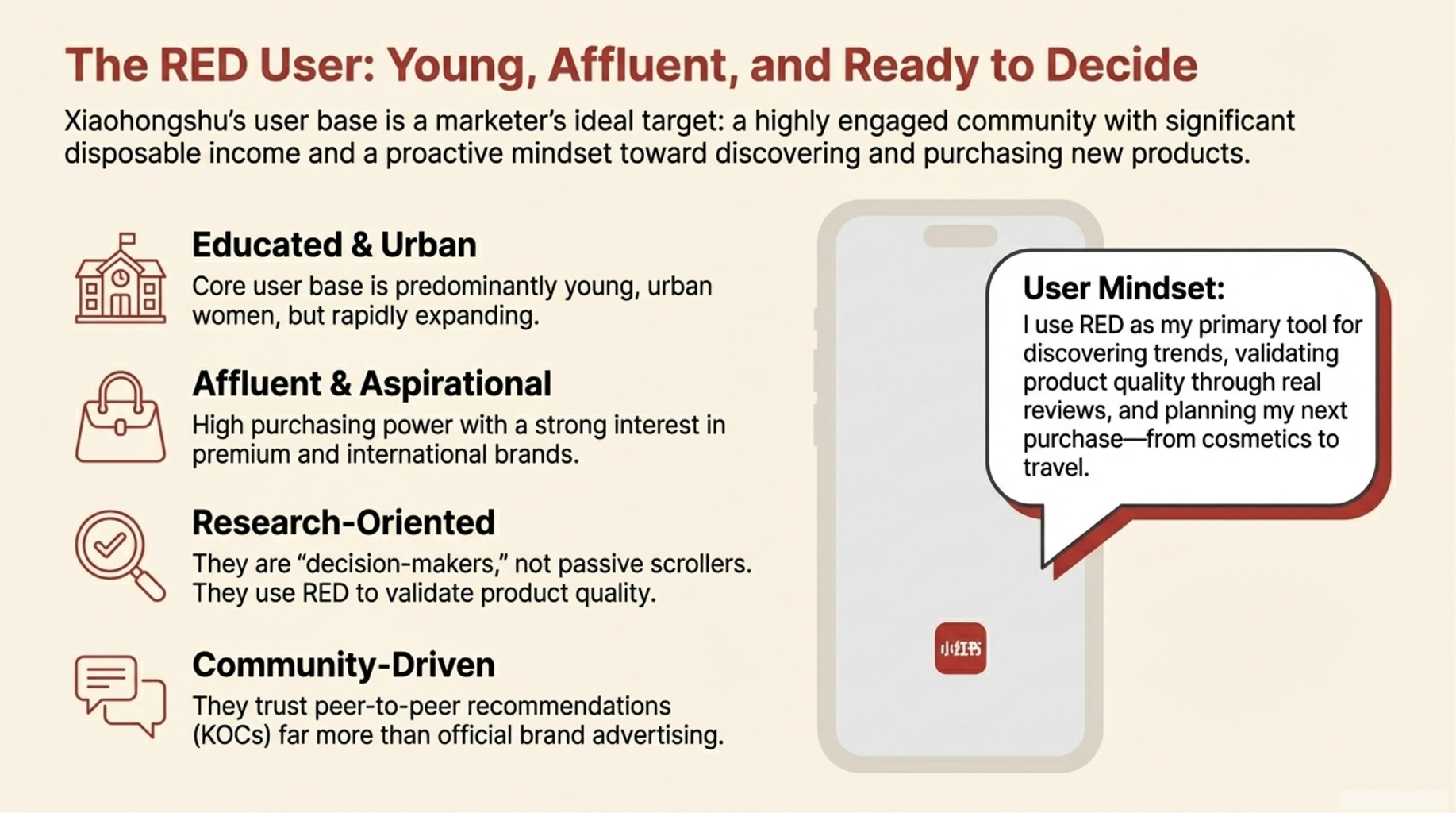
This context is not a critique but a core strategic pillar. It explains why a user base that is highly susceptible to trends and peer recommendations—”easily led” (非常容易被带节奏), in the parlance of market analysts—thrives here. Users come to Xiaohongshu specifically to be influenced, which is why authentic-feeling reviews, simple tutorials, and user-generated posts perform exceptionally well, while overly complex or engineered content fails. This makes it a uniquely powerful environment for brands that can master the art of genuine-looking content.
2.3. The Core Algorithm: Why Imitation Outperforms Innovation
To a Western strategist, Xiaohongshu’s algorithm can seem surprisingly “immature,” yet this perceived weakness is the key to unlocking predictable growth. The core mechanism is straightforward: the algorithm identifies a post structure that becomes popular, often by chance (误打误撞), and then heavily rewards other posts that imitate that same proven format.
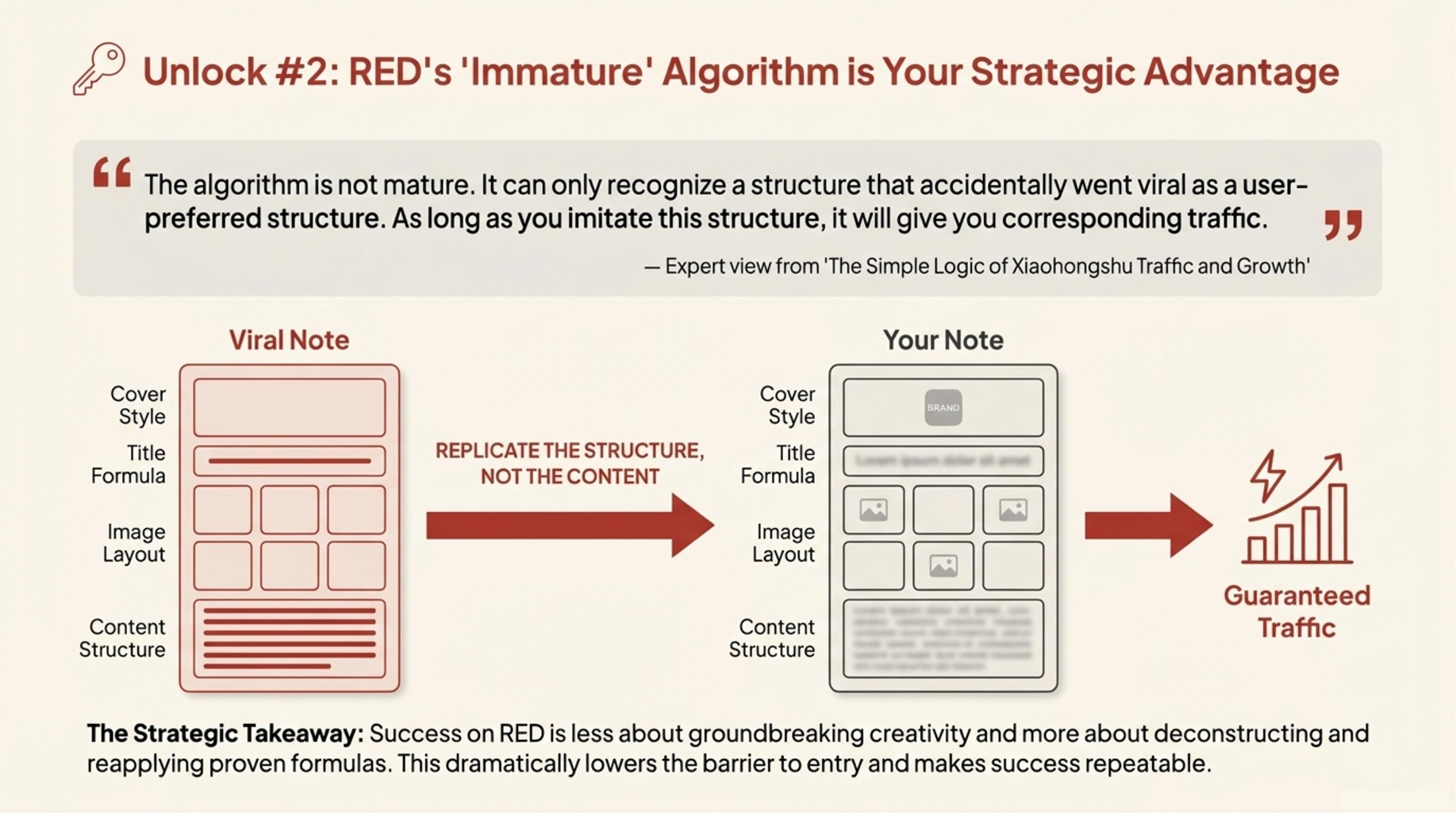
This stands in stark contrast to Western platforms that often prioritize originality and novelty. On Xiaohongshu, an insight that cannot be overstated is that “copying can perform far better than painstakingly written original content” if that original content does not conform to a recognized, high-performing structure. This creates a “win-win-win” outcome:
- Users enjoy familiar, easily digestible content formats.
- Bloggers can produce content efficiently and at scale, confident it will be rewarded.
- The Platform benefits from a massive volume of engaging content that keeps users active.
Understanding this algorithmic preference for strategic imitation over risky innovation is the foundational secret to operating successfully on Xiaohongshu.
3. The Playbook: Executing a Winning Xiaohongshu Strategy
Success on Xiaohongshu does not require a complex, theoretical framework. Western marketers should discard complex ‘mind-map’ frameworks and theoretical models; success on Xiaohongshu is far more straightforward. It demands adherence to a simple, repeatable process grounded in the platform’s unique algorithmic and user logic. The most effective strategies are practical and focused on execution rather than over-engineering.
3.1. The Four-Step “Simple Logic” Framework
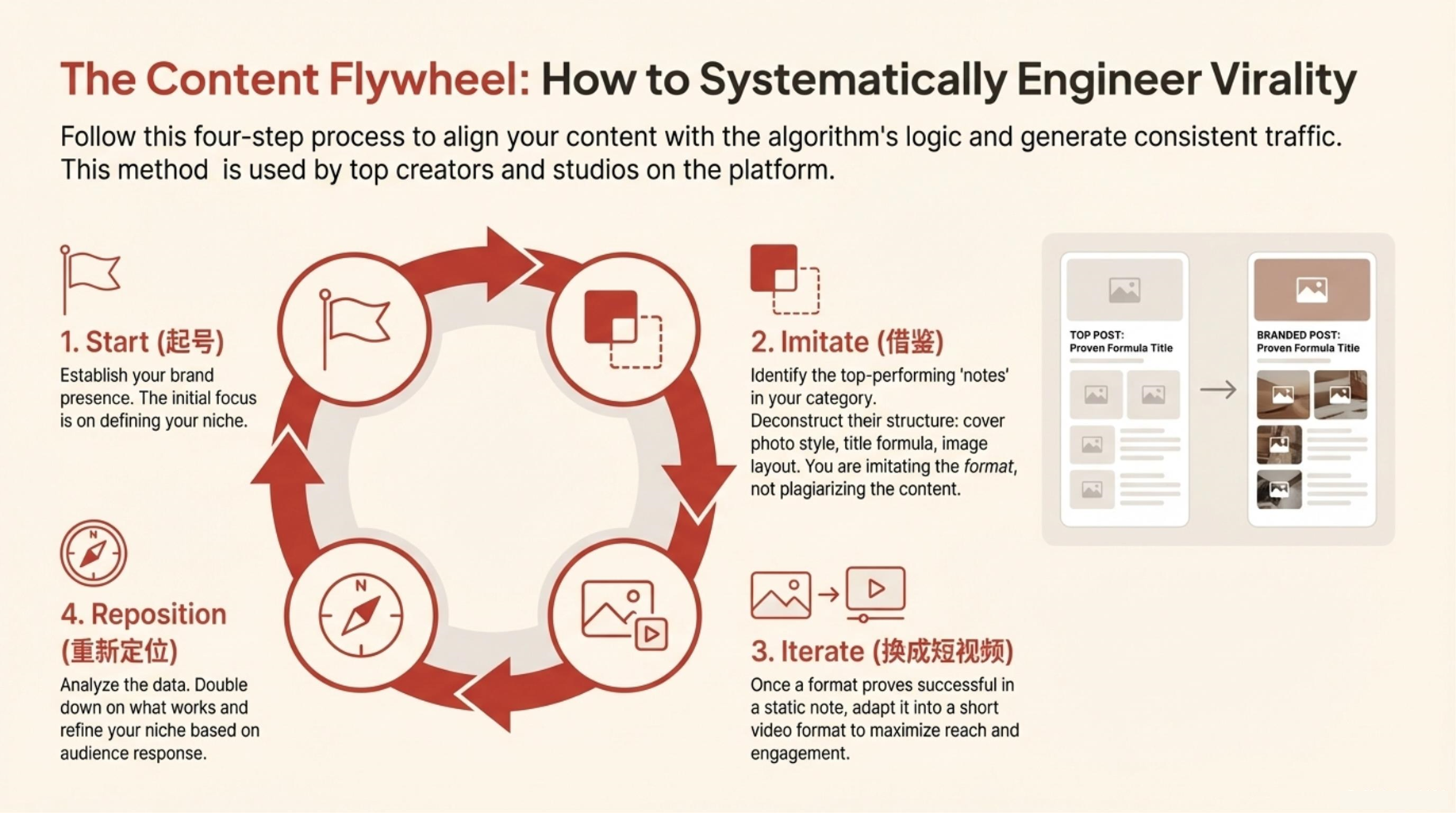
Market analysis reveals a clear, four-step process for establishing and growing a presence on the platform. This framework prioritizes action and adaptation over extensive upfront planning.
- Account Launch (起号): This is the initial setup phase. The focus is on creating the account, defining its basic visual identity, and preparing to post content.
- Strategic Imitation (借鉴): Instead of innovating from scratch, the core task is to identify viral posts within your niche. The goal is to deconstruct and replicate the format, structure, and style—not to plagiarize the exact content. This feels counterintuitive to Western marketers who prize originality, but it is essential for gaining initial traction and teaching the algorithm what your account is about.
- Pivot to Short Video (换成短视频): Once a baseline of engagement is established with image-and-text notes, incorporating short video is a crucial next step. Video content aligns with broader user trends and offers another proven format to test and replicate.
- Re-Position (重新定位): After executing the first three steps and gathering initial performance data, this final step involves refining the content strategy. This is a data-driven pivot, not a complete brand overhaul. Analyze what formats and topics have performed best and double down on them, re-positioning the account with a speed and agility that may be unfamiliar in Western marketing cycles.
3.2. Content That Connects: Master the Art of “Grass Planting”
Xiaohongshu is a “must-win” platform for brand seeding (种草). The primary goal of content is not to make an immediate sale but to build desire, trust, and brand recognition. The most effective posts feel authentic and user-centric, seamlessly integrating products into a lifestyle context.
Effective formats include:
- Authentic Image/Text Notes (图文笔记): High-quality photos paired with detailed, personal-feeling captions that share an experience, a review, or a “how-to.”
- Short Videos: Content that showcases products in a real-world setting, such as application tutorials, “get ready with me” videos, or engaging “store visit” experiences (探店).
This approach is fundamentally different from the hard-sell, “auctioneer-style” (叫卖式) live streams common on other platforms. Xiaohongshu’s value is in its ability to build a genuine connection with consumers, making them feel like they are discovering a brand through a trusted friend, not being sold to by a corporation.
3.3. Beyond KOLs: Building a KOC (Key Opinion Consumer) Army
A significant trend among Western brands is the strategic shift away from relying on a few high-cost Key Opinion Leaders (KOLs) toward activating a large volume of lower-cost Key Opinion Consumers (KOCs). Xiaohongshu is the ideal platform for executing this KOC strategy.
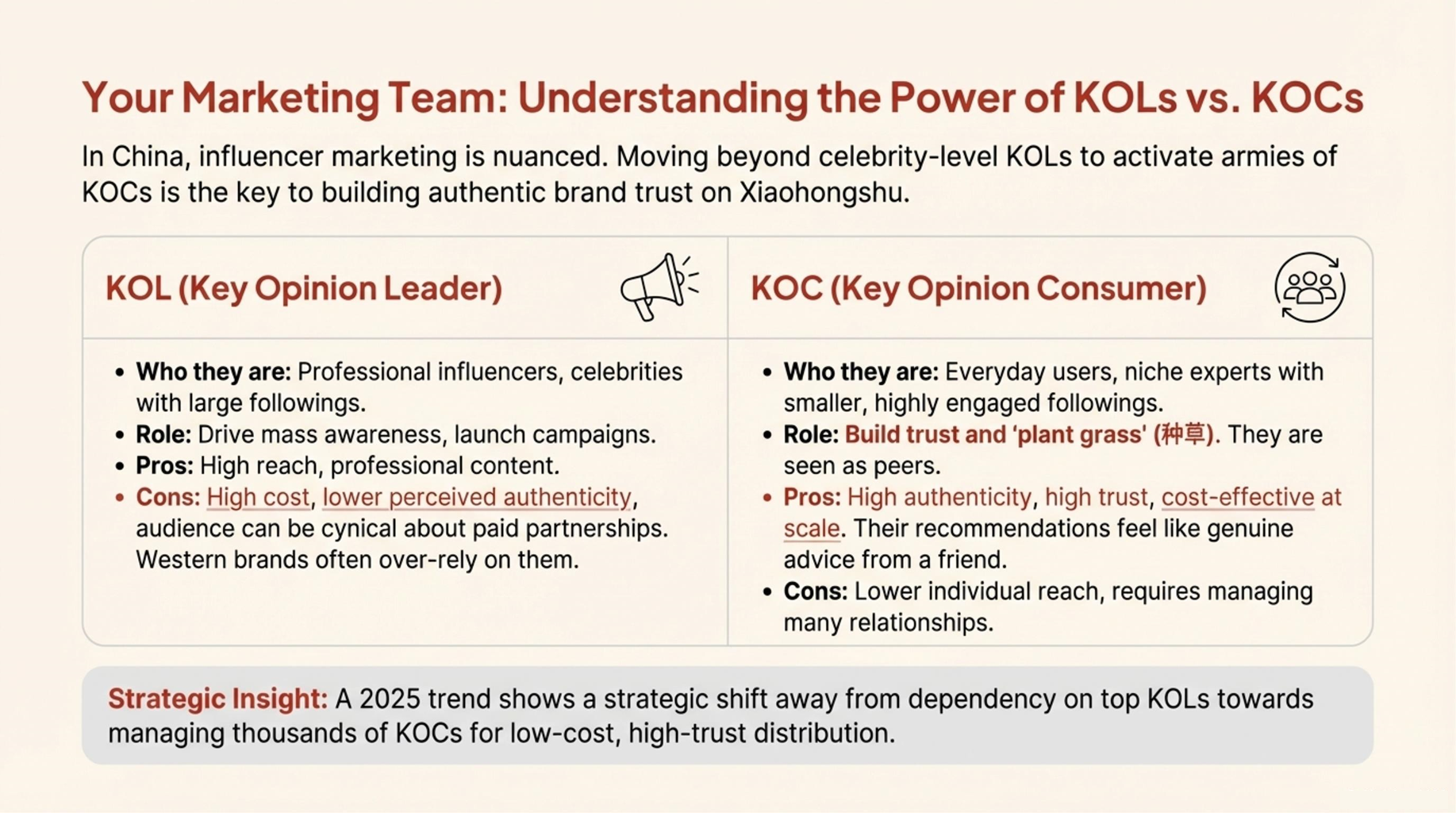
The platform’s true power lies not in a single celebrity endorsement, but in the cumulative effect of thousands of authentic user reviews and recommendations from everyday consumers. A KOC strategy leverages this dynamic by engaging micro-influencers and genuine customers to share their experiences. This approach is more cost-effective and builds higher levels of trust, creating a widespread, grassroots-level influence that feels more credible and organic to potential buyers. While the B2C playbook is clear and potent, applying these principles to a B2B context requires a different and more nuanced perspective.
4. Special Focus: A Realistic Xiaohongshu Strategy for B2B Companies
It is crucial for Western B2B marketers to approach Xiaohongshu with realistic expectations. Market analysis indicates that the platform is generally not an efficient channel for direct B2B lead generation. The user base and content consumption habits are overwhelmingly consumer-focused. Therefore, a successful B2B strategy requires abandoning traditional lead-gen goals in favor of more nuanced objectives.
4.1. Identifying Viable B2B Niches
While broad B2B marketing is ill-advised, specific and niche scenarios exist where Xiaohongshu can be effective. These exceptions typically involve businesses whose products or services have a strong connection to the end consumer or the creative professionals active on the platform.
- B2B2C Products: This includes companies whose products are sold to other businesses but are ultimately used or seen by consumers. For example, a supplier of high-end office furniture can showcase its products in stylish home office settings, or a premium coffee machine manufacturer can target cafe owners by highlighting the consumer experience.
- Design and Creative Services: The platform is populated with aspiring content creators, designers, and small business owners. This makes it a viable channel for firms offering relevant services, such as branding agencies, professional photography services, interior design consulting, or software tools for creatives.
4.2. The Alternative Play: Employer Branding and Talent Acquisition
For the majority of traditional B2B companies in sectors like technology, finance, or consulting, the most insightful alternative strategy is to use Xiaohongshu for employer branding. Instead of trying to sell products, these firms can sell the experience of working at their company.
By showcasing modern office life, employee stories, company culture, and career development opportunities, B2B firms can build a compelling employer brand. This approach directly targets Xiaohongshu’s core demographic of young, educated, and ambitious talent actively thinking about their future careers. It transforms the platform from an inefficient sales channel into a powerful tool for talent acquisition and building long-term brand equity with the next generation of professionals.
5. Conclusion: Key Principles for Success
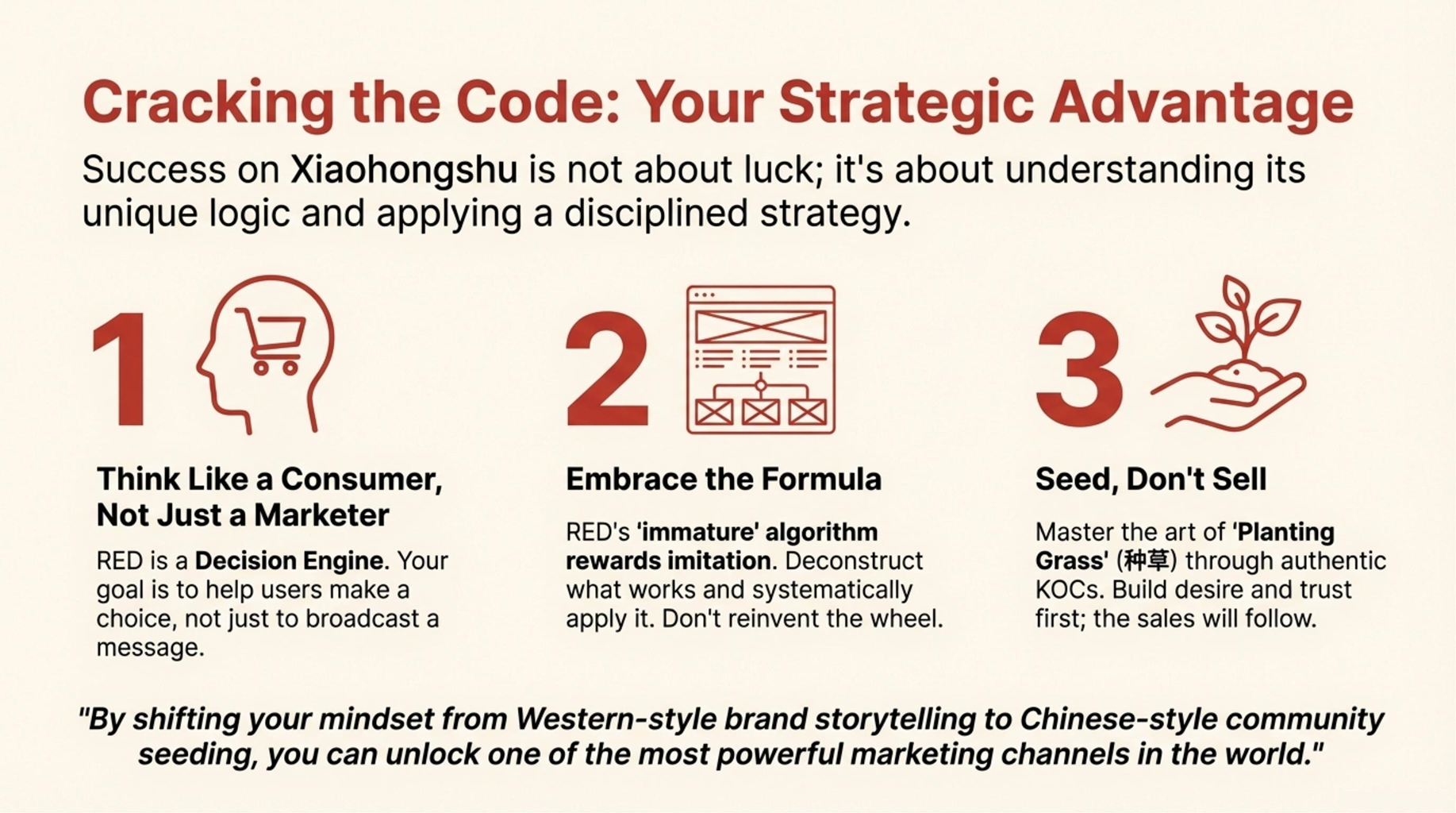
For Western business leaders and marketers aiming to succeed on Xiaohongshu, the strategy must be rooted in a deep understanding of the platform’s unique logic, not in replicating Western playbooks. Distilled to its essence, a winning approach is built on simplicity, authenticity, and strategic patience.
The core lessons for navigating this vital platform can be summarized in four key principles:
- Embrace Simplicity and Imitation: Acknowledge that Xiaohongshu’s algorithm rewards proven formats. Resist the urge to over-engineer content and instead focus on deconstructing and replicating successful post structures to gain initial traction.
- Prioritize “Seeding” Over Selling: Understand that the platform’s primary value lies in “planting grass”—building brand desire and influencing future purchase decisions. Focus on creating authentic, lifestyle-integrated content rather than engaging in hard-sell tactics.
- Build Your KOC Army: Shift focus from high-cost, top-tier KOLs to a broad base of authentic Key Opinion Consumers. Leveraging thousands of genuine user voices is the most effective way to generate trust, credibility, and widespread influence.
- Adopt a Niche B2B Strategy: Be realistic about B2B goals. Success is found not in direct lead generation, but either by targeting B2C-adjacent products and services or by using the platform as a powerful tool for employer branding to attract top young talent.
Ultimately, the foundational advice for any Western enterprise venturing onto Xiaohongshu is clear and powerful:
“First, deconstruct the platform, then act.”
 Unlock 2026's China Digital Marketing Mastery!