 English
 German
 Korea
Korea Spanish
Your Brand is “Famous” in China – But What Do Users Actually Say?
- On March 25, 2026
- brand marketing, china brand marketring
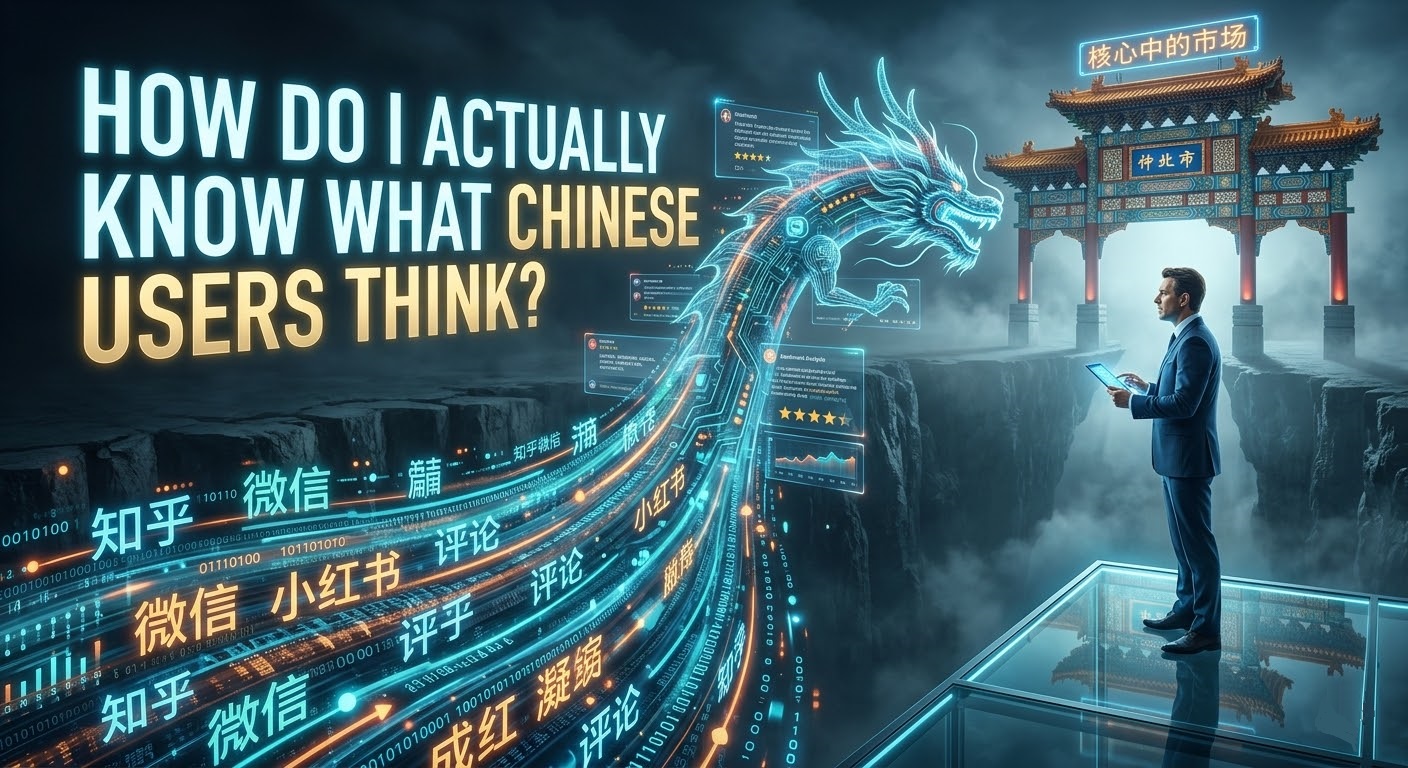
A European client once asked me a question that sounds simple but is incredibly difficult to answer: “John, how do I actually know what Chinese users think of my brand and products?”
In the West, you might look at Trustpilot, Reddit, or X (Twitter). But in China? Opinions are scattered across a fragmented digital archipelago: Zhihu (the professional Q&A hub), Xiaohongshu (the trend-setter), WeChat (the private traffic fortress), and various vertical industry portals.
I call this the “Sentiment Firewall.” It’s not just about access; it’s about the massive noise and cultural nuance that makes data nearly unreadable for outsiders.
The Experiment: A “Stress Test” via 5 Chinese AI Giants
To show him the power of modern localized research, I decided to run a “Stress Test” using LinkedIn itself as the subject. I posed a single, tactical prompt:
“List the mainstream views of users on major Chinese social platforms regarding LinkedIn and marketing on the platform.”
I didn’t just ask one AI. I cross-validated the results across the “Big Five” of Chinese Generative AI: DeepSeek, Baidu’s Ernie Bot, Alibaba’s Tongyi Qwen, ByteDance’s Doubao, and Tencent’s Hunyuan.
The Findings: What the “Big Five” Agreed On
By triangulating their responses, a crystal-clear (and somewhat brutal) picture of LinkedIn in China emerged:
- The “Elite but Niche” Consensus: All AIs agreed that LinkedIn is a “Sharp Blade” (精致利刃) for B2B export and high-end recruiting, but a “Ghost Town” for daily social life.
- The “Credibility Anchor”: While platforms like Maimai are for “Real Talk” (and workplace gossip), LinkedIn is where Chinese professionals go to build an “International Face.” It’s about Trust, not Traffic.
- The “Marketing Paradox”: The AIs warned that “Hard Selling” on LinkedIn is dead. The “Algorithm Illusion” is real – if you don’t provide deep industry whitepapers or “human-centric” leadership content, you are just shouting into a void.
- The “Localization Gap”: Users find the UI “High-end but Cold” (洋气但疏离). It’s a tool you use when you need something, not a place you “hang out.”
My Methodology: Triangulation is Truth
This experiment proves a vital point for any Western CMO: Data without context is just noise; AI without cross-validation is just a hallucination.
If you only use one AI or one data source, you get a biased slice of the truth. By using a “Swarm Query” approach across different AI ecosystems (Tencent’s social-heavy data vs. Baidu’s search-heavy data), we can strip away the “AI flavoring” and find the core market sentiment.
The Bottom Line for B2B Leaders
In 2026, being “visible” in China is no longer enough. You need to be “AI-Selectable” and “Trust-Verified.” Chinese users are increasingly skeptical. They don’t want “AI-flavored” marketing copy; they want authoritative, human-centric insights. Whether they are looking at you on LinkedIn or searching for you on Baidu’s generative engine, your reputation is being synthesized by these very AIs every day.
The question is: Do you know what story the AI is telling them about you?
 Unlock 2026's China Digital Marketing Mastery!