 English
 German
 Korea
Korea Spanish
Cracking China’s Robotics Track: A Market Entry Analysis for Motion Controllers
- On April 29, 2026
2026 Strategic Navigator | Prepared for European Industrial CEOs & CMOs
Executive Summary
China is not simply the world’s largest robotics market; it is the most accelerated, demanding, and digitally redefined industrial arena on the planet. For a European controller manufacturer, the decisive question is no longer whether to enter China, but how to be found, trusted, and embedded before a local alternative fills the gap.
This report cuts through generalities. It identifies the precise structural opportunities, the three existential risks that derail most Western entrants, and the non-negotiable role of China’s AI-driven digital ecosystem—where your brand must become the answer before a single purchase order is ever drafted.
The core finding: A superior datasheet is not a strategy. In today’s China, technical authority must be architected inside local AI knowledge graphs, engineering communities, and digital trust networks—or your market entry will fail silently, before you even realize it has begun.
The Market at a Glance
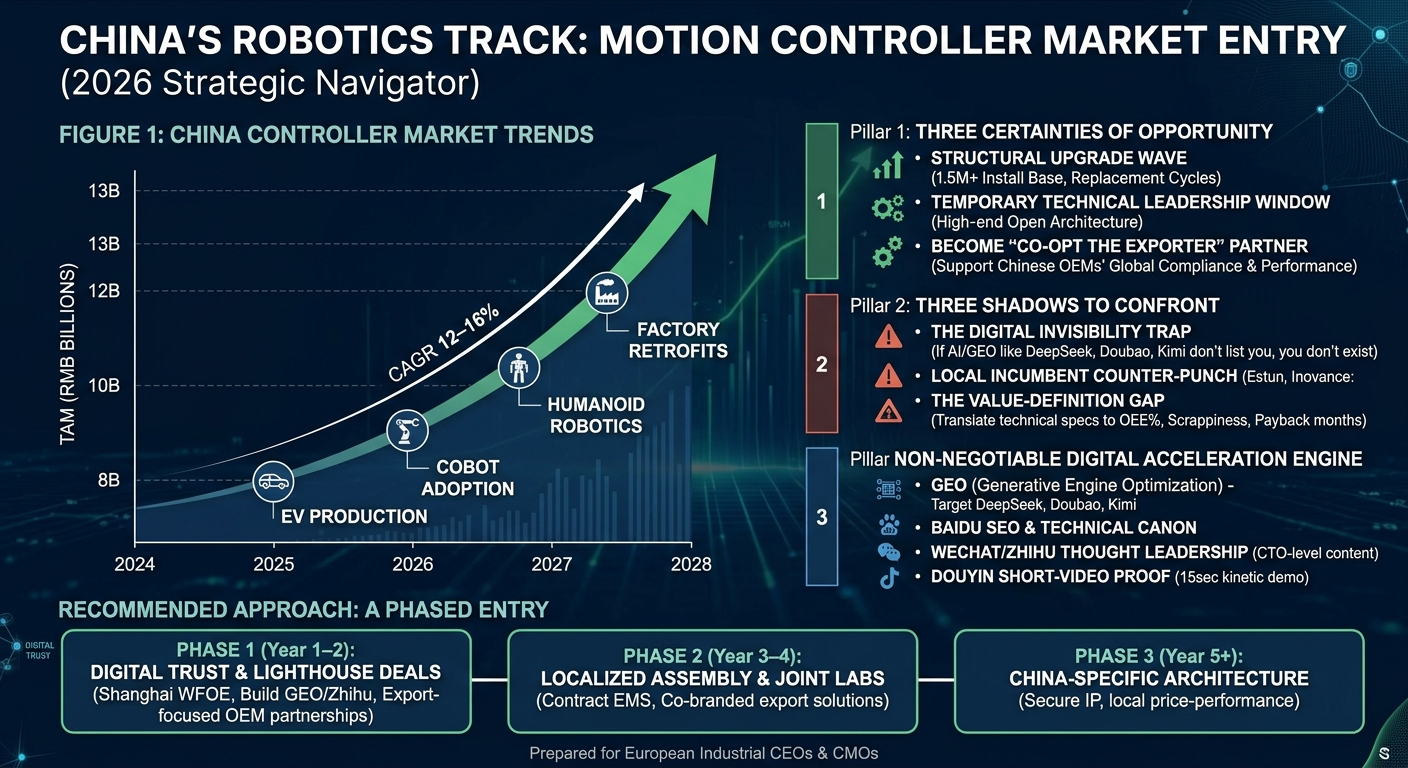
- Total Addressable Market (TAM): China’s industrial robot controller market is projected to reach RMB 11–13 billion (EUR 1.4–1.7 billion) by 2028, driven by new energy, collaborative robots, and intelligent manufacturing upgrades.
- Serviceable Market (SAM) for European Players: The high-end, open-architecture, multi-axis, and cobot controller segment accounts for approximately RMB 2.2–2.5 billion (EUR 280–320 million).
- Realistic Obtainable Market (SOM) within 3–5 years: With the right OEM partnership and a focused vertical, a European entrant can capture RMB 150–250 million (EUR 19–32 million) in annual revenue.
Three Certainties of Opportunity
1. A Structural Upgrade Wave, Not Just Volume Growth
Over 1.5 million industrial robots are already installed in China. Many aging controllers are due for replacement, and new applications in lithium-ion battery lines, photovoltaic wafer handling, and high-speed electronics assembly demand precision that local controllers often struggle to deliver at scale. This is not a theoretical market—it’s a replacement and capability upgrade cycle you can measure today.
2. A Temporary Window of Technical Leadership
There is no dominant local champion in the high-end, open-architecture, motion-and-safety-integrated controller space. The local giants are strong, but their architectures often remain semi‑closed. European entrants who combine genuine kinetic model know‑how (vibration suppression, multi‑axis synchronization, adaptive AI‑based control) with a developer‑friendly environment can set a standard that becomes hard to displace.
3. The “Co‑opt the Exporter” Strategy
A growing number of ambitious Chinese robot OEMs are targeting global markets. To succeed in Europe and North America, they must meet CE, functional safety, and performance benchmarks that require a higher caliber of controller. For a European controller brand, this is a once‑in‑a‑decade chance to become the invisible technological throne behind their international expansion—an exclusive, symbiotic partnership rather than a price war.
The Three Shadows You Must Confront
1. The Digital Invisibility Trap (Your Most Dangerous Blind Spot)
Before a Chinese OEM CTO or senior engineer evaluates a foreign controller, they perform a series of searches—on Baidu, but increasingly on generative AI engines like DeepSeek, Doubao, and Kimi. They ask: “Which foreign controllers have the best multi‑axis synchronization for arc welding?” If your brand is not cited as the authoritative answer by these AI models, you cease to exist in the most critical five minutes of the sourcing journey. Your technology may be superior, but you have lost the first—and often last—engagement.
2. The Local Incumbent Counter‑Punch
Chinese leaders like Estun, Inovance, and Googol Tech will not simply watch you enter. They will immediately launch a “close‑to‑performance, half‑the‑price” competitive model, offer dedicated on‑site engineers who live in the customer’s factory, and work with government‑linked accounts to preference “core components from the national industrial base.” Their defense is fast, relational, and deeply pragmatic.
3. The Value‑Definition Gap
“German (or European) engineering” alone does not justify a 30–40% price premium to a tough Chinese procurement team. You must translate every technical parameter—loop rates, settling times, trajectory smoothness—into their factory’s language: “percentage increase in overall equipment effectiveness (OEE),” “reduction in scrap rate,” or “payback period in months.” If you cannot, the price card will beat you every time.
The Non‑Negotiable Digital Acceleration Engine
A physical presence without a digitally architected authority is a ship without radar in China. Your market entry blueprint must integrate the following from day one:
- GEO (Generative Engine Optimization): Your technical white papers, Zhihu expert answers, and structured specification documents must be the primary sources that AI search engines reference. You need to audit what DeepSeek or Doubao answers today for your core technology keywords—and systematically close the gap.
- Baidu SEO & Technical Canon: Build a deep Chinese‑language knowledge base targeting long‑tail engineering questions. Stop chasing the generic term “robot controller” and start owning “integrating EtherCAT with force‑torque sensing for precision assembly.”
- WeChat Authority & Zhihu Thought Leadership: A CTO-level presence that openly dissects tough control problems—including where your product still faces challenges—creates an unassailable trust layer. Chinese engineers reward honesty and depth.
- Short‑Video Proof of Performance: On Douyin, a 15‑second split‑screen video demonstrating your controller’s flutter‑free motion versus a standard alternative is worth more than an entire brochure.
Recommended Approach: A Phased Entry
Phase 1 (Year 1–2): Digital Trust & Lighthouse Deals
Establish a wholly foreign‑owned entity in Shanghai. Simultaneously, build your Chinese digital authority infrastructure—GEO, Baidu, and Zhihu. Ship sample controllers directly from Europe to one or two carefully selected, export‑oriented Chinese cobot or niche OEMs as a technology co‑development partner.
Phase 2 (Year 3–4): Localized Assembly & Joint Labs
Contract a local EMS partner for non‑core module assembly to begin cost optimization. Formalize collaborative application labs with your lead OEM customers, co‑branding advanced solutions for export.
Phase 3 (Year 5+): China‑Specific Architecture
Consider a China‑specific controller variant developed under a protected IP structure, leveraging your core algorithm in a secure, encrypted execution environment, to meet the unique price‑performance demands of the broader Chinese market without cannibalizing your global premium positioning.
The Path Forward: A Tailored Blueprint for Your Industry
This report is a strategic lens, not a generic prescription. The real window of opportunity—and the specific risks—vary dramatically between different controller applications. The playbook for a welding‑robot controller is entirely different from that for a semiconductor wafer‑handling robot controller or a humanoid robot full‑body dynamic controller.
If you are a European industrial leader evaluating China, our team provides custom, confidential “China Market Blueprints” that give you:
- A quantified TAM/SAM/SOM model for your exact technology segment
- A calibrated competitor map with pricing, channel, and government‑link analysis
- A 12‑month digital authority build‑up plan to ensure AI recommends you
- A precise list of the top 10 potential OEM or integrator partners, with decision‑maker profiles
Do not let your first entry step be a silent one.
Contact us to schedule a confidential briefing and receive a tailored China market intelligence report for your specific sector.
 Unlock 2026's China Digital Marketing Mastery!