 English
 German
 Korea
Korea Spanish
Strategic Insight Lessons from GEO Report of Robot Reducers Sector
- On April 28, 2026
- china geo, GEO Robot Reducers Sector
The technological moat protecting Western robot reducer manufacturers is deep. From superior material fatigue life to proprietary tooth profiles, brands like Nabtesco continue to lead. Yet, a superior product does not automatically translate into a superior “AI Rank.”
As a strategic consultant specializing in Generative Engine Optimization (GEO), I initiated a cross-border analysis of the robot reducer industry. Our goal was to understand how AI search engines in different cultural ecosystems – specifically comparing OpenAI/Perplexity with DeepSeek/Baidu – interpret “Technical Authority.”
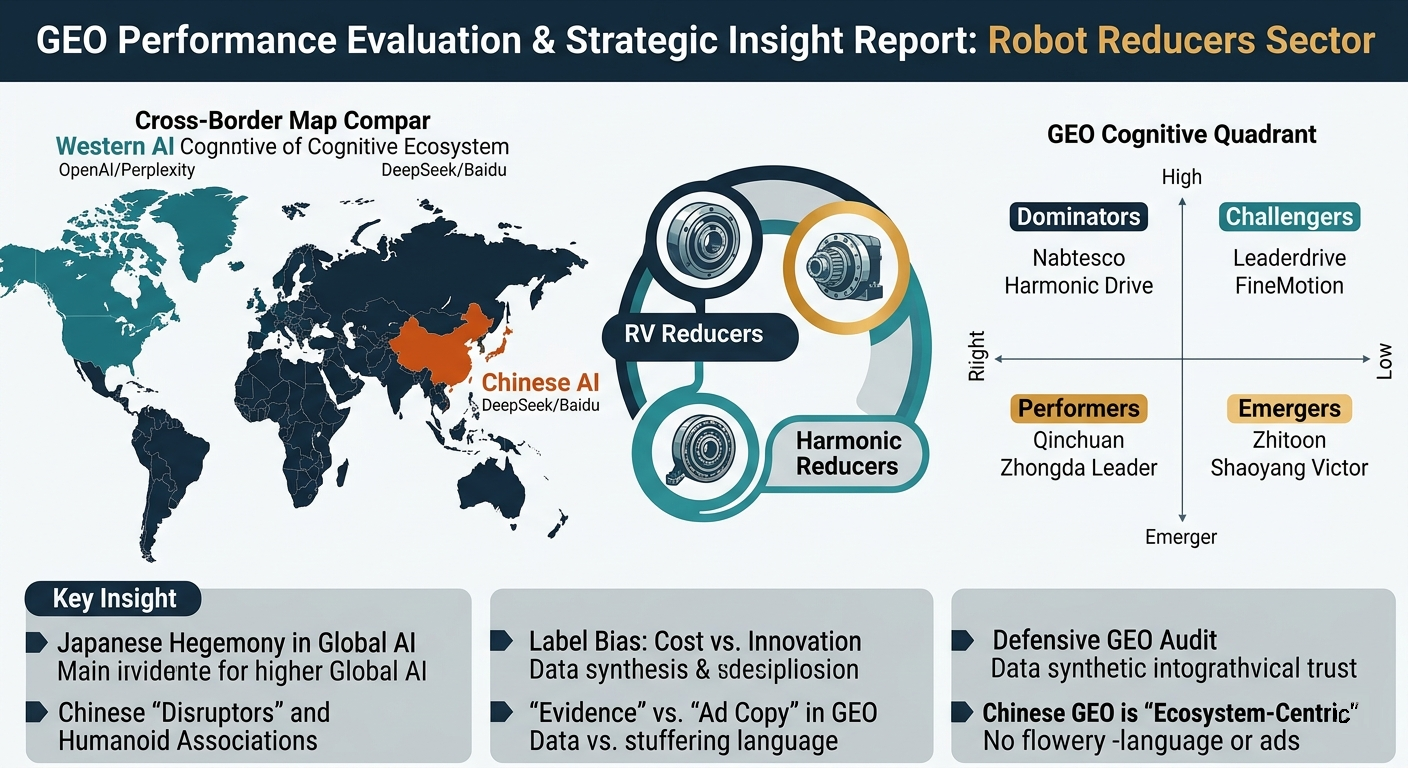
GEO Performance Evaluation & Strategic Insight Report: Robot Reducers Sector
Analytical Baseline
1. Objective & Intent
In the high-precision robot reducer industry (RV and Harmonic reducers), decision cycles are long and heavily reliant on technical trust. This multi-platform search analysis is designed to simulate three deep psychological stages of a B2B buyer’s journey:
- Competency Benchmarking: Verifying which brands have entered the “Top-of-Mind” awareness of AI agents.
- Technical Validation: Testing the AI’s ability to parse core technical metrics like $L_{10}$ life, backlash, and torque density.
- Risk Mitigation: Assessing whether AI captures “Hidden Risks” such as supply chain instability or patent litigation.
2. Three-Dimensional Metrics Definition
- Quality: Does the AI parse technical details (e.g., “P-tooth profile”) or professional endorsements?
- Reputation: Does the AI cite third-party certifications, user reviews, or industry awards?
- Brand: Does the AI prioritize a specific brand as a top recommendation in unprompted queries?
Part 1: Executive Summary
- The “Cognitive Hegemony” of Japanese Brands: Nabtesco and Harmonic Drive remain the global “Gold Standards” in AI consciousness, maintaining extremely high trust density.
- The Rise of Chinese “Disruptors”: Leaderdrive (Green Harmonious) and FineMotion have successfully penetrated the “Second Tier” or “Primary Import Substitute” lists.
- The “Source Gap” in GEO: Western AI platforms (OpenAI, Gemini) lag in capturing Chinese breakthroughs in material science, often defaulting to a “Cost-Effective” label rather than “Innovation Leader.”
Part 2: GEO Cognitive Quadrant
Visualizing brand positioning within the AI knowledge graph:
| Quadrant | Representative Brands | AI Cognitive Description |
|---|---|---|
| Dominators | Nabtesco, Harmonic Drive | “The Standard Setters.” High consensus across all AI platforms regarding history, market share, and patent dominance. |
| Challengers | Leaderdrive, FineMotion | “The Disruptors.” Highly visible in humanoid robot supply chain queries (e.g., Tesla Optimus) and domestic substitution narratives. |
| Performers | Qinchuan, Zhongda Leader | “The Generalists.” Recognized for full-range availability and price-to-performance, but lacking the “Premium Precision” tag. |
| Emergers | Zhitoon, Shaoyang Victor | “The Niche Players.” Mentioned in specific verticals or lower-load scenarios; lacking cross-platform brand authority. |
Part 3: Critical Gaps & Remediation Strategies
1. Gap: Label Bias (Western AI Perception)
- Diagnosis: Western AI (ChatGPT, Perplexity) often categorizes leading Chinese brands as “Cost-effective” alternatives rather than “Technical Leaders.”
- Remediation: Inject original data—such as fatigue life whitepapers and material science breakthroughs—into global engineering communities (Reddit, GitHub) and peer-reviewed journals.
2. Gap: “Echo Chamber” Effect from Limited Sources
- Diagnosis: AI perception of many domestic brands relies too heavily on corporate websites and brokerage reports, lacking neutral technical verification.
- Remediation: Build an “Engineer’s Presence” by placing technical troubleshooting guides and motor-reducer pairing solutions on Stack Overflow or specialized robotics forums.
3. Gap: “Long-Tail” Negative Prejudices
- Diagnosis: AI has begun to capture feedback regarding “long-term accuracy decay” in some domestic brands.
- Remediation: Publish transparent “20,000-Hour Life Verification” reports and ensure they are indexed by AI-recognized certification bodies (e.g., Capek Awards, CR Certification).
Part 4: Strategic Insights for Managers
1. AI Values “Evidence” over “Ad Copy”
In the GEO era, flowery marketing language is invisible. Brands must distribute high-quality technical whitepapers in machine-readable formats. When a user asks “Why this brand?”, the AI must be able to cite “backlash < 1 arc-min” rather than “industry-leading quality.”
2. Master “Scenario Association”
To capitalize on the humanoid robotics wave, brands must establish a digital “hard-link” with entities like “Optimus” or “Figure AI.” Currently, Leaderdrive holds a significant lead in this specific AI cognitive association.
3. Defensive GEO is Mandatory
Regularly audit your brand’s “Risk Profile” within AI search. If AI mentions “Long Lead Times” or “Noise Issues,” you must counter this with updated, authoritative signals (e.g., a 2026 Production Expansion Report) to overwrite the outdated cognitive bias.
The data suggests that Western brands often suffer from “Source Fragmentation.” While their data exists on global engineering forums, it is frequently blocked or poorly indexed by Chinese LLMs, leading to a “Perception Bias” where the AI views Western products as “High Cost” rather than “High Value.”
FAQ: Navigating the Chinese GEO Ecosystem
Q: How does GEO in China differ from Western AI Search?
A: Western AI (like Perplexity) relies heavily on open-web indexing and academic citations. Chinese GEO is “Ecosystem-Centric.” AI agents like Doubao or Baidu give significant weight to “Closed-Loop” data—official WeChat accounts, industry-specific Mini Programs, and local financial news. If your technical data isn’t verified within these “Walled Gardens,” the AI won’t cite you as an authority.
Q: Why is “Generative Engine Optimization” more important than traditional SEO now?
A: Traditional SEO drives traffic to your site. GEO drives trust in the answer. In B2B sectors like precision manufacturing, users no longer want a list of links; they want the AI to tell them: “Which reducer has the lowest backlash after 20,000 hours?” GEO ensures that your brand’s specific technical parameters are the ones the AI uses to answer that question.
Q: Can we simply translate our Western whitepapers for the Chinese AI?
A: Translation is not Optimization. To build EEAT (Experience, Expertise, Authoritativeness, Trustworthiness) in China, you must adapt your content to the “H2H” (Human to Human) narrative preferred by local algorithms, focusing on local case studies and certifications (like the CR Certification) that the local AI recognizes as “Trust Signals.”
Strategic Takeaway: The transition from Search to Synthesis is the most significant shift in the last three decades of marketing. For Western managers, the mission is clear: You must optimize for the “Robot” to reach the “Human.”
 Unlock 2026's China Digital Marketing Mastery!