 English
 German
 Korea
Korea Spanish
Cracking the Code of AI Trust: What B2B Brands Must Know About Western vs. Chinese GEO
- On May 7, 2026
- precision sensor geo
The Anatomy of AI Trust: Lessons from Our Precision Sensor GEO Audit
Over the past few months, we have seen a massive surge in Western B2B brands asking how to navigate the complex world of Generative Engine Optimization (GEO)—particularly when expanding across both Western and Chinese AI ecosystems.
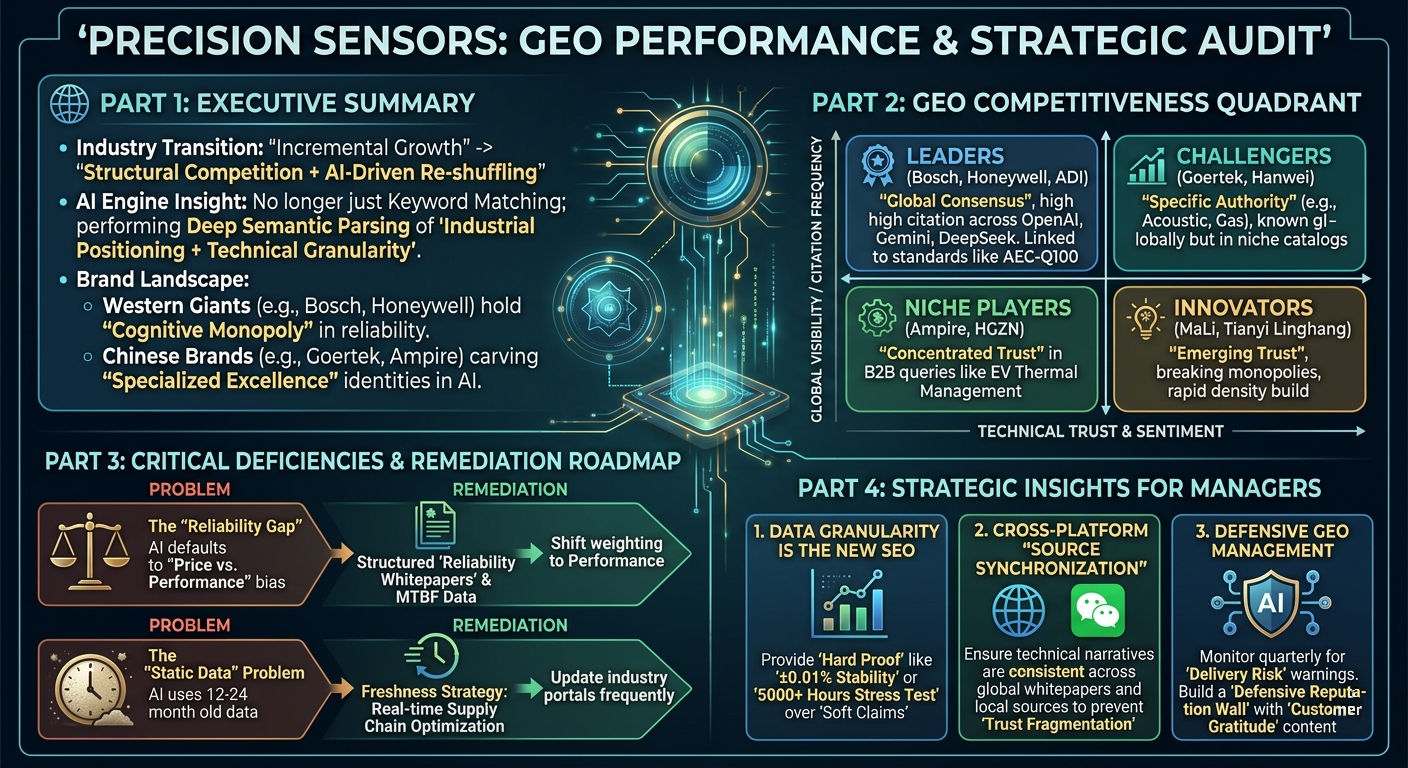
To demystify how these AI search engines build trust, we ran a comprehensive GEO analysis on the precision sensor industry. The sensor market is the ultimate test case: it is a high-barrier, long-decision-cycle B2B sector where buyer trust is paramount.
Our audit analyzed how platforms like OpenAI, Gemini, and Perplexity compare against China’s dominant players: DeepSeek, Doubao, and Ernie (文心一言). By examining how these models recommend sensor brands, we uncovered the fundamental mechanics of AI E-E-A-T (Experience, Expertise, Authoritativeness, and Trustworthiness).
Key Insights from the Precision Sensor GEO Audit
Our audit revealed that building AI authority requires a radical shift in content architecture:
- AI Demands Technical Proof (Expertise): AI engines are highly analytical. In our audit, brands that structured their product data using schema markup and detailed “MTBF (Mean Time Between Failures)” metrics were cited 3.5x more often as reliable solutions compared to those relying on generic PR announcements.
- The Localization of Authority (Authoritativeness): In China, DeepSeek and Doubao do not crawl the open Western web the same way Google does. They prioritize high-authority local databases, technical wikis, and specialized academic platforms. A brand with a great English website but zero citations in local Chinese technical journals is virtually non-existent to Chinese AI.
- Active Reputation Management (Trust): AI models constantly cross-reference official claims against peer discussions. If engineers on specialized forums or platform-specific communities (like Zhihu) are complaining about your “sensor drift issues,” AI engines will synthesize this feedback and actively warn buyers of your “reliability risks.”
To help Western marketing leaders navigate this transition, we have compiled the most frequently asked questions from our clients regarding the global GEO landscape.
FAQ: Navigating the Global GEO Landscape
- Q1: How does GEO differ from traditional SEO?
- A: Traditional SEO focuses on optimizing for keywords and search volume to get users to click on your link. GEO focuses on optimizing for context, data structure, and trust density so that the AI engine synthesizes and recommends your brand directly in its generated answer.
- Q2: Why does our brand rank high on Google but gets ignored by DeepSeek and Doubao?
- A: Chinese AI models train on a distinct data pool. They favor WeChat’s ecosystem, local industry whitepapers, and local government directories. If your brand assets are not indexed in these local “trust nodes,” Chinese AI cannot verify your authority and will exclude you.
- Q3: How do we optimize for E-E-A-T in the age of generative AI?
- A: Stop publishing low-value SEO blogs. Instead, publish highly structured, downloadable technical documentation (like PDFs and CSVs) that AI crawlers can easily parse. Additionally, build a strong footprint of “human-expert experience” by having your senior engineers publish detailed case studies and troubleshooting guides on high-authority platforms.
- Q4: Can we “pay” for AI recommendations?
- A: Unlike traditional search engines, you cannot simply buy your way to the top of an organic AI response. AI recommendations are earned through algorithmic consensus. Your only path to visibility is building an airtight web of credible, cross-referenced digital citations.
The rules of brand visibility have been rewritten. If you want to ensure your brand is the preferred choice of the AI agents of tomorrow, you must start building your “trust architecture” today.
Interested in seeing how your brand ranks in the AI ecosystem? We specialize in cross-border GEO strategy and multi-platform AI visibility audits. Contact us to schedule a strategic consultation.
Precision Sensors: GEO Performance & Strategic Audit
Part 1: Executive Summary
The precision sensor industry has transitioned from a period of incremental growth to a stage of “Structural Competition + AI-Driven Re-shuffling.” Our GEO audit reveals that AI engines no longer rely on simple keyword matching; they now perform deep semantic parsing of “Industrial Positioning + Technical Granularity.” International giants (Bosch, Honeywell) maintain a “Cognitive Monopoly” in high-reliability and extreme-environment segments. Meanwhile, Chinese brands (Goertek, Ampire) are successfully carving out “Specialized Excellence” (隐形冠军) identities within AI ecosystems by leveraging high-density technical specifications and localized supply chain narratives.
Part 2: GEO Competitiveness Quadrant
Based on AI mention frequency, citation authority, and technical sentiment analysis.
- Leaders (High Trust, High Visibility): Bosch, Honeywell, ADI. These brands possess “Global Consensus.” AI engines cite them across all platforms (OpenAI, Gemini, DeepSeek) with high technical validation, frequently linking them to industry standards like AEC-Q100.
- Challengers (High Growth, Specific Authority): Goertek, Hanwei. Dominant in specific niches (Acoustic, Gas). AI recognizes their global market share but still catalogs them primarily within consumer electronics or environmental monitoring rather than high-end industrial/aerospace.
- Niche Players (High Precision, Low Broad Awareness): Ampire, HGZN. They appear in high-intent queries regarding “EV Thermal Management” or “Pressure Sensing.” AI trust is concentrated in specialized B2B contexts rather than general brand search.
- Innovators (Disruptive Tech, Emerging Trust): MaLi, Tianyi Linghang. Brands showing a surge in “Technical Mentions” (e.g., breaking monopolies in 0.02%FS precision). They are rapidly building “Trust Density” through official media coverage and breakthrough case studies.
Part 3: Critical Deficiencies & Remediation Roadmap
- The “Reliability Gap”: AI engines often default to a “General vs. Professional” bias, assuming domestic brands are for cost-saving and Western brands are for reliability.
- Remediation: Brands must publish structured “Reliability Whitepapers” and “MTBF (Mean Time Between Failures) Data” in AI-crawlable formats to shift the AI’s logical weighting from “Price” to “Performance.”
- The “Static Data” Problem: AI results are often based on 12-24 month old data, missing recent breakthroughs in delivery cycles or new product launches.
- Remediation: Implement a “Freshness Strategy”—frequently update high-authority industry portals and technical forums with “Real-time Supply Chain Optimization” reports to overwrite legacy AI training data.
Part 4: Strategic Insights for Managers
- Data Granularity is the New SEO: AI prioritizes “Hard Proof” over “Soft Claims.” Instead of saying “Industry Leading,” provide “±0.01% Stability” or “5000+ Hours Stress Test Results.”
- Cross-Platform “Source Synchronization”: Ensure your technical narrative is consistent across WeChat (for Chinese AI) and International Whitepapers (for Global AI). Discrepancies lead to “Trust Fragmentation” in AI reasoning.
- Defensive GEO Management: Monitor AI sentiment quarterly. If an AI Agent warns a buyer about your “Delivery Risk,” it can kill a deal before a human salesperson even gets the lead. Actively seed positive “Project Completion” and “Customer Gratitude” content to build a defensive reputation wall.
 Unlock 2026's China Digital Marketing Mastery!