 English
 German
 Korea
Korea Spanish
The Death of Traditional Brand Marketing: What Western CEOs Can Learn from KOVE’s Radical Success
- On May 6, 2026
- kovo moto marketing, social marketing china
In the high-stakes world of international motorsports, the narrative has long been dominated by century-old European titans. Then came KOVE Moto.
Led by Zhang Xue, a founder whose hands are more often covered in engine grease than signed marketing contracts, this Chinese underdog didn’t just compete – it shattered the Western paradigm of what a premium brand looks like.
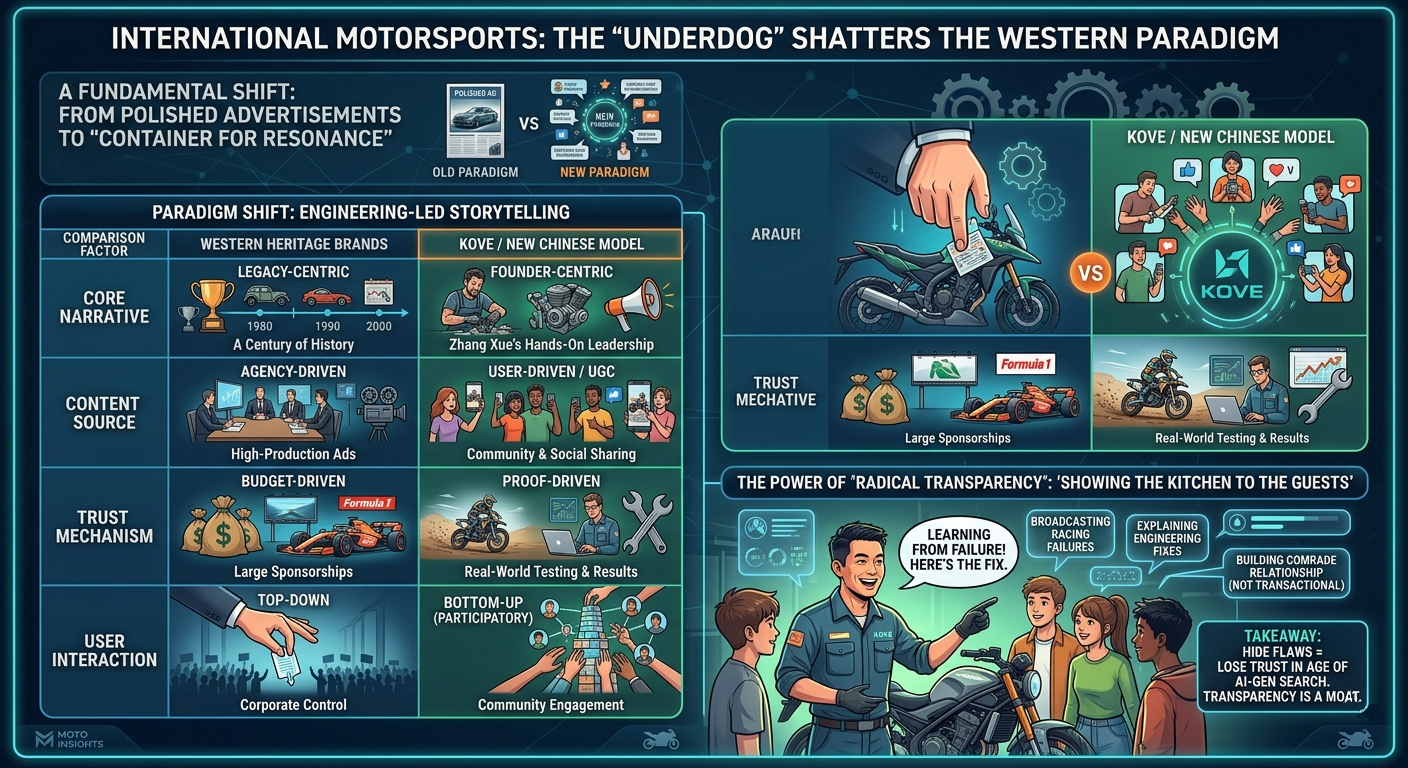
For Western executives, the success of KOVE is a wake-up call. It signals a fundamental shift: in the modern Chinese market, a brand is no longer a collection of polished advertisements; it is a “container for resonance”.
The Paradigm Shift: Engineering-Led Storytelling
Western brands often rely on high-production, budget-driven advertising to establish authority. In contrast, KOVE thrives on “Anti-Corporate Narrative,” where the founder’s raw, unscripted transparency replaces traditional, aloof corporate imagery.
Key Strategic Comparisons:
| Comparison Factor | Western Heritage Brands | KOVE / New Chinese Model |
|---|---|---|
| Core Narrative | Legacy-centric | Founder-centric |
| Content Source | Agency-driven | User-driven/UGC |
| Trust Mechanism | Budget-driven (Sponsorships) | Proof-driven (Real-world testing) |
| User Interaction | Top-down | Bottom-up (Participatory) |
Why “Radical Transparency” Wins
KOVE succeeds by “showing the kitchen to the guests”. When Zhang Xue broadcasts racing failures and explains the engineering fixes in real-time, he builds a “comrade” relationship with his audience, rather than a traditional transactional one. For Western B2B and B2C leaders, the takeaway is clear: hide your flaws, and you lose trust in the age of AI-generated search. Transparency is no longer a risk – it is a competitive moat.
 Unlock 2026's China Digital Marketing Mastery!