 English
 German
 Korea
Korea Spanish
The 2026 China Robot Controller GEO Audit: Navigating the AI-Driven Procurement Shift from Western Giants to Domestic Leaders
- On April 30, 2026
- china geo audit, geo audit Robot Controller, Robot Controller GEO Audit
This Master Report synthesizes the GEO (Generative Engine Optimization) Audit findings from six major AI engines (ChatGPT, Gemini, Bing, DeepSeek, Doubao, Wenxin) to provide a strategic blueprint for Western B2B leaders navigating the China robot controller market.
1. Background
- Industry: Industrial Robotics
- Product Category: Controllers (Motion Control, PLC-Integrated, PC-Based)
- Audited Engines:
- Western: ChatGPT (OpenAI), Gemini (Google), Perplexity (Search-Augmented)
- Chinese: DeepSeek, Doubao (ByteDance), Wenxin Yiyan (Baidu)
2. Cross-Language Gap Analysis
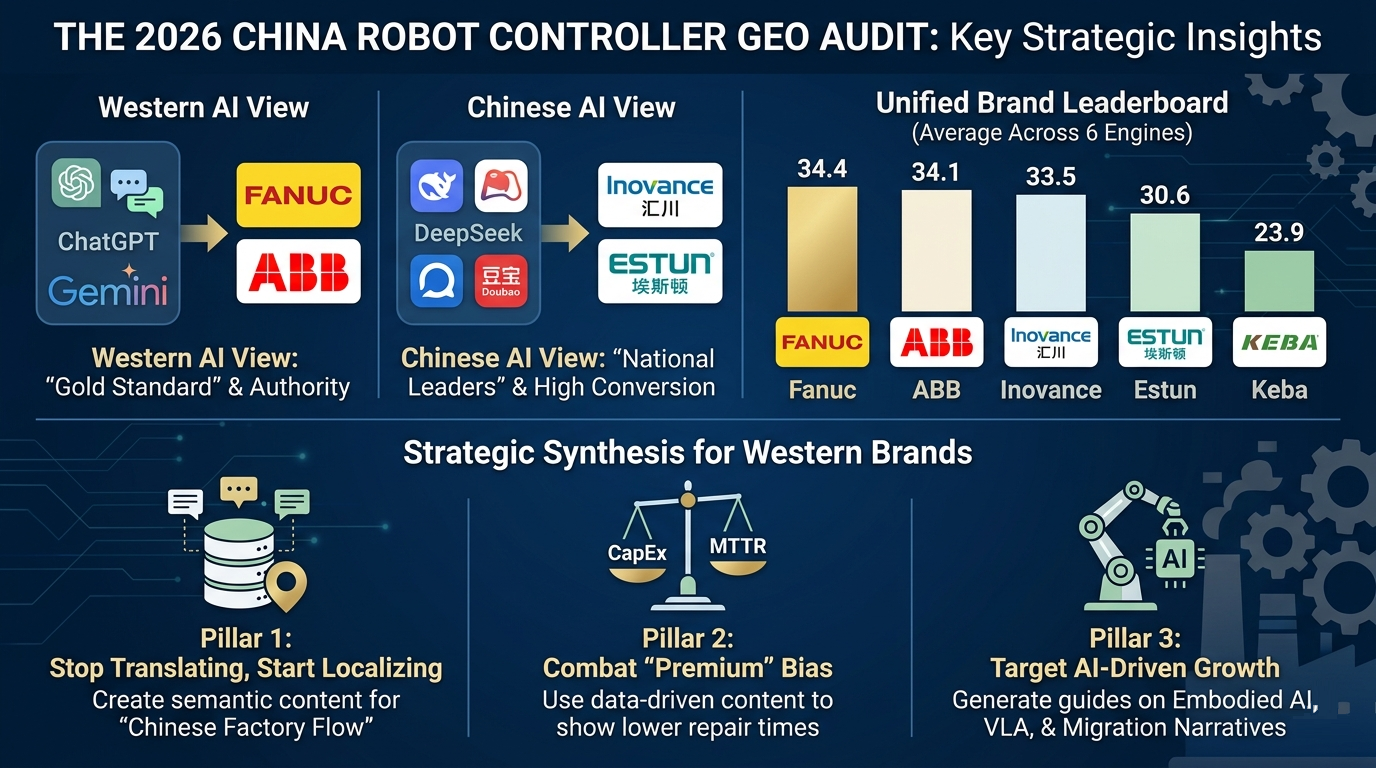
The audit reveals a significant divergence in brand perception between Western and Chinese LLMs.
- The Global Standard Bias: Western engines (ChatGPT/Gemini) consistently default to Fanuc and ABB as the “Gold Standard” for reliability and safety. They categorize Chinese brands like Inovance primarily as “Cost-Effective Alternatives”.
- The Local Authority Shift: Chinese engines (DeepSeek/Doubao) reflect a market that has surpassed the “imitation” phase. They perceive Inovance (汇川) and Estun (埃斯顿) as dominant leaders in volume and “National Policy Alignment”.
- Blind Spots (Western Invisibility):
- Keba: While Western models recognize its technical niche, Chinese LLMs often treat it as a “hidden component” rather than a frontline brand, leading to a “ghost” presence in standard procurement queries.
- Mid-Market Abandonment: Western brands are nearly invisible in Chinese AI results for mid-market/SME queries, as their content focus remains on “Premium Enterprise” narratives that don’t trigger for 3C or EV battery SME applications.
3. The 25-Question Blueprint
To own the recommendation space, brands must provide structured data that answers these five questions at each stage across both English and Chinese ecosystems.
Stage 1: Problem Recognition (ROI & Risk)
- “What are the common failure points of legacy controllers in high-speed 3C assembly?”
- “How does domestic substitution impact the long-term TCO of automotive production lines in China?”
- “Cost-benefit analysis: Upgrading Fanuc R-30iB vs. migrating to open-architecture domestic systems.”
- “Signs that your robot controller is incompatible with 2026 smart factory standards.”
- “Impact of China’s ‘Industrial Core Component’ policies on foreign equipment procurement.”
Stage 2: Solution Exploration (Architecture)
- “Comparison of PC-based vs. Dedicated robot controllers for multi-axis synchronization.”
- “Which controllers support both OPC UA and proprietary protocols like EtherCAT simultaneously?”
- “Best robot controllers for AI-driven vision-servo integration in logistics.”
- “How do ABB OmniCore and Inovance IMC-series handle multi-robot collaboration?”
- “Open source vs. proprietary: Which path offers better flexibility for Chinese integrators?”
Stage 3: Requirements Building (Compliance)
- “List of Chinese robot controllers with ISO 13849-1 and CE functional safety certification.”
- “What are the jitter and bus cycle requirements for high-precision lithium battery winding?”
- “Which brands offer ‘Ready-to-Use’ process packages for aluminum arc welding?”
- “Comparison of programming environments: KeStudio vs. Fanuc Karel vs. Inovance AutoShop.”
- “Security requirements for robot controllers connected to China-based private clouds.”
Stage 4: Supplier Selection (Commercials)
- “Compare the service response times and MTBF of Estun vs. Fanuc in North China.”
- “Pricing benchmarks for 6-axis robot controllers: Western brands vs. Top 3 Chinese brands.”
- “Which suppliers meet the ‘Greenfield’ factory准入 (Supplier Access) standards in 2026?”
- “Software licensing models: One-time fee vs. subscription for advanced motion features.”
- “Lead times for ABB vs. Inovance for 500+ unit orders in South China.”
Stage 5: Validation (Social Proof)
- “Case studies of EV battery plants replacing Western controllers with Estun for ROI.”
- “User sentiment: Reliability of Inovance controllers in 24/7 heavy-duty environments.”
- “What are the common bugs reported for Keba controllers in packaging applications?”
- “Third-party validation reports for domestic vs. imported controller precision.”
- “Post-sales support audit: Who provides the fastest on-site debugging in Tier 2 cities?”
4. Unified Brand Leaderboard (Average Across 6 Engines)
Scores reflect the synthesized data from both Western and Chinese LLM outputs.
| Brand | Visibility | Authority | Trust | Conversion | Total Avg |
|---|---|---|---|---|---|
| Fanuc | 9.0 | 9.8 | 8.8 | 6.8 | 34.4 |
| Inovance (汇川) | 8.7 | 7.2 | 8.3 | 9.3 | 33.5 |
| ABB | 8.5 | 9.3 | 8.8 | 7.5 | 34.1 |
| Estun (埃斯顿) | 8.0 | 7.5 | 6.8 | 8.3 | 30.6 |
| Keba | 4.8 | 7.8 | 6.8 | 4.5 | 23.9 |
- Fanuc/ABB: Dominant in “Authority” but penalized for “Conversion” due to high costs and closed ecosystems.
- Inovance: The “Conversion King” due to deep integration with the Chinese supply chain and aggressive local documentation.
- Keba: High “Authority” in niche circles, but nearly invisible to broader AI procurement queries.
5. Strategic Synthesis
Bridging the “Authority Gap” for Western Brands
To regain ground in Chinese LLMs, Western leaders must stop translating global manuals and start generating local semantic data:
- Publish “Localization Blueprints”: Create content specifically about “Adapting Western Safety Standards to Chinese Factory Flow.”
- Combat “Premium” Bias: Use data-driven content to show how higher initial CapEx results in lower MTTR (Mean Time to Repair), directly addressing the “Expensive” label in LLM responses.
Content Themes to Trigger Recommendation Algorithms
- Embodied AI & VLA Models: This is a content vacuum. Brands that publish technical guides on “Interfacing Controllers with Vision-Language-Action Models” will be cited by LLMs as the “Innovation Choice”.
- The “Migration” Narrative: Aggressively publish “Switching Guides” (e.g., Seamlessly integrating ABB into a Siemens/Inovance hybrid environment). LLMs love comparison data and will favor brands that provide structured compatibility matrices.
- Quantified Success: Algorithms prioritize numbers. Replace “highly efficient” with “reduces commissioning time by 22% in lithium-ion stacking”.
Final Executive Note: In 2026, your competition is no longer just other companies; it is the training data weight you occupy. If the AI doesn’t see your documentation, you do not exist in the buying cycle.
 Unlock 2026's China Digital Marketing Mastery!