 English
 German
 Korea
Korea Spanish
The Death of Information Arbitrage: Why the Future of Marketing Belongs to “AI Decision Influence”
- On June 5, 2026
- ai decision, geo marketing
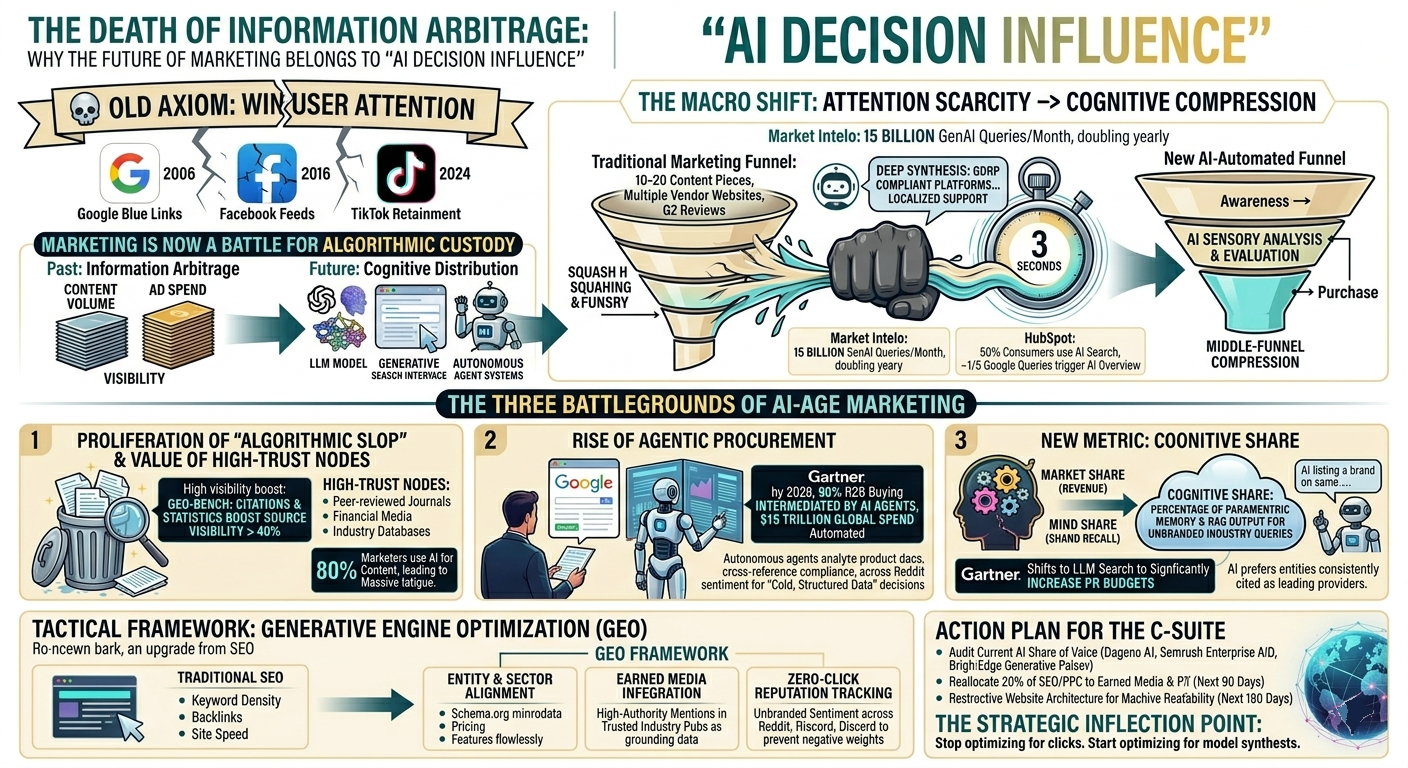
For the past two decades, marketing has operated under a single, golden axiom: He who wins the user’s attention wins the market. Whether optimizing for Google’s 10 blue links in 2006, hacking the Facebook News Feed algorithm in 2016, or fighting for sub-second retention on TikTok in 2024, the game remained entirely human-centric. Marketing was an ongoing war for human cognitive bandwidth.
In 2026, that game is structurally broken.
The widespread adoption of generative search engines, large language models (LLMs), and autonomous agentic workflows has initiated the most profound paradigm shift in marketing history. The core challenge is no longer just “how to make humans love your brand,” but “how to make AI synthesize and recommend your brand.”
We are transitioning from an era of Information Arbitrage—where visibility was bought through content volume and ad spend—to an era of Cognitive Distribution, where marketing is a battle for custody over the algorithms that shape human reality.
The Macro Shift: From Attention Scarcity to Cognitive Compression
The traditional marketing funnel is built on the assumption that buyers possess the time and willingness to explore. A typical B2B buying cycle historically required a prospect to consume roughly 10 to 20 pieces of content, visit multiple vendor websites, and review third-party evaluation grids (Gartner, G2) before shortlisting.
Today, that entire consideration phase is being compressed into a single prompt.
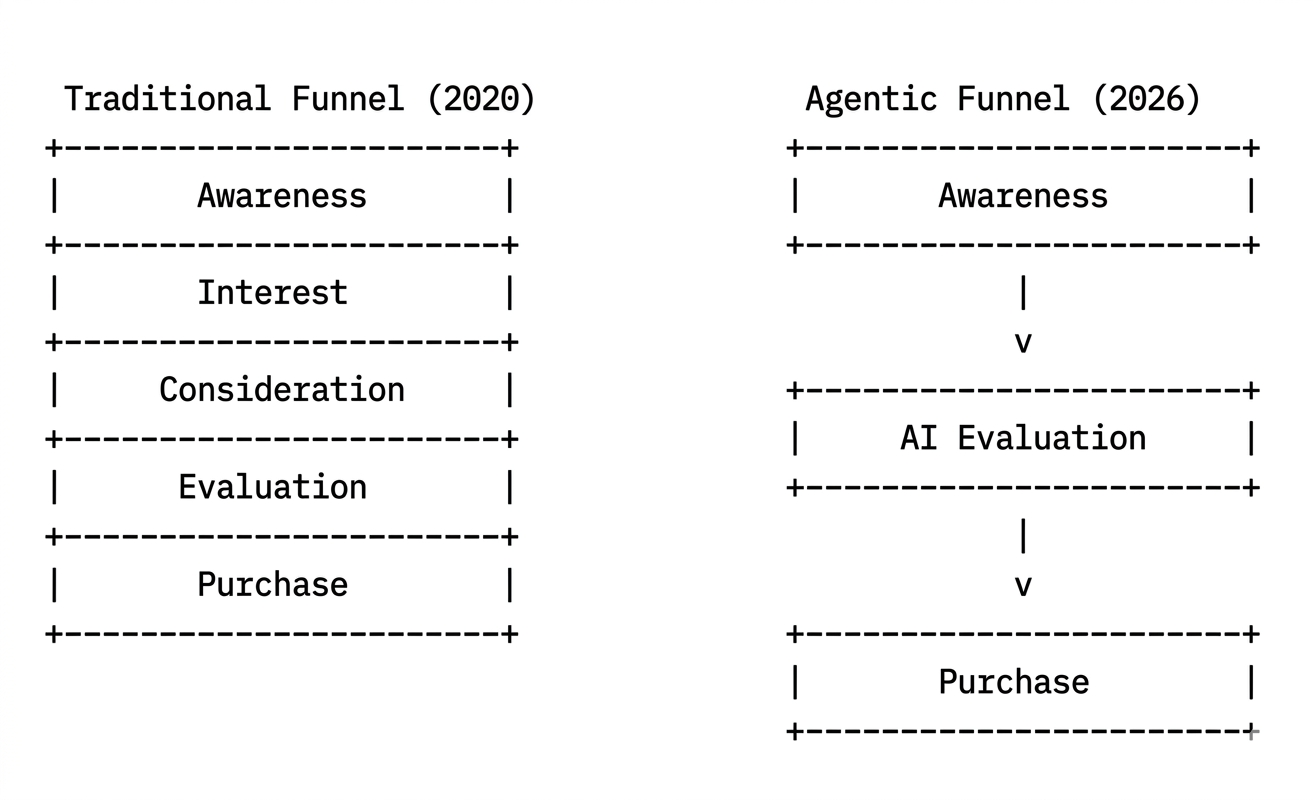
When a buyer asks an AI assistant, “Analyze the top three enterprise marketing automation platforms for a European healthcare manufacturing firm expanding into APAC, focusing on GDPR compliance and localized support,” the LLM executes what data scientists call cognitive compression. Within three seconds, it ingests millions of data points, filters out promotional fluff, and provides a definitive answer.
According to data published by Market Intelo, generative AI platforms process over 15 billion queries per month, a number that continues to double year-over-year. Furthermore, research from HubSpot’s 2026 State of Marketing Report indicates that 50% of all consumers now utilize AI-powered search, and nearly half of all traditional Google search queries trigger an AI Overview.
For enterprises, this means the middle of the funnel—the “Consideration” and “Evaluation” phases—is being automated. If your brand is not synthesized into that three-second AI output, you are locked out of the deal before the human buyer even knows you exist.
The Three Battlegrounds of AI-Age Marketing
To win in this new environment, corporate strategy must pivot to address three distinct layers of algorithmic influence.
1. The Proliferation of “Algorithmic Slop” and the Value of High-Trust Nodes
Because GenAI has driven the marginal cost of content creation to absolute zero, the internet is flooded with synthetic text. HubSpot notes that while 80% of marketers now use AI for content creation, the resulting volume has led to massive content fatigue.
When information is infinite, trust becomes the only viable currency. LLMs do not look at a fancy landing page; they search for verifiable, third-party validation.
In a study utilizing the GEO-BENCH framework, researchers found that including specific data citations, authoritative quotations, and verifiable statistics boosted a brand’s source visibility within LLM responses by over 40%. AI engines actively seek out what are known as “high-trust nodes”—entities that are consistently cited by peer-reviewed journals, mainstream financial media, and foundational industry databases.
2. The Rise of Agentic Procurement
The change runs deeper than consumer search. Gartner’s strategic predictions reveal a striking shift in enterprise operations: by 2028, 90% of B2B buying will be intermediated by AI agents, pushing over $15 trillion of global spend through automated agent exchanges.
B2B procurement is being systematically reprogrammed. Instead of a human purchasing agent looking at a Google ad, an autonomous software agent will read your product documentation, cross-reference it with compliance databases, scrape Reddit and specialized forums for sentiment analysis, and make a buying decision based on cold, structured data.
3. The New Metric: Cognitive Share
Marketers have historically measured Market Share (revenue) and Mind Share (brand recall). In 2026, the foundational metric is Cognitive Share—the percentage of real estate your brand occupies within an LLM’s parametric memory and retrieval-augmented output for unbranded industry queries.
If an enterprise asks Perplexity or ChatGPT to name the “leading provider of supply chain logistics software in North America,” who does the AI list first? Who does it back up with citations? The enterprise with the highest Cognitive Share wins the primary traffic referrals.
Tactical Framework: Generative Engine Optimization (GEO)
Traditional SEO was about keyword density, backlink quantities, and technical site performance. Generative Engine Optimization (GEO) and Answer Engine Optimization (AEO) treat the website not as a destination for humans, but as a structured data repository for LLM crawlers.
The core mechanics of a modern GEO framework rely on three pillars:
| Strategic Pillar | Focus Area | Technical Execution |
|---|---|---|
| Information Extraction | Entity & Vector Alignment | Implementing comprehensive Schema.org microdata (Product, Organization, FAQ) to ensure LLMs can extract pricing, features, and specs flawlessly. |
| Citation Provenance | Earned Media Integration | Shifting digital PR from generic backlinks to high-authority mentions in trusted industry pubs that LLMs actively use as grounding data. |
| Sentiment Governance | Zero-Click Reputation | Tracking unbranded sentiment across unstructured channels (Reddit, Discord, StackOverflow) to prevent negative weights in model training sets. |
The Death of the Traditional Corporate Blog
The standard corporate playbook of writing 500-word SEO articles to capture transactional keywords is obsolete. AI Overviews satisfy those informational queries via zero-click answers on the search results page.
Instead, content teams must pivot to a Two-Pronged Content Model:
- For the Machine: Hyper-structured, data-dense documentation, whitepapers, and API-like product feeds that allow AI agents to scrape and verify your capabilities with precision.
- For the Human: Deep, opinionated, high-conviction thought leadership (podcasts, original research, proprietary data) that lives in spaces AI cannot easily scrape or replicate—such as gated communities, private networks, or premium newsletters.
Action Plan for the C-Suite
If your marketing organization is still treating AI as an efficiency tool to churn out more copy, you are optimizing for a system that no longer exists. Chief Marketing Officers must immediately reallocate capital to defend their digital authority.
1.Audit Your Current AI Share of Voice: Immediate Priority.
Deploy modern LLM monitoring platforms (such as Dageno AI, Semrush Enterprise AIO, or BrightEdge Generative Parser) to establish a baseline of how your brand is perceived across ChatGPT, Perplexity, Gemini, and Claude. Identify where the models misrepresent your product specs or prefer competitors.
2.Reallocate 30% of SEO/PPC Budgets to Earned Media & PR: Next 90 Days.
Gartner reports that the mass shift to LLM search will significantly increase PR budgets. Why? Because LLMs rely on third-party validation to verify claims. If your brand does not have a heavy footprint in tier-one industry publications, independent reviews, and expert citations, you will be invisible to AI retrieval mechanisms.
3.Restructure Content Delivery for Machine Readability: Next 180 Days.
Transition your website architecture from a human-first layout to a hybrid machine/human setup. Ensure every product, service, case study, and comparison page is backed by flawless, deeply nested JSON-LD schema. Convert vague marketing copy into concrete, citable “fact blocks” that an LLM can easily lift and quote.
The Strategic Inflection Point:
In the industrial age, victory belonged to those who controlled the physical means of production. In the internet age, victory went to those who controlled the ad platforms and search aggregators. In the AI age, victory belongs to those who influence the cognitive generation process itself.
Stop optimizing for clicks. Start optimizing for model synthesis.
 Unlock 2026's China Digital Marketing Mastery!