 English
 German
 Korea
Korea Spanish
Beyond the Search Engine: How WeChat and the GEO Ecosystem Redefine B2B Procurement and “Digital Trust” in China
- On June 5, 2026
- wechat marketing, wechat marketing strategy
The Illusion of Global Digital Uniformity
For Western C-suite executives executing global market entries, the default assumption is that digital behavior scales linearly across geographies. There is a comfortable, well-worn playbook: optimize for Google, build out corporate LinkedIn networks, establish enterprise SEO architectures, and deploy automated email nurturing sequences via HubSpot or Marketo.
In the Chinese industrial market—the world’s epicenter for electric vehicle (EV) manufacturing, high-tier robotics, and complex supply chain upgrades—this playbook does not merely underperform; it renders your enterprise completely invisible.
The primary strategic error made by Western industrial MNCs is treating China’s digital landscape as a mirror image of the West, wrapped in different branding. They assume Baidu is simply Google with Chinese characters, and that WeChat is a consumer-focused combination of WhatsApp and Facebook. This cognitive dissonance creates a severe strategic blindspot.
The reality on the ground is that China’s B2B procurement paradigm has bypassed traditional Western digital funnels entirely. Relying on an enterprise website and Western-style email outreach to win multi-million-dollar precision manufacturing or sensor contracts in China is equivalent to attempting to run a modern factory without electricity.
The Paradigm Shift: Unlocking the Chinese “Black Box”
To understand why this gap exists, one must look at data from the China Academy of Information and Communications Technology (CAICT) and platforms like Tencent. The contemporary Chinese B2B buyer journey operates in a deeply integrated, mobile-first, and highly algorithmic ecosystem. The traditional linear funnel—Awareness, Consideration, Intent, Purchase—has been replaced by a continuous loop of multi-layered engagement occurring entirely within a single super-app infrastructure.
Furthermore, a structural transformation is unfolding. The discovery mechanisms within China’s digital walls have shifted from traditional search engine indexing toward Generative Engine Optimization (GEO). With major Chinese LLMs and AI platforms (such as DeepSeek, Baidu’s ERNIE, Kimi AI, and Tencent’s native AI layers) actively integrating into communication networks, information is synthesized dynamically.
When a Tier-1 automotive R&D director in Shanghai or Shenzhen seeks a specialized sensor or a high-precision robot reducer, they do not open a desktop browser to execute a keyword search on an indexing engine. They query generative engines directly or utilize internal search mechanics inside the closed ecosystem of WeChat.
If your corporate technical documentation, case studies, and compliance certifications are sitting exclusively on an un-localized Western server, your brand does not exist within the parameters that these generative engines crawl and evaluate. The traditional B2B search engine optimization framework has been fundamentally disrupted by AI-driven procurement architectures that prioritize localized digital authority.
Strategic Remediation: The Architecture of WeChat and WeCom
Bridging this digital divide requires Western premium B2B manufacturers to transition from a broadcast mindset to a service and trust infrastructure. To establish “Digital Trust” across complex geopolitical boundaries, a brand must understand the structural hierarchy of China’s dominant platform.
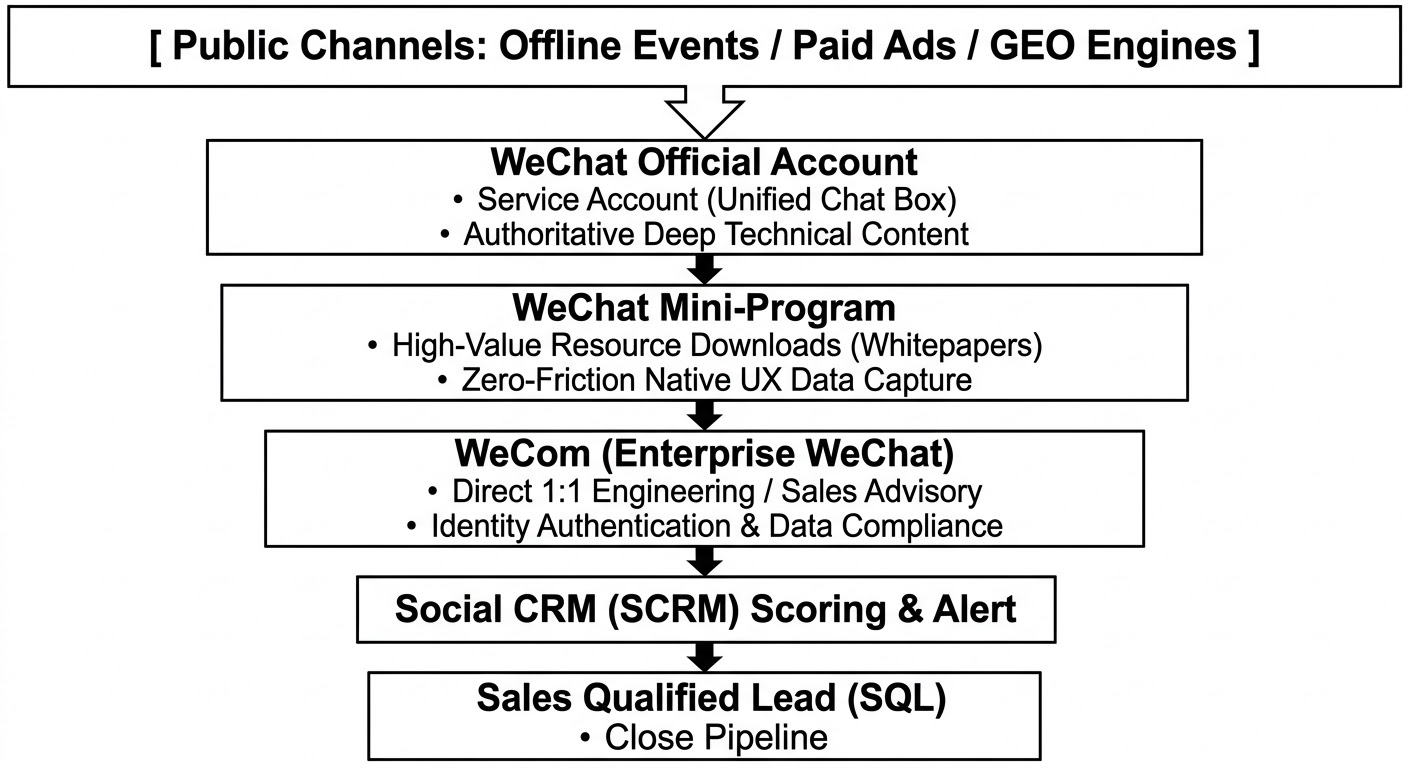
WeChat Official Account vs. WeCom: The Strategic Distinction
For a Western industrial provider, navigating WeChat requires an exact allocation of platform capabilities. The architecture is split between institutional broadcasting and decentralized, professional relationship management.
-
The WeChat Official Account (公众号): This functions as your enterprise’s secondary localized corporate website. For B2B organizations, a Service Account (服务号) is highly recommended over a Subscription Account. Service Account updates land directly within the user’s primary chat list, capturing significantly higher open rates (historically averaging ~7% compared to the ~3% seen in cluttered subscription folders). This is where your brand anchors its institutional authority—publishing exhaustive, deep-dive whitepapers, engineering application notes, and regulatory certifications.
-
WeCom (企业微信): While the Official Account belongs to the brand, WeCom belongs to the corporate network, connecting directly to the user’s personal WeChat. It allows your enterprise engineering and sales representatives to interact with Chinese procurement officers on a 1:1 basis, backed by verified corporate identity. If an employee departs your organization, the client relationships, chat histories, and data logs remain secure within your corporate Social CRM (SCRM), eliminating the risk of client attrition through personal contact loss.
Generating B2B Leads Through Algorithmic Alignment
The contemporary WeChat algorithm rewards high-intent engagement over simple broadcast frequency. Since recent platform updates, personalized recommendation engines heavily weigh metrics such as scroll-depth, repeat visits, article saves, and group shares.
To systematically feed the B2B pipeline, Western enterprises must implement a seamless digital workflow:
-
Contextual Entry: A technical lead discovers an authoritative article via WeChat Search (Souyisou) or through an algorithmic recommendation driven by GEO keyword alignment.
-
Frictionless Conversion: The user is guided from the long-form article to a WeChat Mini-Program (小程序) to download a detailed technical schematic or product compliance brief. The Mini-Program allows for immediate, verified contact collection without forcing the user out of the native application ecosystem into an external browser.
-
Data-Driven Nurturing: This interaction triggers a data point within an integrated SCRM system. When the lead performs multiple high-intent actions—such as analyzing a case study on precision robotic integration—an automated notification alerts an industrial sales representative via WeCom to initiate direct technical advisory.
Institutional Validation and Case Proofs
The necessity of this strategy is confirmed by broad-market data and field deployment. Research from Chinese enterprise consulting firms indicates that over 54% of Chinese business professionals spend more than 30 minutes daily digesting industrial and professional insights exclusively through WeChat Official Accounts.
In the high-value industrial manufacturing and automation sectors, companies that successfully deployed an integrated WeChat and WeCom SCRM architecture saw an average 220% increase in lead conversion rates alongside a 40% contraction in total sales cycle durations. This efficiency gain is achieved by eliminating the high friction of email communication—a medium that Chinese procurement and R&D directors routinely deprioritize.
Consider the case of a global leader in precision illumination and industrial component supply. Facing stagnation from traditional web platforms, they migrated their entire localized pipeline into WeCom. By converting their product documentation into interactive Mini-Programs and connecting their sales personnel directly to the client network via authenticated enterprise accounts, the organization achieved a unified framework that protected corporate IP while accelerating custom engineering approvals across multiple tier-1 buyers simultaneously.
The Big Question
If your global digital strategy assumes a procurement journey that your highest-value Chinese targets have structurally abandoned, are you executing a growth plan—or are you actively funding your own displacement by local competitors who own the digital architecture of trust?
 Unlock 2026's China Digital Marketing Mastery!