 English
 German
 Korea
Korea Spanish
The Algorithmic Iron Curtain: Why Western Engineering Premium is Becoming Invisible in China’s AI-Driven Supply Chains
- On June 8, 2026
- china buying decision, visible china supply chains
The Illusion of Irreplaceability
For decades, Western B2B executives operating in premium industrial sectors—precision CNC machining, robotics, advanced optics, and specialized sensors—have relied on a comfortable paradigm: “If we build the highest-tolerance component, the Chinese market will find us.” This philosophy assumed that superior Western engineering possessed an inherent gravitational pull, insulated from the peculiarities of local digital marketing. Lead generation was a predictable matrix of international trade fairs, long-standing joint-venture relationships, and technical data sheets distributed via local sales agents.
This reliance on historical prestige has become a dangerous strategic blind spot.
While Western C-suites view China through the lens of macro-geopolitical de-risking, a profound, quiet structural shift has occurred on the factory floors and R&D labs of Suzhou, Shenzhen, and Shanghai. The veteran procurement director who valued twenty-year-old relationships is retiring. Replacing them is a new generation of digital-native R&D engineers, product managers, and supply chain architects. These decision-makers do not browse physical trade shows looking for catalogs, nor do they bypass digital channels because “B2B is a relationship business.”
They operate within a hyper-digitized, AI-integrated industrial ecosystem that moves at an unprecedented velocity. If your technical specifications are not visible within their specific digital discovery loops, your enterprise does not merely suffer from poor marketing—your premium product structurally ceases to exist in the Chinese market. The anxiety plaguing Western CMOs regarding the “Chinese Digital Black Box” is justified, but the diagnosis is often wrong. The threat is not the local competitor’s superior hardware; it is your invisibility within the algorithms that dictate modern Chinese procurement.
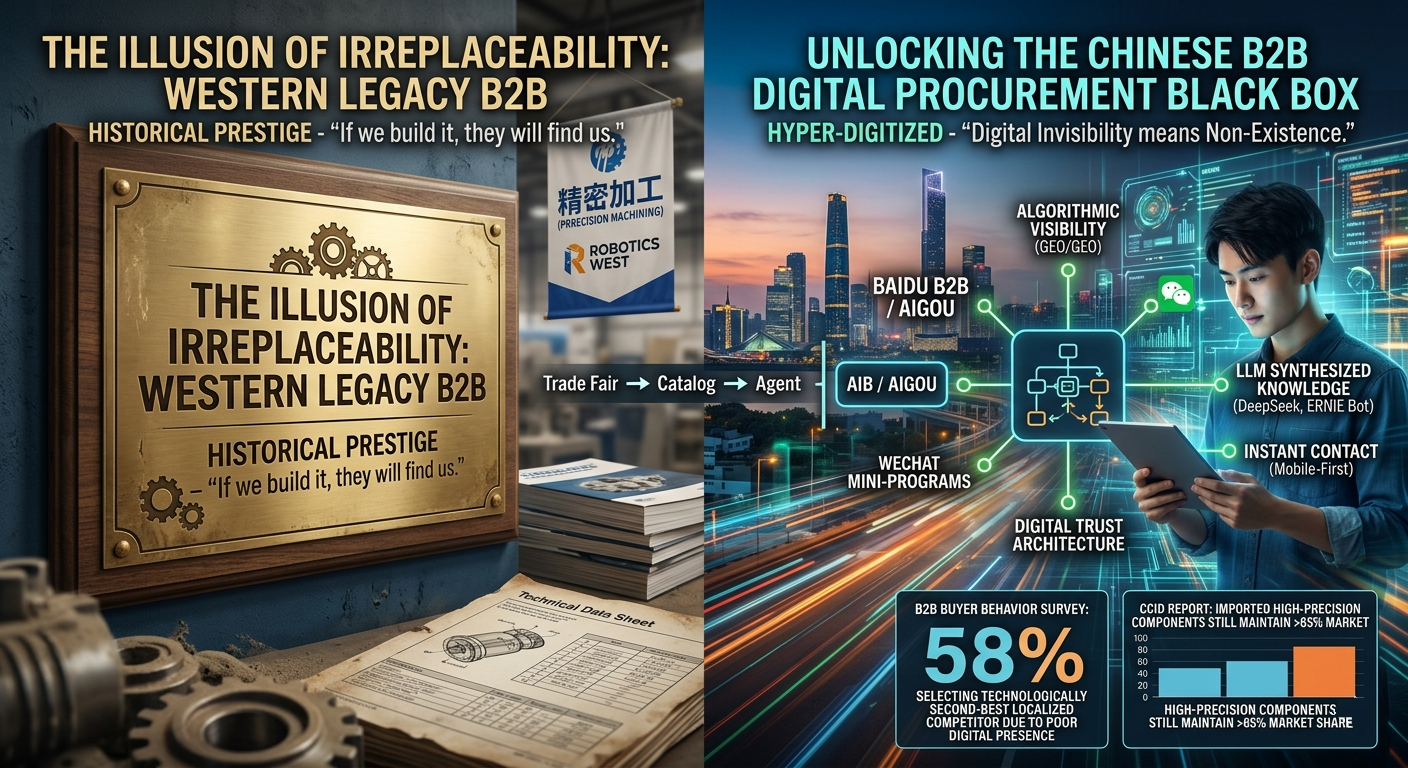
Unlocking the Chinese B2B Procurement Black Box
To understand how lead generation occurs in China today, Western enterprises must discard the Google-centric, linear funnel model (Awareness → Consideration → Conversion) and analyze the unique structural mechanics of the Chinese digital ecosystem.
The Myth of the “Search-Free” Chinese B2B Buyer
A common piece of misinformation circulating in Western marketing circles is that “the open web is dead in China, and B2B buyers only use WeChat.” Data from the China Internet Network Information Center (CNNIC) and enterprise search audits conducted by industrial consulting firms like iResearch demonstrate a more nuanced reality.
Search engine infrastructure remains foundational for B2B procurement, but the nature of search has fragmented and evolved.
[Traditional Linear Search] ——–> Google/LinkedIn ——–> Website Form Fill
[Fragmented Chinese Ecosystem] —–> Baidu B2B (Aigou) ——> Instant Verification
├—-> DeepSeek / ERNIE ——-> LLM Synthesized Knowledge
└—-> Vertical B2B Matrix —-> WeChat Mini-Program Ecosystem
While a consumer might spend their entire digital life inside closed application ecosystems, a Chinese industrial procurement team executing a multi-million-RMB sourcing strategy for automotive production lines or semiconductor packaging equipment operates across a hybrid matrix:
- The Information Verification Layer (Baidu & Vertical Engines): Initial technical validation and corporate compliance checks still heavily leverage Baidu, alongside specialized national enterprise verification platforms like Qichacha and Tianyancha.
- The Industrial B2B E-Commerce Matrix: Platforms like Baidu Aigou and 1688 Industrial Market have evolved from low-end wholesale directories into sophisticated B2B marketplaces where complex specifications for components like planetary reducers and high-precision sensors are indexed, compared, and filtered by procurement algorithms.
- The Generative Search Revolution: Over the past 12 to 18 months, Chinese engineering teams have aggressively integrated Large Language Model (LLM) architectures—such as DeepSeek, Baidu’s ERNIE Bot, and Alibaba’s Tongyi Qianwen—directly into their research and development workflows.
The Generative Engine Optimization (GEO) Shift in R&D
How does a modern Chinese R&D director look for a specialized European sensor or a high-tolerance Swiss micromachining component? They no longer type broad keywords into a standard search bar. Instead, they prompt an AI engine:
“Compare the thermal stability and failure rates of European imported high-precision pressure sensors versus domestic Tier-1 alternatives for a lithium-battery manufacturing environment exceeding 180°C.”
The AI engine does not return a list of ten blue links leading to Western corporate homepages. It synthesizes a structured report based on data extracted from indexed technical whitepapers, Chinese academic repositories (CNKI), industry forum discussions, and platform-specific database nodes.
If your company’s technical parameters, application case studies, and compliance certifications have not been optimized for these generative architectures—a discipline known as Generative Engine Optimization (GEO)—the AI simply synthesizes a response featuring your competitors. The lead generation event is killed before a human agent ever enters the loop.
The Mobile-First Contract Lifecycle
When a Chinese customer decides to actively contact a foreign enterprise, the interface is almost exclusively mobile and instantaneous. The Western expectation that a prospect will download a 45-page PDF whitepaper after filling out a comprehensive Hubspot form is fundamentally incompatible with Chinese user psychology.
According to data from the Tencent B2B Industry Research Center, over 78% of initial technical inquiries in the industrial manufacturing sector are initiated via WeChat enterprise ecosystems, corporate Mini-Programs, or direct instant-messaging channels embedded within B2B platforms. The buyer demands immediate access to the lead application engineer, direct download of CAD models via mobile-responsive links, and instant verification of localized technical support.
The Currency of Digital Trust Across Geopolitical Boundaries
In Western markets, digital authority is heavily weighted by domain authority, backlink profiles, and long-form thought leadership on LinkedIn. In China’s premium B2B sector, Digital Trust is calculated through a highly scrutinized matrix of institutional validation, localized digital infrastructure, and algorithmic presence.
To bridge this divide, Western enterprises must build an architecture that satisfies both human procurement committees and Chinese AI search scrapers.
┌────────────────────────────────────────────────────────┐
│ DIGITAL TRUST ARCHITECTURE │
├────────────────────────┬───────────────────────────────┤
│ Institutional Validation │ ICP License, Local Hosting, Qichacha │
├────────────────────────┼───────────────────────────────┤
│ Algorithmic Authority (GEO) │ Structured Data, Academic Citations │
├────────────────────────┼────────────────── ────────────┤
│ Verification Network │ Expert Endorsements, Industry Forums │
└────────────────────────┴───────────────────────────────┘
Data-Driven Realities of the Chinese Industrial Landscape
According to the 2025-2026 China Manufacturing Digital Transformation Report by CCID Consulting (a leading think tank under the Ministry of Industry and Information Technology), China’s aggressive push for industrial automation and high-end manufacturing upgrades has created an unprecedented demand for premium components that domestic suppliers cannot yet replicate at scale. The report notes that while localized substitution is high in mid-tier commodities, imported high-precision components still maintain a market share exceeding 65% in advanced sub-sectors like medical robotics, high-speed rail telemetry, and semiconductor lithography peripherals.
However, the 2026 B2B Buyer Digital Behavior Survey conducted by Analysys International reveals a stark paradox: 58% of Chinese procurement managers stated they had actively selected a technologically “second-best” localized or regional competitor over a superior Western brand simply because the Western brand’s technical documentation, localized case studies, and responsive digital contact channels were non-existent or inaccessible behind the Great Firewall.
Strategic Remediation: Bridging the Cognitive and Algorithmic Divide
To capture the structural dividend of China’s massive manufacturing upgrade, Western B2B leadership must transition from passive market observation to active algorithmic alignment. This requires a three-tiered strategic framework.
┌──────────────────────────────────────────────┐
│ THREE-TIER ALIGNMENT MATRIX │
├─────────────────┬────────────────────────────┤
│ 1. Infrastructure │ ICP License, Local CDN, Mobile Engines │
├─────────────────┼────────────────────────────┤
│ 2. GEO Optimization │ Native Mandarin Corpora, Tokenized Data │
├─────────────────┼────────────────────────────┤
│ 3. Ecosystem Loop │ WeChat B2B Hub, Instant Technical Access │
└─────────────────┴────────────────────────────┘
Step 1: Infrastructure Localization (The Baseline of Trust)
You cannot establish digital trust if your platform is inaccessible. Western enterprises must deploy a localized digital footprint. This means:
- Securing an ICP License (Internet Content Provider) from the Ministry of Industry and Information Technology (MIIT).
- Migrating local marketing assets to a mainland China hosting infrastructure or utilizing a robust local Content Delivery Network (CDN) such as Alibaba Cloud or Tencent Cloud to bring page load times under 1.8 seconds.
- Purging all Western tracking scripts, fonts, and video players that trigger network latency or complete page blocking.
Step 2: Algorithmic Engineering for Chinese LLMs (GEO)
Traditional SEO focuses on keyword stuffing for search engine crawlers. GEO requires feeding the local AI ecosystem with highly structured, accurate, and authoritative data that LLM scrapers can easily digest and synthesize.
- Tokenization Optimization: Technical specifications must be translated by industry-specialist engineers who understand localized technical nomenclature (e.g., specific industrial standards like GB/T vs. DIN/ISO), not generic translation software.
- Structured Content Distribution: Publish deep-dive application notes, compliance matrices, and academic-grade whitepapers across indexed networks, including local industrial forums, research repositories, and authorized digital PR distributions that Chinese LLMs utilize as high-weight training data.
Step 3: Closing the Conversion Loop via the Local Ecosystem
Once discovery happens via Baidu or an LLM search, the conversion architecture must match local preferences:
- The WeChat B2B Hub: Transform the corporate WeChat Official Account from a basic PR channel into a technical service hub. Integrate a Mini-Program that allows users to search product parameters, view 3D CAD models, check regional inventory availability, and connect instantly with a localized application engineer.
- Frictionless Inquiries: Replace lengthy web forms with quick-response QR codes, enabling a seamless transition from desktop research to mobile conversation.
The Big Question
The competitive landscape in China is no longer defined by a race between Western hardware and Chinese copies. It is a race between Western legacy complacency and Chinese algorithmic speed.
As your board evaluates global capital allocation and geopolitical risk, the critical strategic question you must answer is this:
“Are we losing market share in China because our technology is no longer competitive, or have we simply allowed our brand to become digitally invisible to the algorithms that control the world’s largest manufacturing supply chain?”
 Unlock 2026's China Digital Marketing Mastery!